Home E-mail Ordering/Contact Info
PRS Fender Gibson Ibanez Acoustic & Ac/Elec Misc Electric Archtops Basses Lefty
Amplifiers Misc Instruments Guitar Effects Keyboards Pro-Sound Parts Links Repairs
AMPLIFIERS, AMP ACCESSORIES and CABS
(SEE BOTTOM OF PAGE FOR SPEAKERS, ACCESSORIES, TUBES, ETC.)
ATTENUATORS:
1.
THD
Hot Plate 2.7 Ohms Attenuator for 2.7 Ohm load and works best for amps
rated at 2.7 ohms such as Fender 3X10 combo's. Offers
Bright and Deep switches for tailoring your sound - Bright switch gives you two
different high frequency levels to compensate for an overly bright,
or dull speaker cabinet while the Deep switch offers two distinct bass settings
to help you fill out the bottom end, or reduce the bass in a cabinet with too
much low end. Has built in noise reduction up to 10dB, line out, and a fan to
keep it cool. Perfect shape, works flawlessly, and with new ones going for
$369, a sweet deal for $249.For full specs click here for
THD's site.

2.
THD
Hot Plate 4 Ohms Attenuator, (front/back).
Hotplates have been our most popular attenuator thanks to THD's top-notch
engineering and superb build quality. This one is built for a 4 Ohm load and
works best for amps with a 4 ohm output and 4-ohm speaker load (including 8 ohm
combo with 8 ohm extension cab - or a 4 ohm combo or head). Features Bright and
Deep switches for tailoring your sound - Bright switch gives you two different
high frequency levels to compensate for an overly bright,
or dull speaker cabinet while the Deep switch offers two distinct bass settings
to help you fill out the bottom end, or reduce the bass in a cabinet with too
much low end. Has built in noise reduction up to 10dB, line out, and a fan to
keep it cool. Super clean shape, works flawlessly, and with new ones going for
$329, save $100 on this very near mint one; $239. Ships in original box with
manual. For full specs click here for
THD's site.


A Big thanks to UPS!:
Check out the latest
damaged amp courtesy of the UPS gorillas. This was a wonderful-sounding
Premier B-160 Club Bass, an especially good sounding Blues amp for guitar.
Original ’65 Jensen C15N is totaled beyond repair, speaker baffle is in many
parts. It was wrapped in 3 layers of the large bubble wrap inside a triple-wall
box. Think they would pay off on insurance? Think again. I insure everything I
ship for full value, however, I do that only in the
event of loss or in the event of obvious carrier damage such as tire tracks
across the box. I took care of my customer - but unfortunately nobody will take
care of me. If this happens to you, the only tip I can give you is they will
pay off if:

1.
you
spend many hours on the phone and impress upon them that you're not going to go
away;
2.
you
send them a letter on a lawyer's letterhead threatening legal action and
reminding them that it’s illegal to receive payment for insurance and not pay
off when there is a claim.
RARE, BOUTIQUE, VINTAGE, COLLECTABLE
1.
Budda
Verbmaster 30 2X12 Combo, (panel),
(top),
(back),
(tubes),
(footswitch/manual),
(chassis).
Rare 30W model with 6L6 power! Serial number VG3-018, this is one of the
early 30-watters from Jeff Bober and Budda. Before he sold Budda, Jeff had a
small company that did some of my repairs and built some killer little amps
called Budda, all hand-wired and built in small numbers. After gaining a
reputation as the amp guru of the Baltimore area, doing Marshall mods and various repairs and hot-rodding, his extensive
knowledge went into designing some of the best boutique amps ever made. After
Jeff sold his company, he stayed on at the Maryland factory, aka "Budda
East", building both his original designs plus the new
"Superdrive" series, which initially were still hand-wired. The
hand-wired series, which offered little profit margin, soon fell victim to
corporate thinking and was discontinued in favor of the "Superdrive
II", which were strictly circuit board designs. The 30-watt Verbmaster was
one of Jeff's hand-wired prior to the sale (this one's a 2001 model). Most of
these featured a quad of EL84's but a few, like this one, were built with a
pair of 6L6's. This amp delivers complex tone characteristics, rich in harmonic
structure and organic in nature. The tone can be described as a cross between a
Deluxe and an AC30, with the aggressive attack of a Plexi. It's a fairly
complex amp for Budda, which generally featured 3 knobs and no frills, not even
an fx loop. The Verbmaster features an excellent
sounding reverb with two distinct sounds, "sand" and "surf";
Hi-gain and Normal inputs, each voiced differently; and the usual bass - treble
- volume controls. The high-gain input adds a tube stage to overdrive the
normal input's gain stage, which in turn drives the unique tone-control stack.
The back panel features an effects loop; slave output with level control;
parallel speaker outs with a 4/8/16 ohm switch. Tubes are a pair of Russian EH
6L6's power tubes, Russian Sovtek 5AR4 rectifier, with two 12AX7s, a 12AT7, and
12AU7 in the preamp/reverb. The dual reverb circuit features a darker sound
with high-end roll off in the "Sand" setting, with "Surf"
being a more over the top brighter tone. This amp breaks up very early and
isn't recommended for anyone looking for clean headroom - but for a non-master
volume high-gain amp, you get a beautiful tube breakup at a relatively low
volume. For many players, this will be the perfect amp for larger clubs. In
typical Budda fashion there's nothing conservative about the wattage rating.
This amp will stand up against many other tube amps rated at 50 watts or more.
Here's a sample of the versatility of the smaller 18W Verbmaster (1X12), using
only a guitar's volume control (no effects were used), click here for a YouTube
demo. Budda is know as much for their touch
sensitivity and players who appreciate this characteristic will especially love
this amp. OEM speakers are made by Eminence for Budda and sound very good.
Budda hand-wired amps remain some of the best values on the market, and one of
the few that weren't clones of Fender or Marshall. I read where Budda is
starting up their hand-wired series again, including a Verbmaster. I don't have
any reports on them yet but I can't imagine sounding any better than this original
model, built by the master himself. A killer amp for $1499.


2.
Budda
Verbmaster 18 4X10 Combo, (panel),
(top),
(back),
(back
panel), (footswitch),
(chassis).
90's model - Serial VMD-0003, the 3rd Verbmaster built! Back in the day Jeff
Bober had a small company that did some of my repairs and built some killer
little amps called Budda, all hand-wired and built in small numbers. After
gaining a reputation as the amp guru of the Baltimore area, doing Marshall mods and various repairs and hot-rodding, his extensive
knowledge went into designing some of the best boutique amps ever made. Jeff
eventually sold his company, but stayed on at the Maryland factory, building
both his original designs plus the new "Superdrive" series, which
were great amps but not hand-wired. The hand-wired series, which offered little
profit margin, soon fell victim to corporate thinking and was discontinued.
They came out with a 10th Anniversary hand-wired but at $5K list, the amp was
essentially a Twinmaster with a commemorative badge. The Verbmaster was a
fairly complex amp for Budda, with more than 3 knobs and an effects loop. The
Verbmaster features anexcellent sounding reverb with two distinct sounds,
"sand" and "surf"; Hi-gain and Normal inputs, each voiced
differently; and the usual bass - treble - volume controls. The high-gain input
adds a tube stage to overdrive the normal input's gain stage, which in turn
drives the unique tone-control stack. The back panel features an effects loop;
slave output with level control; parallel speaker outs with a 4/8 ohm switch.
This amp breaks up very early and isn't recommended for anyone looking for
clean headroom - but for a non-master volume high-gain amp, you get a beautiful
tube breakup at a relatively low volume. For many players, this will be the
perfect club or practice amp. Although 18 watts may seem rather tame, this is a
deceptively loud amp. For a good example of the versatility of the Verbmaster
(1X12), using only a guitar's volume control (no effects were used), click here for a YouTube demo.
Other than the Anniversary model, which is great but overpriced, Budda
hand-wired amps remain some of the best values on the market, and one of the
few that weren't clones of Fender or Marshall. Dealer cost on these was over
$1500 on my last price list that had the hand-wired and it's an excellent amp,
in nice shape, for $1399. See lower down on this page for the same era
handwired Budda Twinmaster Ten.


3.
Dr.
Z Mazerati GT Head, (front
panel), (top),
(back).
Who does't love Dr Z's, the ultimate in simplicity and pure tone that's
characterized by their smooth overdrive, tight bass, and quiet operation, even
at full volume. One of the main characteristics of the GT, even more than other
Dr Z's, is it's interaction with a guitar's volume control. Crank up the amp
and go from full tube saturation to clean and articulate by rolling back your
volume. Guys like Brad Paisley, who could easily opt for any type of high tech
gain device, rely on this simple method of voicing their amp. The distortion
never gets muddy or too fuzzy, just a very fat, with plenty of harmonics. From
what I understand, this newer GT model is a major revamp of the original
Mazerati, which was essentially a Ghia with double the output (4 EL84's instead
of the Ghia's two). The GT is voiced for much more gain, providing more of the
singing quality players love about Z's. Players
compare the tone to Trainwrecks so it isn't surprising that the GT uses the
time tested output transformer designed for us by Trainwreck's own Ken Fischer.
Cranky out 38 watts, the GT utilizes two 12AX7s, a quad of EL84s, and a 5AR4
rectifier. The GT is cathode biased so output tube changes are a breeze. With
just a volume and tone you won't get lost in a futile attempt to dial in a
perfect tone. Perfect tone is its preset. There are outputs for 4/8/16 ohms so
it's compatible with any cab you want to use. Also, this one is a 10th
anniversary model, with a commemorative badge on the top. Here's a good thread
on The Gear Page (link)
devoted to the GT and YouTube demo's here and a list here. If you're
looking for incredible amounts of touch dynamics, in the highest gain amp Dr. Z
has ever produced, this amp's for you. New price was $1649 but this one's mint
and just $1149.


4.
2004 Eden
CXC112 Time Traveler with WT330 Head, (panel),
(top),
(back),
(back
panel), (stock
pic). Eden makes some of the best bass amplification around, falling
between the mid-line SWR and high-end Aguilar gear. The choice of many studio pro's and top touring acts, they make great touring
amps, over 1000W, in various enclosures, all the way down to some small
practice amps in their Nemesis series. The CXC112 is a lower powered amp
compared to their World Tour series, but it doesn't scrimp on features. One of
the cool things I like about this amp is the cabinet design. At around
30"X15"X14", it has a narrow design, but tall enough that you
don't have to bend down to adjust the controls. It's perfectly tuned and the
design makes the low end sound absolutely huge. With a 12" LF driver and a
horn, crossed-over at 4K ohms, it's got plenty of thump,
while retaining the high end clarity. Frequency response is 42Hz to 20KHz, which handles the lower notes of a 5/6 string with
ease. It's characterized as a warm, throaty mid-bass with good low end and a
mellow upper register. A few of the features of the WT330 head, World Tour
series, include 3-band EQ with the mids switchable from 550Hz to 2.2KHz,
dbx-style compression, optically coupled dynamic booster system for bass and
treble, an assortment of patch points, balanced DI output. The compressor on
this amp is really impressive, and you can use it to smooth out the overall
tone, or completely squish the sound, nearly down to zero output if turned all
the way up, plus it's much more quiet than most
comp's. The Enhancer adds sparkle to your tone and
will make it stand out in the mix; I would never turn it off completely. They
Dynamic Boost switches add a new twist and with the Bass switch engaged you get
thundering lows that shake the windows, even at lower volume. On the back panel
you have speaker outs - choice of Neutrik or 1/4" pair; effects loops;
tuner out that can act as an extra instrument send if desired; stereo Aux
in/out; balanced recording out with XLR jack and level control plus ground lift
switch. The cabinet is carpet covered with heavy duty side handles, a fan
located on the side, and plastic corners. Although Eden says they would prefer
a 4 or 8 ohm load, they also state that you can safely run the WT330 head down
to 2 ohms. RMS output at 2 ohms is 420 watts; 330 at 4 ohms; or 200 at 8 ohms,
as is the rating of the CXC112 cabinet. It's Plenty of
power for club gigs or if you need more, just add another cab and jack it up to
330. One of the cool things about this set up is that the WT330 can be removed
and used with other cabinets, or by itself if you're
using it for a studio gig. The amp is in clean shape while the cabinet is in
normal used condition with some carpet wear and two of the plastic corners are
missing a small corner piece. Performance is perfect, pots have been cleaned
and it sounds fantastic. If you're looking for a fairly compact amp that's
equally at home in the club or studio, this set-up is hard to beat for $579,
$100's less than the new cost on the head alone.


5.
1966
Gibson GA-20 RVT "Minuteman", (panel),
(top),
(back),
(footswitch).
This amp has been in stock for around 2 years and I finally got it out to our
tech to get it sounding "right". I thought about posting it as it
came in - an okay sounding amp that could benefit from some tweaking. I'm glad
I decided to wait to get it benched so I can offer it as an excellent sounding
amp with a fairly crisp clean tone and an excellent breakup at low volume that
should appeal to blues players. Everybody loves vintage Fenders and during this
era the comparable model would have been a blackface Deluxe Reverb. I honestly
don't know why Fenders are so expensive compared to Gibsons. Both are very
solidly constructed with comparable transformers and other components and
point-to-point soldering. Fender smartly stuck with generally the same models
from year to year while Gibson tended to turn out different models every few
years. Most of these were good designs but the market never got familiar enough
with any of them before a new line was released. The GA-20RVT is a low wattage
amp, perhaps 8-12 watts but, regardless, not the 20 that the model suggests,
with reverb (RV) and Tremolo (T). Most American amps, and British for that
matter, weren't using Fender's 6L6 or 6V6 power tubes and this model uses a
pair of 6BQ5S power tubes 5 preamp tubes (3 12AU7 and 2 6EU7). It's 2-channel amp with Volume, Treb, Bass on Ch-1;
Loudness, Treb, Bass, Reverb, Tremolo Depth, and Tremolo Speed on Ch-2. Effects
are footswitchable via a 2-button footswitch (included) with a long cord
attached to the amp. All components are original; trannies dated 1966, CTS
12" speaker dated '66, original 2-prong power cord. Cosmetically the
panels and covering are in good shape and the worst flaws are
some rust on the centers of the knobs and on the handle, plus one of the back
panels is missing. If you're looking for a quality tone in a hand-wired
USA amp, for around 1/3 the cost of a Fender, this might just be the ticket. In
fact this amp scored an overall "10" on Harmony-Central (link).
Everything was just tweaked and the amp works perfectly. A good value at $499.
Includes schematic and original footswitch.


6.
Gibson
GA-5 by Mojotone Amp, (pic2),
Identical to the Gibson amp above (side
by side), other than a different speaker and yellow tolex but identical
case, chassis, and same quality components. I've heard that Mojo built Gibson's
GA-5's but also built a few like this one without the Gibson logo and "Les
Paul Junior" screened on the control panel. It's an excellent sounding amp
with the same tone and response as the GA-5 above and in perfect shape. Any
studio needs an amp like this. $399.<


7.
1978
Marshall Super Lead, Mod. 1959, (panel),
(top),
(back),
(bottom),
(chassis/tubes).
Few amps have attained "holy grail" status, and by this I don't mean
the rarest of the rare, rather an amp whose reputation is so iconic that it
tends to be the most highly sought after for certain seekers of tone. Other
amps that fall into this category are the Blackface Deluxe Reverb, Tweed
Bassman, Boogie MK IIC+, and some of the truly rare like Dumbles and
Trainwrecks. If there is one amp that defined the sound of Rock music, it is
the Super Lead, Model 1959. This model achieved benchmark status beginning with
Townsend and Hendrix and carried on through EVH, with a virtual who's-who of
rock players since. While the '67-'69 Plexi, with their Plexiglas front panel
is the most highly cherished of the 1959's, clean examples of that model sell
for as much as a nice car and, quite honestly, it sounds about the same as
these later models. With 100 watts of pure Marshall tone,
this amp is way loud and when cranked up, you'll not find a more pure rock
tone. Inside this amp and it looks 100% Jake, complete with hand-wired circuit
and no evidence of replaced components or overheating. As you can see in the
pics, this is likely the cleanest examples on the market. The only noteworthy
flaw I've noted is slight oxidation to the polished brass handle (shown here).
Tubes are all vintage, with a quad of old EI 6550's
and Servicemaster 12AX7's in the preamp. This amp is tuned perfectly and needs
nothing to create what might be the finest tone you've ever heard. If you've
ever heard a 1959SLP, you know that it's an extremely loud amp. If you're going
to play in a club, be prepared to use an attenuator. Amps in this condition are
quickly fetched up by collectors and are forever removed from circulation. The
beaters make the rounds; the keepers get kept. They also don't come cheap, but
with a reissue JMP 1959SLP head selling for $2349, wouldn't you rather have this
33 year old beauty...for less, and one that sounds as good as it looks. $2200
for this iconic amp that can be the centerpiece of any amp collection, or a
killer amp to take on tour if you promise to take care of it.


8.
Marshall
Haze 15 MHZ15 Tube Guitar Head, (panel),
(top),
(back),
(optional
footswitch (close-up).
The Haze 15 combines classic tube tone, with modern day digital effects, the
best of both worlds. For players who like to keep things simple, with this baby
there's no more hooking up a bunch of stomp boxes - you've got emulated spring
Reverb, as well as Echo, Chorus, and Vibrato. With a 12AX7 to warm up the
preamp, and a 6V6 cranking out 15 watts of tube power, this amp has the warm,
natural sound of a tube amp. It's diminutive size,
just 19.5" wide, makes it more desirable for players who don't want the
look of a full stage rig, but the vintage styling is straight out of the 60's.
Designed in the same style as the big Marshalls, the 2 distinctive
footswitchable channels of the Haze offers a variety of tonal possibilities. The
Normal mode provides a rich and organic clean sound with loads of headroom,
while the Overdrive channel delivers a warm overdriven tone, with a separate
Gain control to dial in as little, or as much, grit as you want in your tone. A
Bright switch is shared between both channels - when engaged it adds extra bite
and sparkle. Both channels also share a shared 3-band EQ. Channel effects are
remembered when you return to the channel, meaning you can set up your clean
and overdrive sounds and return to them over and over again without having to
readjust your settings. The warm emulated spring reverb has its own independent
control, allowing you to add as much reverb as required, and it also has a
positive off (click) position when you want it out of the circuit completely. Click here for a good
YouTube demo from Nevada Music (UK). The optional Marshall PEDL10049 4-button
footswitch IS INCLUDED with this amp and has controls for Channel Select, OD
Boost, Reverb, and Effect, with an LED indicator for each button. These sell
new for $599 but this one is in brand new condition AND includes the optional
$69 footswitch, all for $469. Note: They make a cabinet specifically for the
Haze, but it should also work great with the C110 below. The width is an
identical 19.5", the head and cab share the same wattage, so you would get
optimal speaker breakup, and it's rated at the proper 16 ohms.


9.
Marshall
4X12 - JCM800 Model 1982A Cab, (back).
Fairly rare cabinet which was a high-power version of the 1960A, made expressly
for the higher powered (250W) Model 2000 (guitar)
or Model 2001 (bass heads). When these rare heads were produced in 1981 at the
start of the 800-series, Marshall didn't have a cab that could handle the
output and thus the 1982A/B, rated at 400W, was introduced around '82 to handle
the power. Although you don't see many of these on this side of the pond, they
were actually in catalogs from '82 to '87. From what I've read, original
speakers for this cabinet would have likely been G12H-100 Celestions. This one
is loaded with G12M-70 Celestions which are more noted for being stock in the
1960A/B cabinets early to mid 1980's. This, combined with the fact that these
speakers will only handle 280W, makes me fairly sure that they're not original
to this cabinet. As you can see, this cab has been roaded a bit and the
covering in back has been torn. We can recover the back if desired for around
$70 parts & /labor, or less if you just want the center "slice"
re-covered. Originality aside, this is a pretty rare cab compared to the common
1960A and, especially if you're into hard rock, these G12M-70's are good
sounding speakers. All considered, a pretty nice deal
at $599. If you ever come across a 2000/2001 head, you've got a rare bird. The
new cost on these was 2X the cost of a 100W head and because of this--plus the
fact that they're simply too loud for anything other than a stadium tour--very
few were produced.


10.
Marshall
JCM800 1960B 4X12 Cabinet, (pic2).
Bottom cab for your full stack, includes casters. Hard to find mate for your
JCM800 head, and the perfect match for my JCM800 1960A on my amps page (shown
here). Loaded with original British Celestion G12T-75, 75W speakers, this
300W cab should never blow a speaker and has obviously worked night after night
for many years. It has obviously seen its share of clubs in its 20 years as
evidenced by a few nicks here and there and a large piece of covering missing
from the back which we can paint black at no cost - or spot repair with tolex
for $50 - but, hey, this is an old Marshall cab and it looks "right"
just the way it is if you ask me. The Chinese made G12T-75's are selling for
$109/each so at $435, it's like getting a quad of *British* G12T-75's for the
price of Chinese and the cab thrown in for free. Anyhow, $435 and it works
perfectly. Discount for local pickup.


11.
Marshall
JCM800 1960A Cabinet, (back),
(speakers).
Hard to find genuine JCM800 cab, loaded with original British Celestion
G12T-75, 75W speakers. Cab is in typical used condition with a few tears to the
tolex on back, but looks pretty good from the audience perspective. If you have
a JCM800 and want the proper matching cab, here you go, just $450 plus shipping
- or discount applies to local pickup.


12.
ca.
mid-50's Mullard 5-10 by E.A.R., (sides),
(chassis/trannies),
(circuit),
(front
panel), (Mullard
tubes), (Wharfedale
speaker). Okay, ignore the pea green cab. It's what's inside that counts. What we have here is a very old hand-wired
Mullard 5-10 amp, which was a very popular circuit in England as soon as it was
published in "Practical Wireless" magazine in 1954 and, in fact, this
same amp is being built today. Mullard created this circuit and published it as
a means to sell their vacuum tubes ("If you build it they will
come....") as well as the recommended Partridge transformers. The
amplifier featured five tubes and an output of 10 watts - hence the model name "5-10".
Of those tubes, one was a diode-rectifier (an EZ80),
one was a pre-amplifier pentode EF86 and one a double-triode ECC83 as
phase-splitter. The power amplification was handled by a pair of EL84 working
in push-pull configuration. Mullard also had a variation, 5-20, which was a
20-watter that substituted EL34's for the increased power. There is a lot of
info on this amp on the web in various UK usegroups. Click here for
the best site I found with a blow-up of the original magazine pages which
introduced the amp and another useful link is here. Although countless
numbers of these were built as DIY projects, this one was produced by
"Electric Audio Reproducers Ltd" aka E.A.R. It is a quality made
piece with a steel chassis and attractive gold paint including a bottom plate
to seal in the circuit. Controls, Bakelite knobs of course, are an input
selector switch, bass, treble, and volume. The power input jack is in the back
and is the typical 2-post UK type (I probably have one around here somewhere).
On the left side of the unit is another power input which I am guessing was to
plug in a record player or radio tuner (there's an antenna jack mounted to the
chassis) - and small plate with two widely spaced pin holes which I believe was
the UK standard for speaker jacks, to be used if you wanted to hook up an
extension speaker. The power transformer is tappable with a jumper to select
your required power. Unfortunately, it's wired or 220V, 230V, 240V, and 250V,
so you'll need a step-down transformer to use it. Since they are painted, I
don't know if these trannies are Partridge but chances are many of these
component will work on early Vox amps and other UK gear or if you're an audio
collector, it's a pretty cool find, especially in the USA. In my search I found
that some of the later models had circuit boards, rather than this
point-to-point soldering. Personally, I think it would be a pretty cool project
to transform it into a guitar amp. Because I don't have a way to test it, it's
being sold "as is" but I will offer a refund, less shipping, if
you're not happy with it. I'll mention though that this came from my old
"UK-connection" and a few dozen other pieces, all guitar amps, I got
from him all worked fine. This unit is in very tidy condition for its age, even
the old Wharfedale speaker looks clean, although there is a little dark gunk
around the trannies that probably needs some goo-gone to remove. $499 for this
prize.


13.
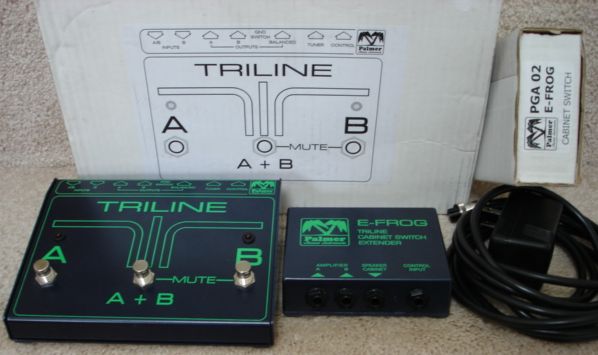
Palmer TriLine and
E-Frog, (Stock
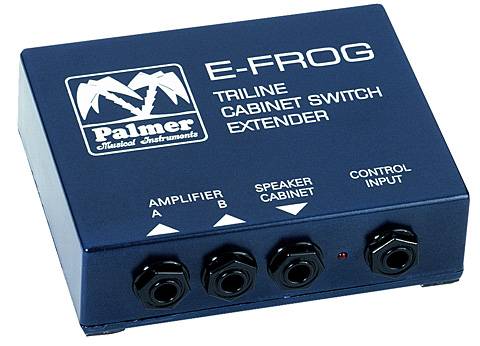
Pic). ONLY the E-Frog is available as the TriLine has been sold. If you're
playing one guitar over two amps, but you want to send both amps through the
same speaker cabinet - here's the answer, the Palmer E-FROG. (PGA-02). This
unit is "as new" in original box and available for $79.Again, this is
for the E-Frog ONLY.
14.
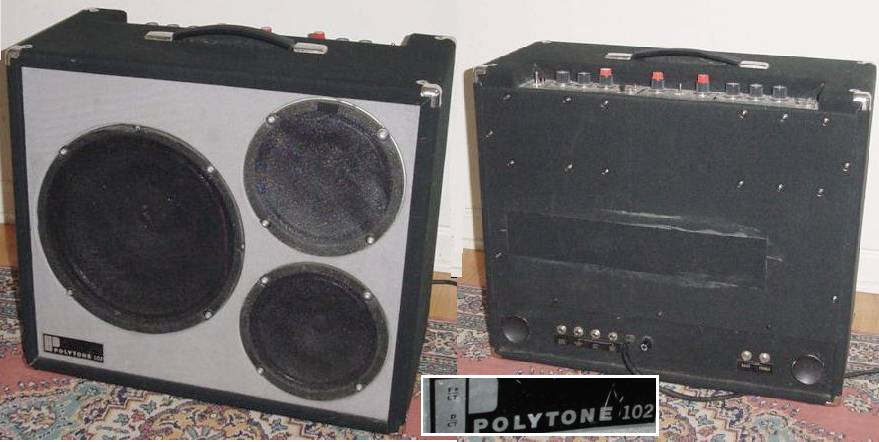
Polytone 102, ca. 70’s,
very cool stereo amp with a single 12” and dual 8” speakers, plenty of
power, stacked pots for each channel, mono/stereo switch, reverb, some sort of
“octave” switch that acts somewhat like vibrato (only cooler), light-up
panel, one of the more unique amps I’ve had and I give it two thumbs up for
tone and features, $450.
15.
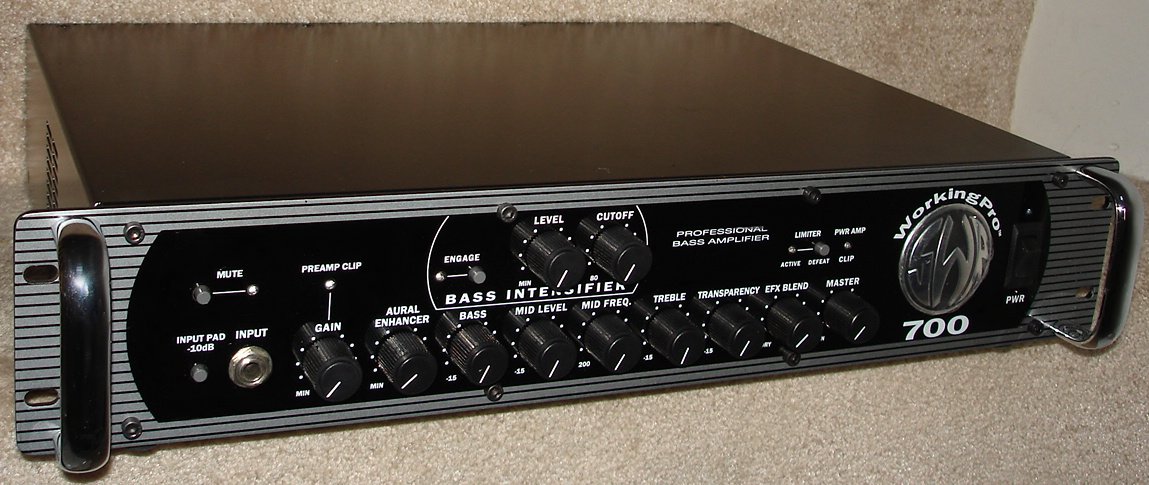
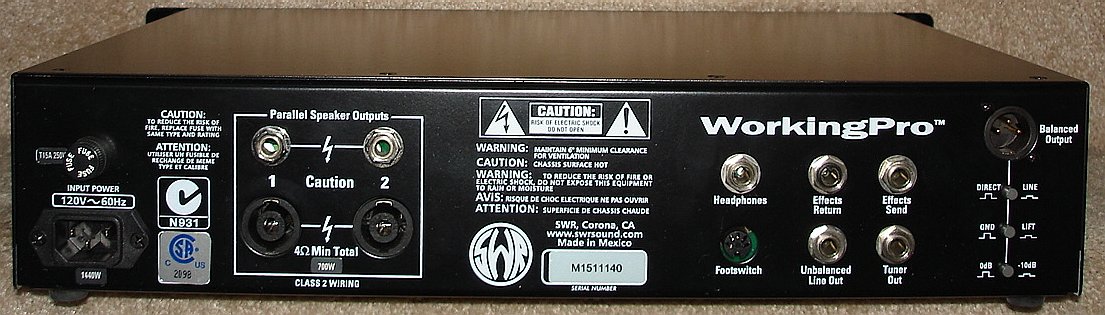
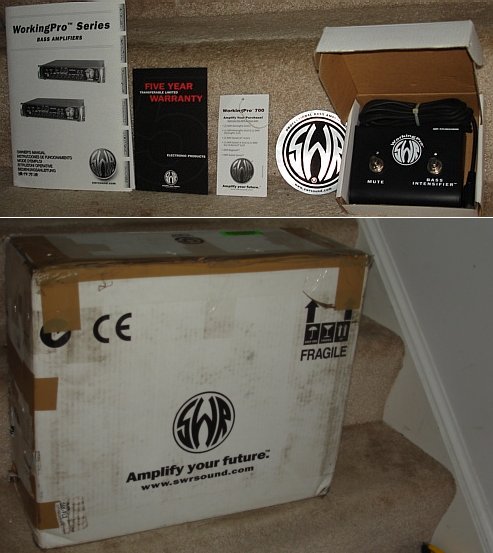
SWR Workingpro 700
Bass Amp, (back),
(accessories/box).
Bass amplification has come a long way. Back in '85 I had a hot backline when I
traded up to a Peavey MK IV head, with a massive 210W output, through a
matching 1520 cabinet. Keep in mind that this rig replaced a Peavey TNT100
combo, followed by a Randall 140W head with 2X15 cab.
Since that time technology has come a long way and headroom is what it's all
about and at 700 watts @ 4 ohms (450@8), there's enough headroom here to handle
any club venue you might come across. SWR has had specialized in great bass
amplification, and ONLY bass amplification, for a few decades and, although not
cheap, it's the best gear on the market for a moderate price. Among the
features of this nice unit: Mute switch (footswitchable); -10dB pad option on
input for active pickups; Independent preamp gain and master volume controls;
Exclusive SWR Aural Enhancer tone control; 4-band active EQ with variable
midrange; Bass Intensifier with level and frequency cutoff controls
(footswitchable); Automatic limiter with defeat option; XLR balanced output
with pre/post switch, ground lift and -10dB switch; Side-chain effects loop
with blend control; Tuner out jack; Unbalanced line out jack; Headphone jack;
Footswitch jack for included 2-button switch (switches Intensifier and mute);
dual 1/4" and dual Speakon speaker jacks. For a video demo of the
Enhancer, Intensifier, and Wedge, click here for SWR's myspace page. With a list of $1149,
the WP 700 sells new for $799. This unit appears unused, with only a few hours
of play and never racked, offered in "as new" condition with original
box, manual, footswitch, etc, for $579.
16.
SWR Bass 350 Head
- CNB Padded Rack - Gries 1X15 Cabinet, (SWR panel), (back features), (CNB Rack),
(Gries Cab).
Dollar for dollar, nothing beats SWR for bass amplification in my opinion.
While it's fairly expensive, it's still within the range of most players and
the tone can't be beat at any price. This Bass 350 is a good example. This
model ran from '92 to '02, usually with a red panel which changed to this
chrome panel the last few years. It's straight ahead, without load of switches
or graphic EQ that largely duplicates the active EQ pots, but you can dial in a
great tone with any bass and make adjustments to suit any song or venue. I used
the Basic 350 for a few years with nothing but a 2X10 cabinet and the tone was
outstanding. Features include 350 watts RMS @ 4 ohms, 450 watts RMS @ 2 ohms,
active and passive inputs, a very effective Aural Enhancer to add
"air" and "space" to your toe, 3-ban EQ with variable
mid-range EQ, sidechain mono effects loop, effects blend control, built in
limiter with LED indicator, limiter defeat switch, cooling fan, fan defeat
switch, XLR balanced record out, line/direct out switch, tuner send, dual
1/4" or Speakon output jacks, 2-space rack mountable. Manual is
downloadable here.
The 1X15 cabinet is made by Gries, a small company in Mass. It's an extremely
well made cab, built for years of use. No MDF here, it's built entirely of
3/4" plywood with a 3/4" baffle. It's covered in black tolex with
metal corners, black basket weave grill cloth, rear ported, and weighs in at
just 40 lbs. Speaker is an Eminence cast frame 300 watt 8 ohm with neodymium
magnet. Size is around 21X21X16, big enough to give you loads of bottom end and
thump. Rack is a CNB 2-space padded, very solidly built with compartments for
cables, pedals, etc. The Bass 350 retailed for $999, cheap in high-end bass
terms, in 2002. This makes great-sounding portable rig and you can own the
whole set-up for $679 - or $650 without the rack.


17.
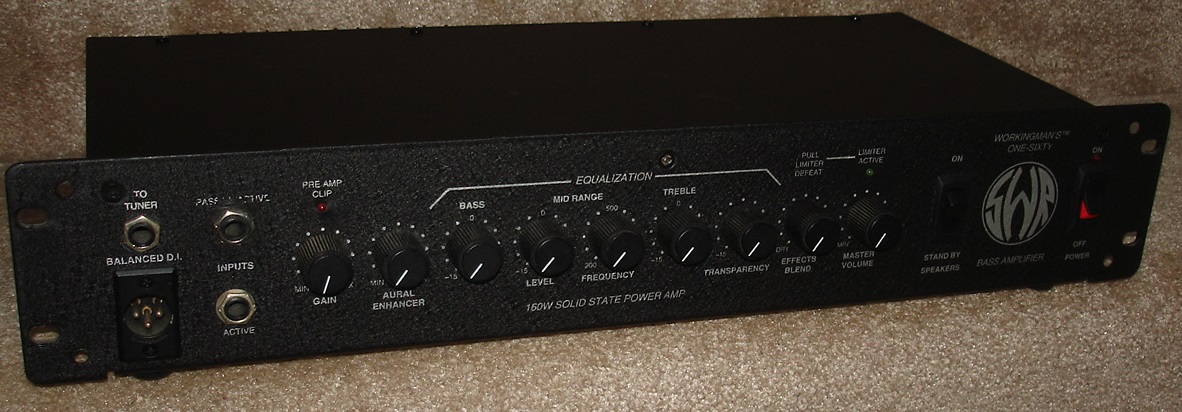
SWR Workingman's 160.
One of the later additions to the popular Workingman series. 160 watts, perfect
for club gigs; small and lightweight. Excellent tone shaping with Aural Enhancer,
EQ (Bass, Sweepable Mid, Treble, “Transparency”, Gain and Master Volume,
Effects loop Blender with “pull” limiter defeat, passive/active inputs,
balanced DI output, tuner output, speakers on/off switch, just a ton of
features in a 2-space rackmount and a featherweight for a unit that cranks out
160 watts RMS. It's barely used and very clean shape cosmetically. Full specs
and manual are at SWR's site here. If
you wanted a Workingman’s 160 but wanted to run your current speaker cabinet,
save around 50% and get just the amp for $279. Note: only $250 with purchase of
the SWR Stereo 800 power amp.
18.
SWR Stereo 800 Power Amp,
(back), (manual/output ratings).
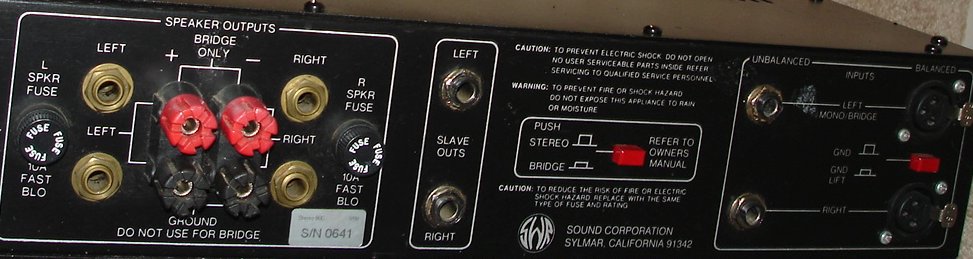
If the Workingman 160 above isn't enough power for the big gigs, this baby will
rattle the drinks in the back of the room. With up to 850 watts in the bridged
mono mode, 400/side in stereo, this amp is a monster. The front panel features
include, for each channel, a four segment dot display indicating headroom,
separate volume controls and an on/off switch. The back panel features include
separate balanced and unbalanced inputs for each channel, a ground lift switch
for the balanced inputs, a stereo/bridge switch, and individual slave outputs
for each channel so that several power amps may be driven from a single signal
source. Speaker outputs include two 1/4" phone jacks, one banana jack and
one speaker protection fuse for each channel. Also included on the back panel
is an external line (mains) fuse. You can use this with your existing preamp,
or in the case of the Workingman 160 below, you can use the 160 watts from the
Workingman to power your high frequencies (such as 10" cabinet), and this
amp to power your lows (such as a 2X15" cab). Full specs are at SWR's site
here.
This amp had a long run, from '91 to '01, while this one is a '98. Never abused
and good shape for a used amp. A fairly expensive amp at $1295 retail when
discontinued in '01, this one works perfectly and for SWR quality, a good buy
for a very loud amp at $399. Includes original manual.


19.
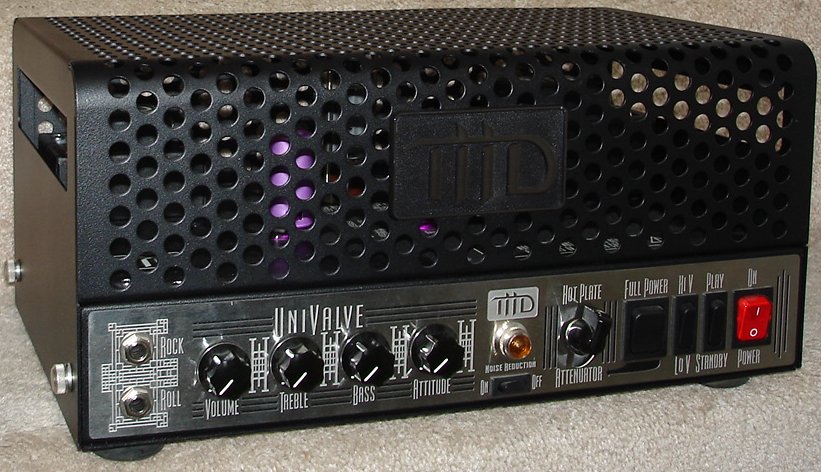
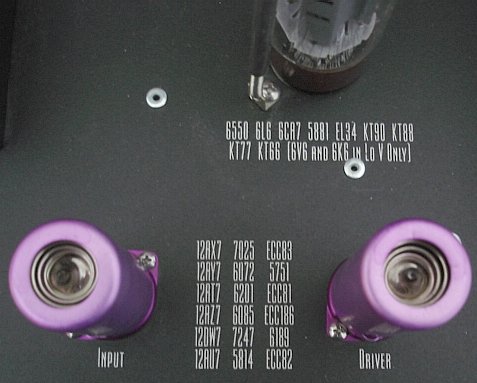
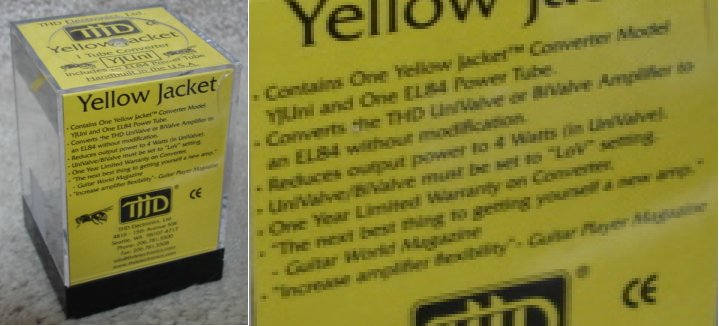
THD UniValve, (panel), (top), (tube types), (back), (Yellowjacket).
One of the most ingenious and best sounding amps of all time. Although there
are a few imitators on the market, THD was the first and remains the best, and
the one that's overbuilt like no other. The Uni-Valve has the capability to run
on almost any tube including 6L6, EL34, 6550, 7027, KT90, KT88, KT77 and KT66
– all providing unique tones without the need for rebiasing when you change
them. This one even includes optional THD Yellowjacket which lets you use an
EL84, which can lower the output to 4 watts. Likewise, the two preamp tubes can
be any combination of 12AX7, 12AT7, 12AU7, 12AY7 or 12AZ7. The UniValve
delivers tones from smooth and clear to very aggressive overdrive and is easily
capable of driving a 4 x 12" cabinet, yet quite small and light. It has a
built-in Hot Plate Power Attenuator that allows for full output distortion at
almost any volume. Totally handbuilt, the Univalve is a 15W Class A amplifier
in a Single-ended Class A circuit. It features 2
inputs: one for high gain and one for low gain, with Volume, Treble, Bass, as
well as Attitude control knob which adds more harmonics and treble for a more
edgy sound, while turning it down gives you a sweeter and warmer tone even when
over-driven. A switch selects full power or attenuator, which, when activated,
kicks in a built-in Hot Plate output attenuator which is also sold separately
by THD and is one of the best attenuators made and features a hard bypass.
Unique noise reduction circuit which uses a yellow light bulb that glows
brightly during play (on/off switch included to turn off the bulb). This noise
reduction circuit and the transformer-isolated line output make this amp
perfect for driving other larger guitar amps or power amps without that overly
harsh tone you hear from most guitar line outputs. Although it's only 15 watts,
it's a very LOUD 15, comparable to other amps rated at 2 to 3 times the
wattage. The low wattage, especially with the attenuator, makes it a great amp
for any application and it will sound as good in your bedroom studio as it does
in a 200-seat club. The Transformer-isolated line out has adjustable level
control and a built-in dummy load if you only want to hear the tone in your
headphones. It features line or instrument level output, allowing you to run
into another amp's guitar input, power amp in, mixing console, etc. Output can
be 2, 4, 8, or 16 ohms. Click
here for a good YouTube video with several guitars and amp settings; check
out the clean to dirty via the guitar's volume knob at 5:00 minutes. Here's a
good site with full specs and some technical info (link) and
overall 100 reviews at Harmony Central where it scored all 9's or better (link).
Personally, I love these amps and it is one of the definitive studio amps, that's easily adaptable to any stage setting. These sell new
for $999, inexpensive for a handmade amp with these features. This one is dead
mint, and even with the optional Yellowjacket, $300 cheaper at $699. (Note: If
you need more output, I have the THD Bi-Valve, with
twice the power, available for $950 on my amps page).




20.
Ca. 1968 Vox Scorpion 4x10
Combo, (pic2),
(pic3). The
V116 Vox Scorpion combo amplifier, introduced in 1968, was designed from a
combination of parts and subassemblies from earlier Vox amps. The closed-back
cabinet was the one used by the Royal Guardsman, but it used casters instead of
a trolley. Unlike the Royal Guardsman, the Scorpion cabinet had a full front
grill. Inside it's loaded with four 10" 16 ohm Vox Gold Bulldogs (Oxford
made) with ceramic magnets, wired in parallel to make a 4 ohm load. The preamp
and controls are from the Berkeley III head. The
60-watt power amplifier, mounted to the bottom of the amp cabinet, is from the
Royal Guardsman. Vox was the best at refining a solid state design into an amp
that had the warmth and feel of tubes and this is another good example. Fairly
rare model and a good value in a vintage Vox combo. Lots of features including
bi-level control panel with Normal and Brilliant channels, each with its own volume-bass-treble.
On the lower level there's footswitch input, reverb, tremolo depth, tremolo
speed, line reverse switch, and Aux speaker out. Classic Vox looks with Diamond
grill cloth, vertical logo, and top/back control panel. The Scorpion sold for $529
in '68, which was $30 higher than a Fender Twin Reverb, and a good bit of cash
during that era and it equates to over $3000 in today's dollars. Cosmetically
it's in decent shape for 45 years, sounds good, and is a good buy on a rather
unique vintage amp at $699.


OTHER AMPS
1.
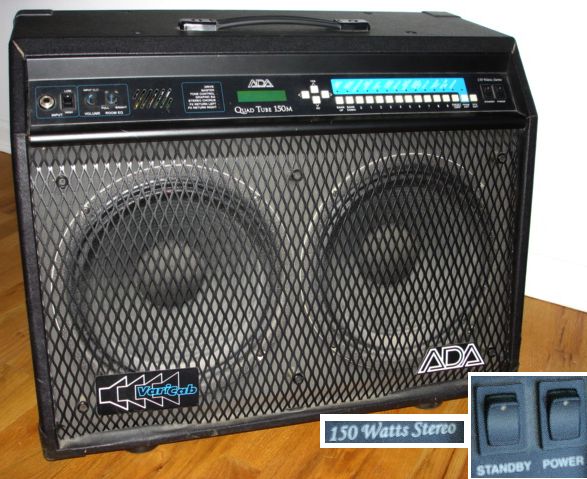
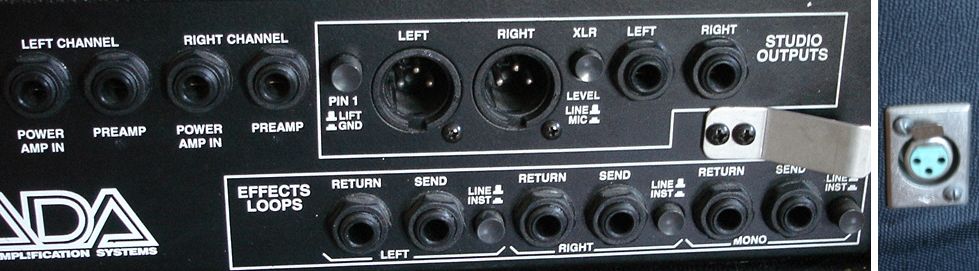
ADA Quad Tube
Programmable 2X12 Combo, (front panel pics
pieced together), (3/4 view), (back panel). The
Big Boy - the baddest amp ever made by ADA. It was also the most expensive,
selling for $2399 15 years ago. This amp is super RARE - try to find another
one. I found one on the web which was actually a NOS model that a store was
selling for the same $2399 but has sold since I looked it up a month ago. I
have not one but TWO of these babies. One of them works perfectly - the other
one has a glitch on some of the patches and is priced accordingly. Looking
through the 62 page manual it's clear that there are too many features to list
here so I'll just do a brief overview. Features 150 watt output (true stereo -
75W/Side) with complete digital control of an all-analog signal path, 128 user
and 39 factory patches, four low-noise 12AX7A tubes with 10 voicing options an
overdrive, onboard compressor, four-band tone controls nine-band graphic EQ,
powerful effects, including "Varicab" (programmable cabinet
emulator), tremolo, stereo chorus, noise reduction, stereo effects loop with
programmable mix control, front panel volume and room compensation EQ,
cabinet-emulated XLR output with ground lift s well as unbalanced 1/4"
outs for recording, complete MIDI with real-time MIDI for on the fly changing
of parameters, rack holster for mounting single rack space to the back, accepts
ADA 4X4 MIDI controller. As I mentioned, one of these works perfectly, priced
at $1399. The other one works perfectly on some patches, while other patches
have a low rumble which runs away if you tap the top of the amp - could be an
easy fix - it's never been benched. This one is totally useable on most of the
patches and is selling "as is" for 1/2 price; $699. If you're an ADA
fan, this might be your only chance to get your hands on one of these rare and
great sounding amps - and a piece of ADA history. Includes 62-page owner's
manual but if you're familiar with the MP-series, you will find it easy to get
around on without the manual.


2.
ATA Grade Amp Case, (pic2), by Alum. Road
Case Co., best quality you can get and this one was formerly owned by the Army
Band where, sadly, money is no object when purchasing band gear. Interior
dimensions are 24X17X12 which is sized for a small/tall combo amp like an
acoustic guitar amp. Flip up handles, very thick stiff padding, built for
abuse. Note: This case does not have casters. This thing will be around long
after we've quit playing. Original cost on these is over $300 but this one's in
nice shape and just $99.

3.
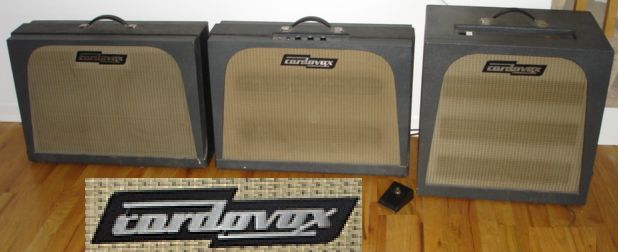
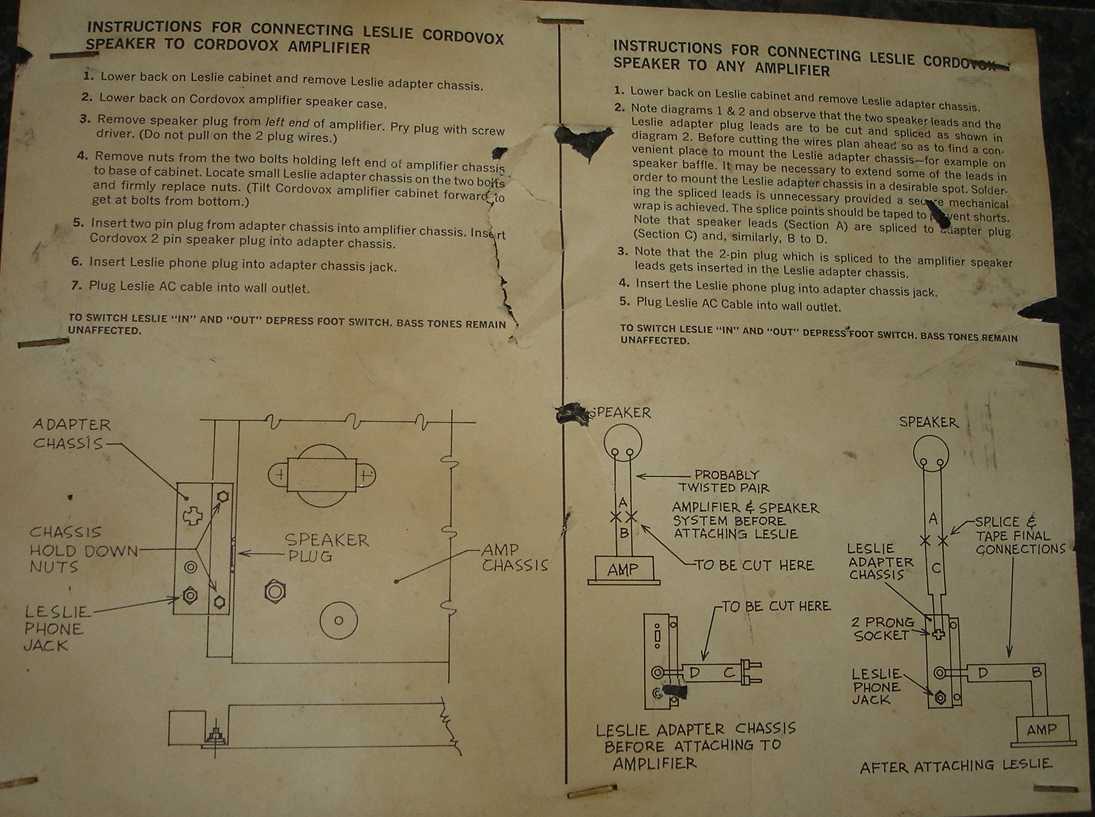
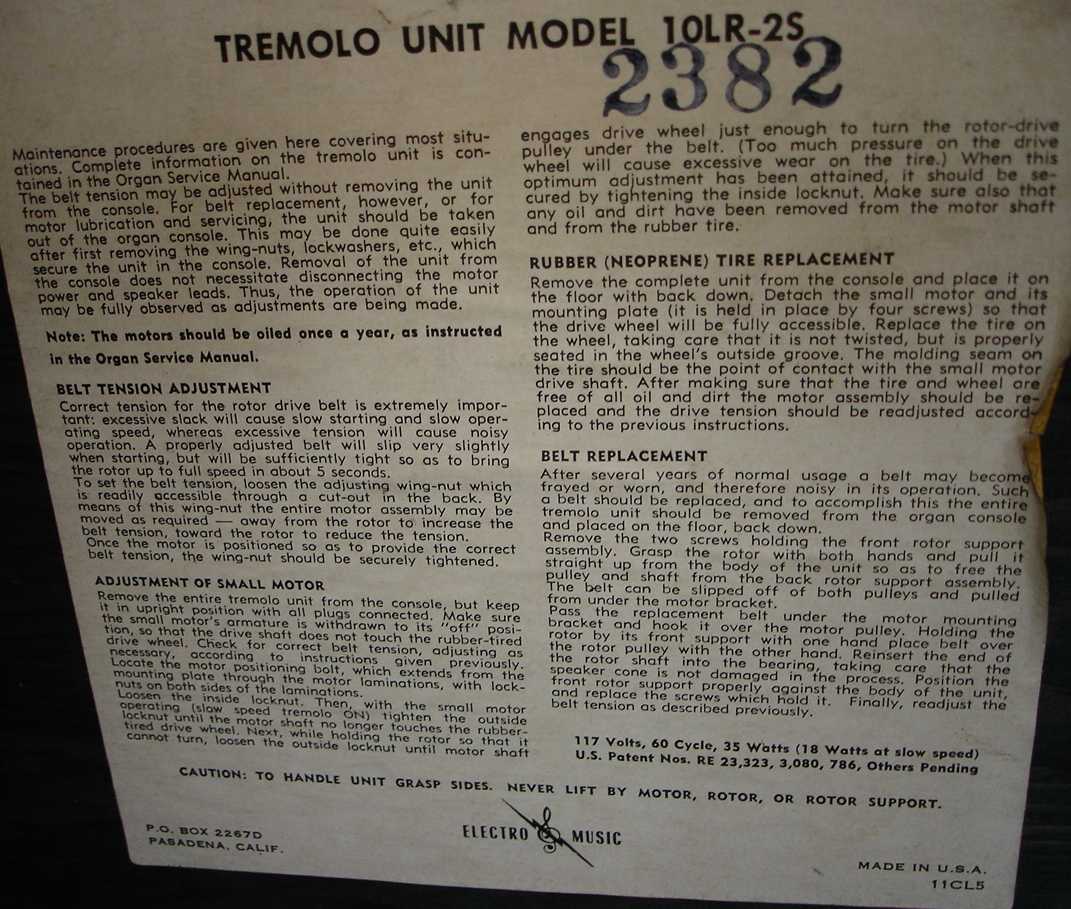
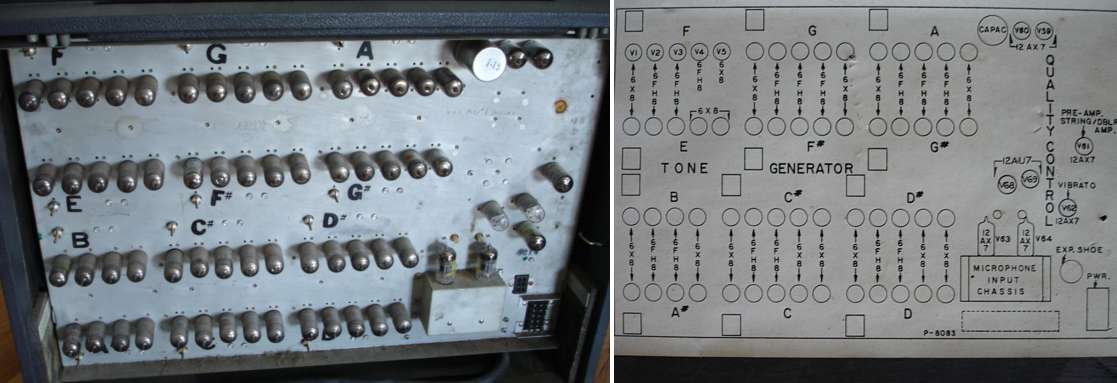
1965 Cordovox Amplifier
3-piece Complete Set, (Leslie), (Leslie-inside with instructions and label), (amp/speaker unit),
(inside
"brain"). Made by the Cordovox company during the height of the
accordion craze, the Cordovox was a very sophisticated amplification system
consisting of 3 parts - (1) amp/speaker cabinet; (2) matching "brain"
or "tone generator" as it's called) which contains loads of circuitry
and 66 (sixty-six!!!) tubes; and (3) slightly larger Leslie (Tremolo unit)
cabinet with a rotating baffle. This unit is in beautiful shape, other than
some discoloration to the grill cloth and seems to work perfectly. As far as
user or travel wear, there is virtually none. This set appears to have sat,
un-used, for nearly its entire life. Although I can only test it with a guitar
I know that the amp cabinet and Leslie cabinet work well. I don't have a way to
test the brain for accordion use but the set is very well preserved and I have
no reason to believe that it doesn't work. The amp/cabinet portion of this unit
is basically a guitar amp, with a pair of Jensen C12R 12" (date-coded 36th
week of '64) speakers and bottom-mounted chassis housing the transformers, 2
power tubes, and a preamp tube. The Leslie houses a Jensen C8R, date coded 1st
week of '65, and has a rotating baffle to create the swirling sound that
Leslies are famous for. Many stomp boxes have been created to emulate this
sound but, trust me, none of them have quite the same
effect as a rotating baffle. It also includes a footswitch to turn on/off the
rotation. I forgot to shoot a pic of the amp panel but it's a simple 3-knob
with volume and tone controls. Although it's low
powered, it's a very good sounding tube amp and has a very smooth break-up. The
Leslie really makes this unit though and used in conjunction with the amp,
you've got some very sweet tones. This unit is potentially worth more in parts
than it is as a 3-piece set, with treasures such as vintage transformers and
original cone Jensen C12R's which are original for many amps, Gibsons and Ampeg
among them. If you're a guitar player with a lot of spare room or you know any accordion
players looking for some top-notch vintage gear, the whole setup is just $850
and, again, in beautiful shape. Includes all cables including a long multi-pin
proprietary cable.



4.
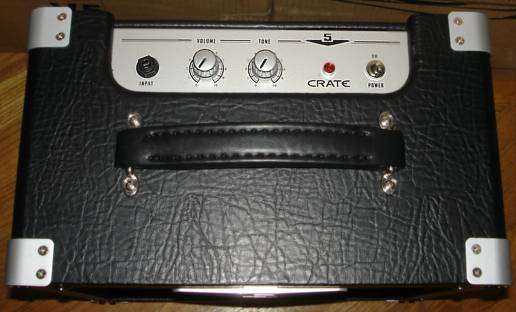
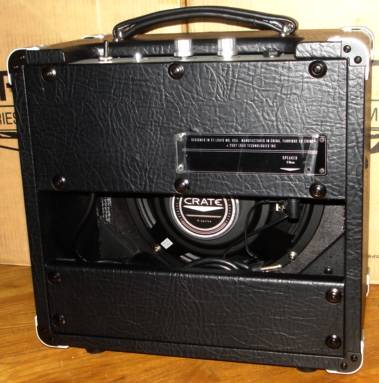
Crate V5
Combo, (top),
(back).
Another all-tube single-ended Class A 5-watter, with EL84 power and a pair of
12AX7's in the preamp, with a 10" speaker. Similar amp to the Palomino
above, except an even simpler circuit with just a volume and tone control. Like
the Palomino, the tone control is complex, completely
changing the character of the tone, somewhat interactive with the volume
control where the tone shift is more pronounced the louder the volume is
cranked. Crate smartly didn't hard-wire the 10" speaker so if you want to
run it into a bigger 8 or 16 ohm cabinet, no problem, and will make this amp
sound huge. Epiphone with their Valve Junior seems to have started the
competition for a low-priced tube amp, followed by Fender, and then everybody
else. I need to point out that there is no comparison with this amp and Valve
Jr./Champion 600. The V5 is much louder, with a good
clean sound, although at low volume, but a great overdriven tone and when you
combine the versatile tone control, this amp is chameleon that goes from dark
and smooth, to mids that jump out of the speaker, to a scooped mid that
actually works for metal. It's a lot of amp, new in the box, for $129. I have a
few of these so if you want an inexpensive stereo set up, pick up a pair.

5.
Epiphone Valve
Junior Head - Refin, (top), (back).
These amps have been getting rave reviews since they came on the market 2 years
ago. At well under $200, now $149, the Valve Junior Head broke the price
barrier in all-tube combos. At 5 watts single-ended Class A you can get a full
power tube distortion at very reasonable home levels but you'll likely be
surprised at how loud 5 *tube* watts can be. Controls are as follows: Volume.
That's it...volume. Tubes are a 12AX7 preamp and an EL84 power. It has a nice
clean sound at low volume but gets a good saturated tone starting around 4 and
attaining increased breakup at virtually every number above 5, and it's also
engineered to work very well with your guitar's volume control. Back it off for
clean, turn it up and send the amp into overdrive. There are a number of mods
available for this amp, including a very popular one by Mercury Magnets which
guarantee boutique tone at around 1/2 the cost of a
boutique amp. There's even a site devoted to this cool lil' amp, http://www.valvejunior.com/. While I'm
sure these mods are nice, it actually sounds good in stock condition. This one
has been refinished to a bronze color, looks very cool to me, and a nice lil'
amp for $110.


6.
Epiphone Valve
Junior Combo. These combo's have been getting rave
reviews since they came on the market 2 years ago. At well under $200, now
$149, the Valve Junior broke the price barrier in all-tube combos. In addition
to obvious cool retro looks, it actually sounds very good. At 5 watts
single-ended Class A through an 8" speaker, you can get a full power tube
distortion at very reasonable home levels but you'll likely be surprised at how
loud 5 *tube* watts can be. Controls are as follows: Volume. That's
it...volume. Tubes are a 12AX7 preamp and an EL84 power. It has a nice clean
sound at low volume but gets a good saturated tone starting around 4 and
attaining increased breakup at virtually every number above 5, and it's also
engineered to work very well with your guitar's volume control. Back it off for
clean, turn it up and send the amp into overdrive. There are a number of mods
available for this amp, including a very popular one by Mercury Magnets which
guarantee boutique tone at around 1/2 the cost of a
boutique amp. There's even a site devoted to this cool lil' amp, http://www.valvejunior.com/. While I'm
sure these mods are nice, it actually sounds good in stock condition. Prices on
new ones are now $199 ($349 list) but this one's in perfect condition, and just
$139. I also have a matching extension cab if desired.

7.
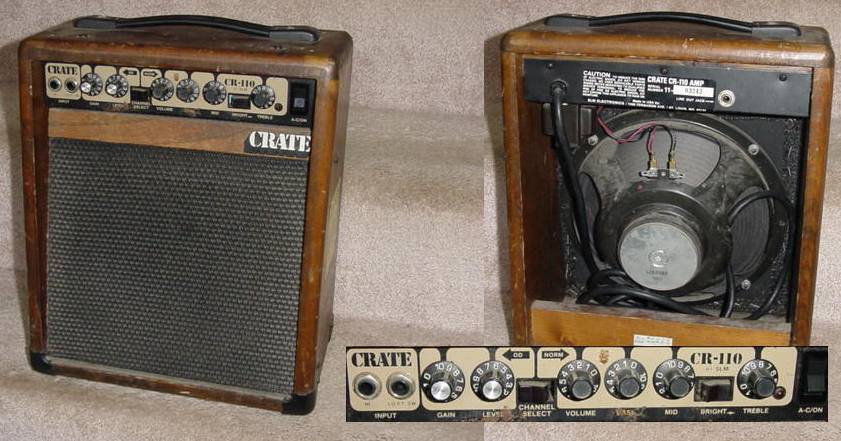
Crate CR-110, original
wooden “crate” model, neat little screamer for the studio and a vintage
example of an original Crate when they were made to look like a wooden packing “crate”.
Clean and overdrive channels, both sound good. A great little reference amp, it
has been my man Martin's bench amp for around 6 years and works perfectly. He
loves the amp and doesn't want me to sell it but for $150 it's yours.
8.
Epiphone SC-28 Amp,
tweed covering, nice shape and upgraded with steel corners and leather handle, stereo
chorus via two 8” speakers, footswitchable overdrive and chorus, nice little
practice or studio amp for $150 (available in Baltimore).

9.
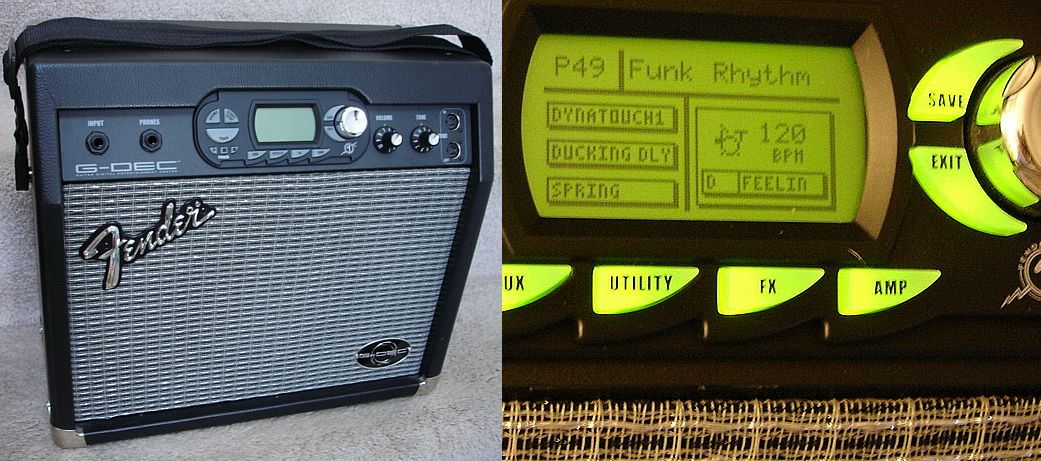
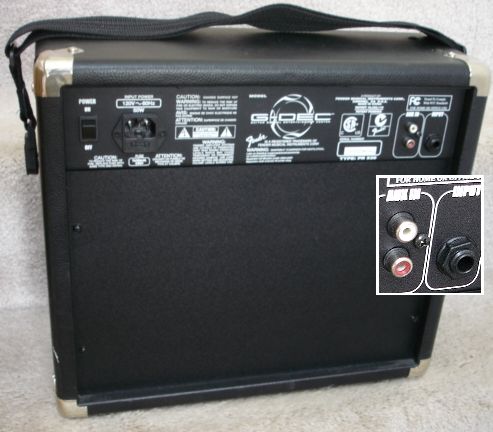
Fender G-Dec, (back). Way more than
an amp, the G-Dec is a great practice tool with backing tracks (bass, drums, onboard midi synth), multi-effect, phrase recorder, looper,
and more. I have used one of these as my personal amp for over
a 3 years, testing guitars several times a day and, more importantly, to
take a brief break from work and just jam out. It has improved my lead skills
tremendously, just working through the 100 or so songs and patches. It's easy
to program - I've yet to read a manual - and sounds very good. If that's not
evidence enough, Eric Johnson uses a G-Dec as his backstage amp and hotel room
practice amp. Click here
for G-Dec specs at Fender's site including a good demo from Eric. YouTube also
has a ton of demo's - click
here and here.
I'm not going to get into all the features since a video is worth a thousand
words and the demo's are better than my writing
skills. Features master volume and tone, loads of amps, effects, etc., all of
them tweakable, headphone out on front panel, midi in/midi out, recordable
looper, click track, and much, much more. For practicing along with an external
CD/Tape/IPod, it has RCA outputs and a stereo 1/4" jack on the back. The
G-Dec puts out 15 watts and an 8" speaker and includes a strap, adjustable
for hand or shoulder carry, for easy transport. Both amps are AC only - not
battery powered. The G-Dec sold new for $269 - this one's super clean and a
very cool practice tool for $145(HOLD-Richard T 7/29).
10.
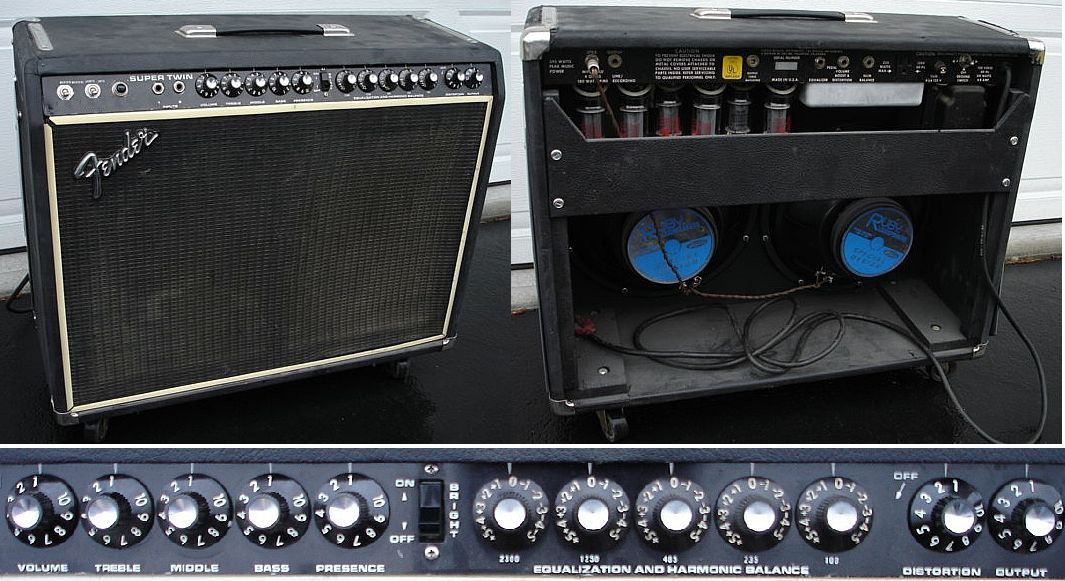
1976 Fender Super Twin,
(back panel), (tube chart), (spkrs). One of the
second series Blackface reintroduced in the mid 1970's in a series of
amplifiers designed by Ed Jahns. The 185W was marketed by Fender to be
"the ultimate" in state of the art amplification. Pretty rare amp,
produced only in '75-'76 (the Reverb version ran a few more years). The new
blackface models overlapped the Silverfaces and both series were available
during this run. High power output was in fashion and Fender added two extra
power tubes to increase the output to a whopping 185 watts (back panel also
boasts 395W "peak music power"). Today, many players consider the
"regular" Twin's 100W as being unmanageable if you crank it to a
breakup point; 185W is simply over the top. One of the main innovations of this
amp was a very sophisticated circuit, and one that was very expensive to build,
which included a 6-band active EQ, in addition to the traditional passive
Bass-Mid-Treb. The Presence knob on this amp is active, plus a 5-band with
frequencies centered at 2300 Hz, 1250 Hz, 485 Hz, 235 Hz, and 100 Hz, with
cut/boost if you turn it to the left or right of center. By making the active
EQ footswitchable, Fender created a quasi-channel-switching. Answering player's
demand for the era Fender also included built-in distortion combined with a
boost control via the "Output" knob. The Output knob was activated
when the Distortion control was activated. While the Distortion isn't bad, it
couldn't compete with the new boys at Mesa-Boogie and while Tremolo and Reverb
were on the wane during this era, Fender purists balked at an amp without these
signature effects. A solid state rectifier powers the amp and four stages of
7025 tubes (i.e. two complete triodes) were used for the preamp section. It
uses the traditional long-tail 12AX7 phase inverter but instead of powering the
power tubes, it was followed by a 12AT7 cathode follower as the low impedance
circuit was better suited for the 6 6L6's than the
12AT7 phase inverter normally used. In all this amp
uses 11 tubes: six 6L6, two 7025, a 12AX7, a 12AT7, and a 12AU7. Original
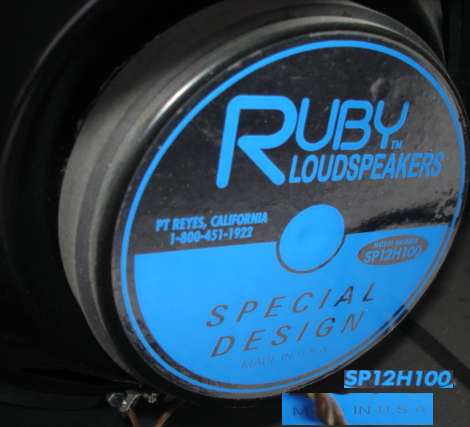
speakers have been replaced with a pair of old Ruby model SP12H100's, made by
Eminence. They're the same as the Legend 1258, but with a larger 2 1/2"
voice coil. If you're a player looking for more volume than you'll ever need,
this might be a good choice. Weighing in at around 90 lbs., this is a lot to
lug around, although it does have casters once it's on the floor, but shipping
is going to be costly, which is why I'm pricing it low. There's a wide range of
prices on these and if you look around the web you'll usually see them at
$700-$1200. This one works well and is an interesting piece of Fender history
for $599 - plus around $100 shipping. Takes a standard 2-button footswitch with
1/4" stereo jack, labeled "EQ" and "Dist". We can
supply an aftermarket one for $25, or a Fender one for $35.


11.
Fender Diminsion IV 70's,
For your non-vibrato equipped vintage amps, this give
you some very cool vintage vibrato tones via an "oil can" design.
Easy to install - just plugs into reverb jacks on Fender tube amps $175.

12.
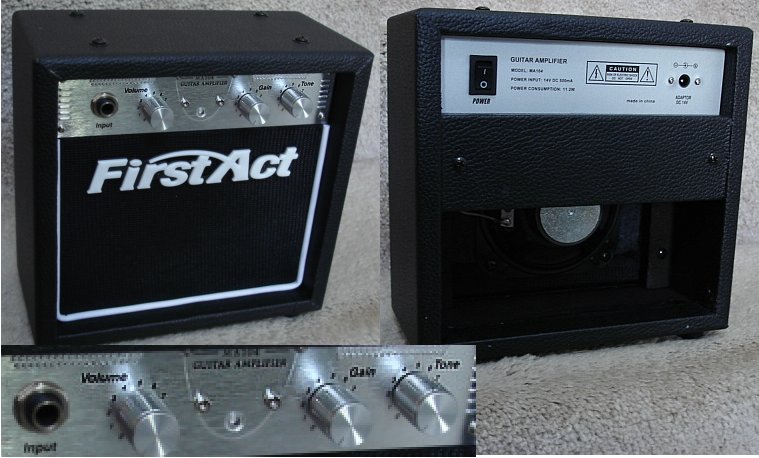
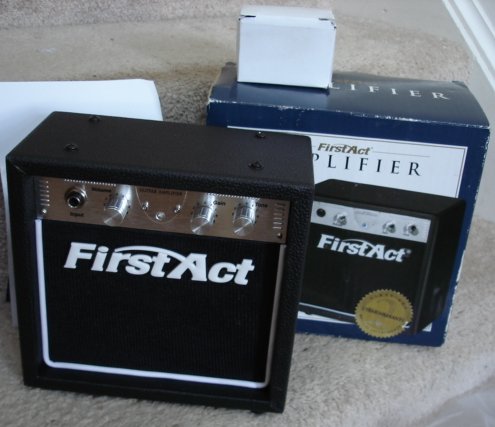
First Act MA104,
(close-up). I
get in some strange gear. This isn't as bad as it looks and actually sounds
good for its size, much more like a real amp than the little battery powered
Fender/Marshall/Vox/etc. Has a decent clean sound and
a cool buzzy overdrive. Includes power supply. Mint in original box for $18.
13.
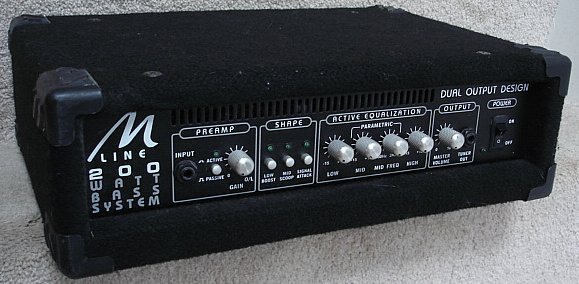
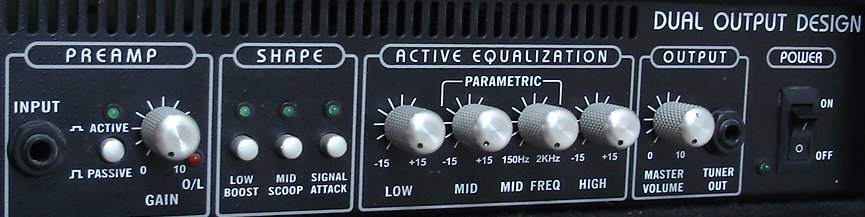
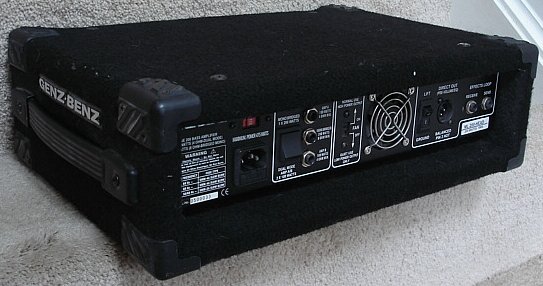
Genz-Benz ML200
Bass Head. (panel), (back>, (detail), (top).
Excellent tone shaping for a variety of applications in a lightweight, easily
portable head. The ML200 head features the same amp used in the 112T, 115T, and
210T combos, with the speakers. This allows you to use the amp with whatever
speaker cabinet you prefer, and it's easier to handle a 20 lb. head and 25 lbs.
cab, rather than a 55 lb. combo. The ML200's flexible dual-output design lets
you operate this power amp in bridged mode, pumping 200 watts into an eight-ohm
cabinet, or as 2 separate amps, each putting out 100 watts into 4 ohms.
Starting with the input jack, you can select Passive
or Active via pushbutton switch, and adjust your gain control until the red
overdrive light flashes occasionally. Tone shaping includes "Shape"
controls for Low Boost, Mid Scoop, and Signal Attack, while active EQ includes
Low, semi-parametric Mid, and High. The output knob
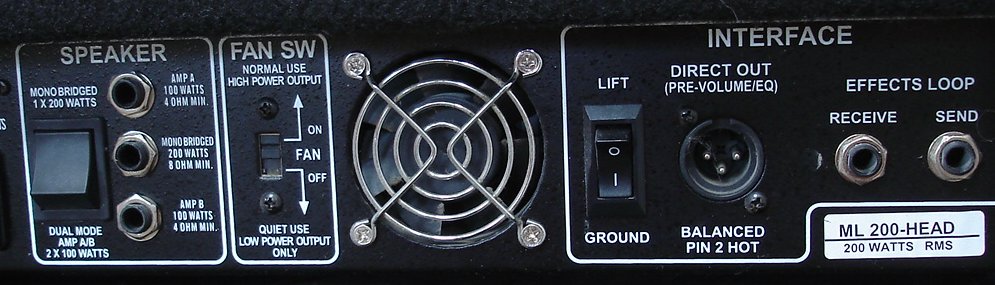
controls the overall volume and there's a tuner output jack adjacent. Back
panel features dual 100W output jacks, as well as a 200W bridged output.
There's also a fan on/off switch, ground lift switch, XLR Direct Out for
recording or going direct to your live mixer, and an effects loop. Genz-Benz
builds good sounding gear at good prices. If you're looking for a nice sounding
head for small to medium gigs, this one's in nice shape and hard to beat at
just $199.
14.
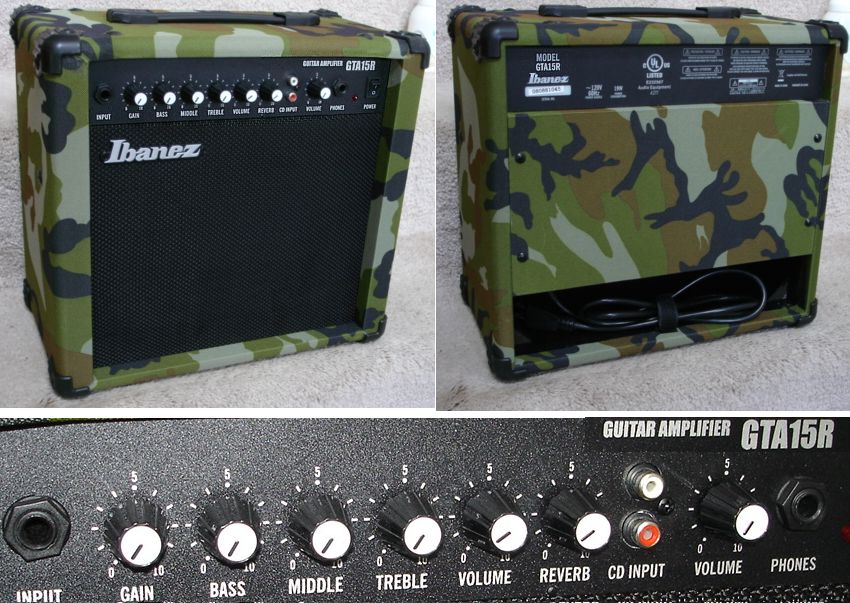
Ibanez GTA15R Guitar Amp Excellent
starter amp for anything from blues to rock to metal. Keep the gain down for
nice clean tones, crank it up for excellent preamp
distortion. Three band EQ allows you to boost the mids
for a nice blues/rock tone - or boost bass and treble for that scooped mid's
Metal tone. 15 watt RMS, plenty for any practice situation, through a solid
8" speaker. Features 3-band active equalization, reverb for spacious
tones, CD input for jamming along with CD or IPod, and headphone output for
silent practing. AC cord stores easily in bottom of amp. For a 15 watt amp with
reverb, a sweet deal at $65. Add headphones below for $13.99 for private
practice.
15.
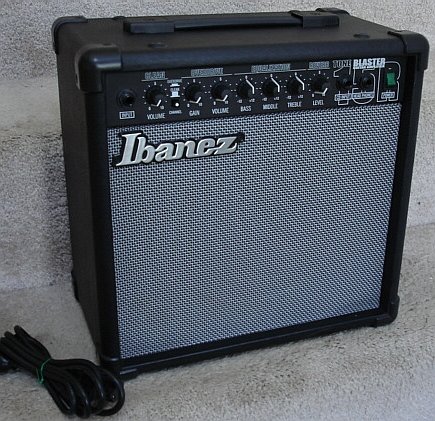
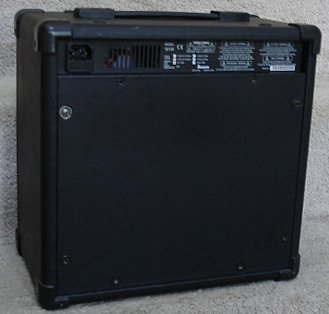
Ibanez TB15R
Toneblaster Amp , (panel), (back). Nice
little practice/beginner combo with 15 watts through an 8" speaker.
Features include dual channels (clean/overdrive), with separate level controls
for each - plus the overdrive channel has a gain knob to add the desired amount
of distortion. 3-Band EQ is active with center-detented knobs and +/- 12dB of
cut/boost. Good sounding spring reverb. As a practice tool it includes a CD
input to play along with you're CD player, IPod, etc., and Headphone jack for
private playing. This is the last generation TB15R, the new one has a
parametric Mid control but for $59, it's an
inexpensive choice for a beginner or backstage/home practice amp.

16.
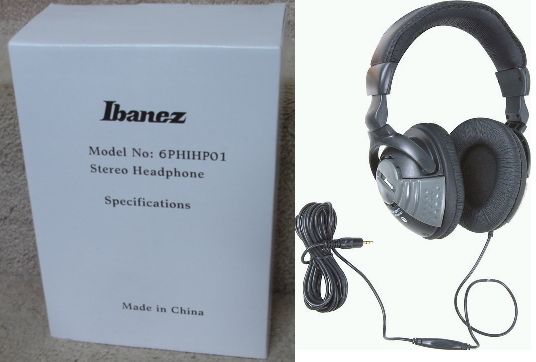
6PH1HPO1
Headphones, stereo, full size with comfortable padding, long cable, great
for private practice through the Ibanez GTA15R or any other amp with a
headphone output.
17.
Hartke 1X15 Transporter
Cabinet 200 watts, $250(mgr)

18.
Hartke 4X10 XL cabinet,
terrific punch with sufficient bottom, XL badge is missing but make no mistake,
this is the road-worthy XL series and not the lightweight Transporter,
$325(mgr)

19.
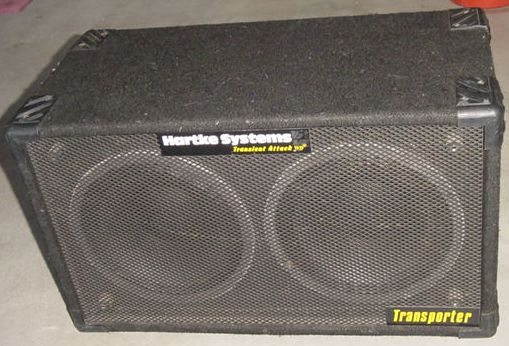
Hartke Transporter 210 Cab , sealed cab, carpet covered, ¼" input, good
choice for use with a 15" or 18" bottom or stand-alone for light
gigs, $145.
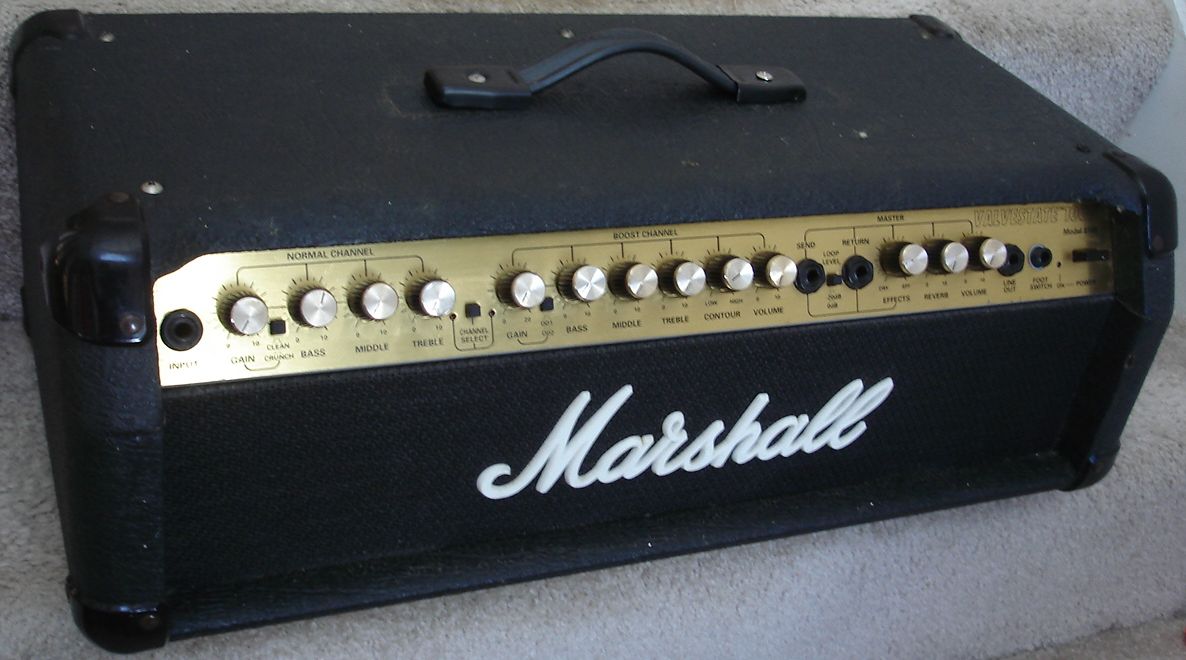
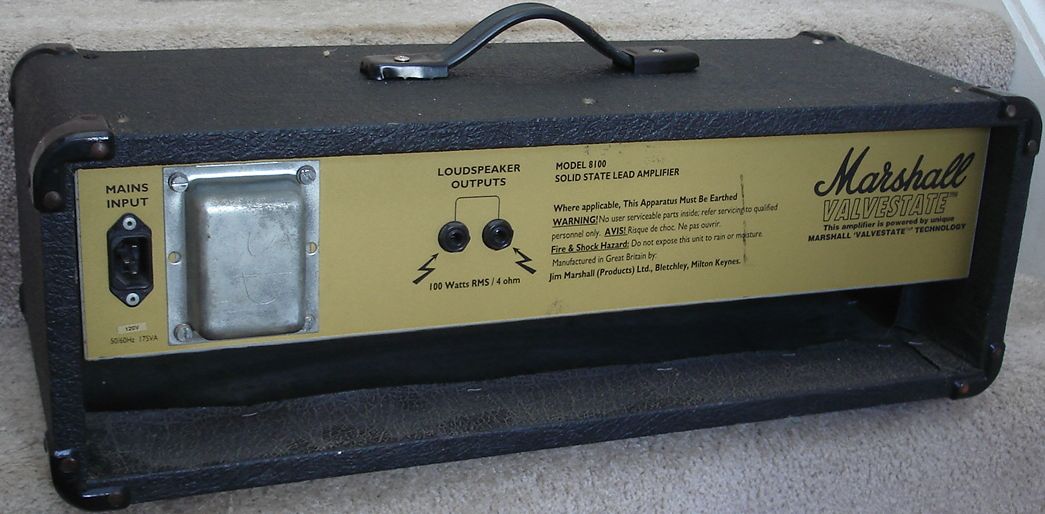
20. Marshall 100V Valvestate, Mod 8100, (panel), (back). Marshall learned how do to solid state right, back in the 80s. The Valvestate series was the next step which followed in the 90s. This Model 8100 has tons of features including 4 channels (clean channel w/boost plus overdrive channel with dual channels), reverb, effects loop with selectable buffer, independent tone controls for each channel, and line out. If that’s not enough, it’s even made in England! Wow, an inexpensive Marshall that wasn’t made in Asia! Some guys don’t realize it but the fact is this 100W Valvestate will sound better to them than a 100W JCM900. That’s a fact. Looks a little dusty in the pics but it’s in pretty nice used condition and a lotta amp for just $225.

21.
Marshall VS2000 AVT20
Valvestate, ECC83 tube, 1X10 Celestion, clean and boost channels, nice reverb,
CD input, DI output, headphone out, ext speaker out, 1” snag in grill cloth
but otherwise very clean, this baby has classic Marshall tone in a compact
package for $185(available in Baltimore)

22.
Peavey
Classic 30 Combo w/Weber Blue Dog , (panel
- click to enlarge), (top),
(back),
(tubes),
(spkr).
Small all-tube combo with a vintage looking tweed covering, chrome panel, and
chicken head knobs - and better than new with the recent installation of a new
Weber Blue Dog Classic British ($110/direct), defined by its warm, clear, loud,
detailed high end that doesn't get hard or harsh at high volumes, aggressive,
big low end, more headroom than the AlNiCo version. The Classic 30 offers
incredible value for a quality American made tube amp. It's a fantastic club
amp with enough power to play larger sized rooms. I frequently compare them to
Fender's Tube Series and, quite honestly, when I've had these set up at shows
next to comparable Fenders like the Blues or Hot Rod Deluxe, the Classic 30 was
almost universally chosen for superior tone - and the Peavey is USA made!.
Features an all-tube circuit with a matched quad of JJ EL84's cranking out 30
watts through 16 ohms - with three 12AX7's in the preamp.
Nice sounding EQ that really does something, and very versatile with a
crisp clean tone with plenty of headroom - and enough gain to satisfy nearly
every rock player. Features two channels plus boost for 3 distinct tones,
selectable via switches on panel or via optional footswitch. Pre- and post-gain
controls on lead channel; Normal volume control on clean channel. It also
features a footswitchable spring reverb that sounds very good, very vintage,
and an effects loop. Full specs, manual, and sound clips, check out Peavey's
Site here.
Click here for a good demo
from Peavey but keep in mind that this is the stock speaker and it sounds even
better with this Weber Blue Dog. There are a bunch of YouTube demo's, here's
one and here.
Optional footswitch, which uses a stereo 1/4" jack, not included but I may
have a 2-button switch for $25 if desired. Recently discontinued but these sold
new for $649. This one's in immaculate condition and even with the new Blue
Dog, priced at $559.


23.
Randal
RC235 Stereo Chorus 2X10 Combo, (panel),
(back),
(back
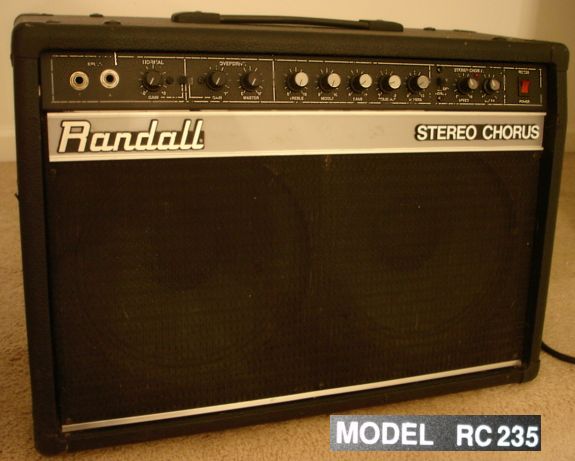
panel) Ca. 1989. Good sounding combo with true stereo chorus. Two 35 watt
amps drive a pair of Randall Jaguar 10s, yielding a lush stereo field. Clean
channel has Gain control, Overdrive has Gain and Master; switch between the two
via toggle switch or optional footswitch. They share EQ knobs for Treb, Mid,
Bass, and Presence, plus Reverb and Chorus with Speed and Depth. Note: The
reverb tank was removed from this amp. It might jut need a new reverb tank
wired in, we haven't checked it out. Back panel has stereo headphone jack,
extension speaker outputs, Line level signal outputs, effects loop, and
footswitch input (channel and chorus on/off). It's missing one of the back
panels but with an open-back amp I don't think it affects the tone. For a few
nice reviews, click here
for Harmony Central. These amps cost $399 20+ years ago. This amp has been here
for years but I just found the pics and apparently it's never been posted. It's
time to move on so blowout priced at $139 plus shipping on an "as is"
but working sale.


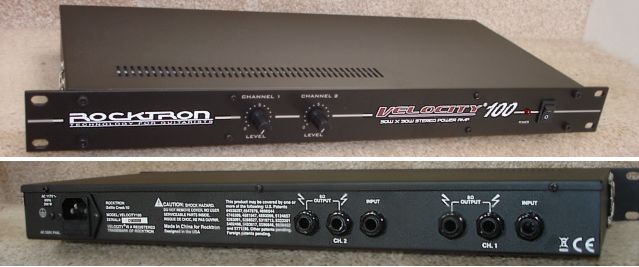
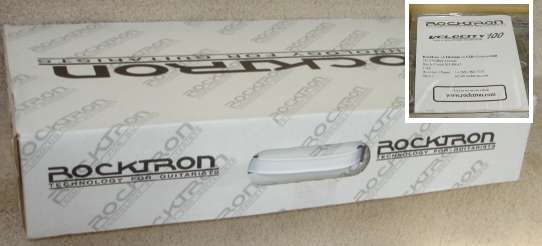
24.
Rocktron Velocity
100 Guitar Power Amp, (pic2), (stock).
"As new in box". Ordered for a rack system that was never built and
virtually untouched. Puts out 55 watts/side at 4 ohms; 40 watts at 8 ohms.
Designed specifically for guitar, the Velocity 100 delivers tube-like dynamics
in a single-space, reliable solid state design. The
Velocity 100 utilizes thermal protection circuitry, along with protection from
over voltage, under voltage or any shorts to the power supply = reliable
performance night after night. Front panel power switch and two front panel
volume control knobs make operation as easy as possible. With a list of $389
this is an excellent value in a virtually new V100 at just $185.

25.
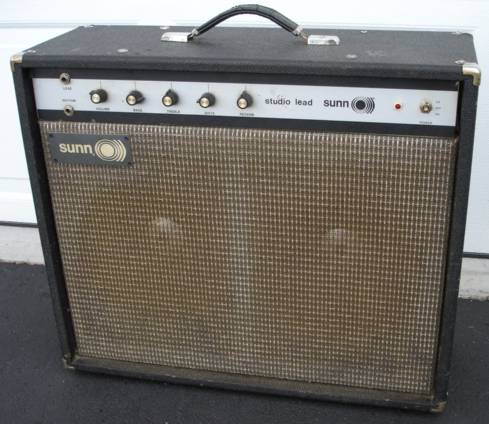
Sunn Studio Lead
1970's, nice sounding solid state combo, USA made. It features 50 watts output
through a pair of Sunn 10" speakers, with Rhythm and Lead input channels
plus reverb. Overall nice shape for an amp that's 30+ years old - has that aged
"patina" that you would expect from an amp that has seen some time in
smoky clubs but that just adds to the vibe of these old Sunns. Tolex covering
is in great shape and overall this amp is a well preserved example on the
whole. Is missing one of the back panels which gives
it less projection but a fuller tone - no problem performance wise. If you're a
collector but find the $1000 Fenders out of your price range, here's a nice
Sunn for just $199.
26.
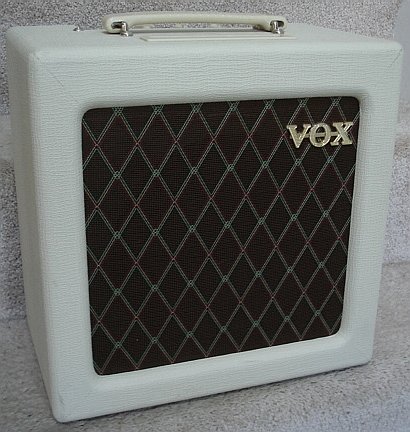
Vox AC4TV Mini, (top/panel), (back), (box/manual). Modern update
of the cherished '61 Vox AC-4, which was the bottom of the AC line but still a
fine amp in its own right. I've only had one original AC-4. They're fairly
scarce in the States and very expensive for a 4-watter. Enter the AC4TV, which
captures the vibe and tone of the original with its all-tube Class-A design in
a small TV-front combo. A very simple design, it features a 12AX7 preamp tube,
and an EL34/ECC83 power tube, with just a volume control, tone (which acts more
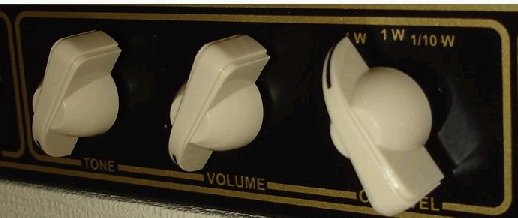
like a treble cut), and output level switch. The OP Level is a feature that
really sets this amp apart from most of these low-powered tube combos, and is
switchable from 4W to 1W to 1/10W, which allows you to get full power tube
saturation at the proper listening level. You might not think this is necessary
with a 4W amp but cranked all the way, you're going to annoy some people. Crank
it back to 1W, or if that's still too loud, 1/10th of a watt. Carr had this
same idea with the Mercury years earlier, and I was surprised at how loud 1/10
of a watt actually was. It also features a 16 ohm external speaker out in case
you want to run into a separate speaker cab. I played this through a Marshall
4X12 and the sound was huge. The look is unmistakable Vox with diamond grill
cloth, classic white covering, top vent, Vox dog bone handle, and pointer style
control knobs. Full more info check out Voxamps.com.
Here's a few YouTube clips (clip1)
(clip2)
and a cool one with a memory man for "The Edge" type tone (clip3).
List price is $350 but I have a few of these, new in the box, for just $179.

SPEAKERS:
1.
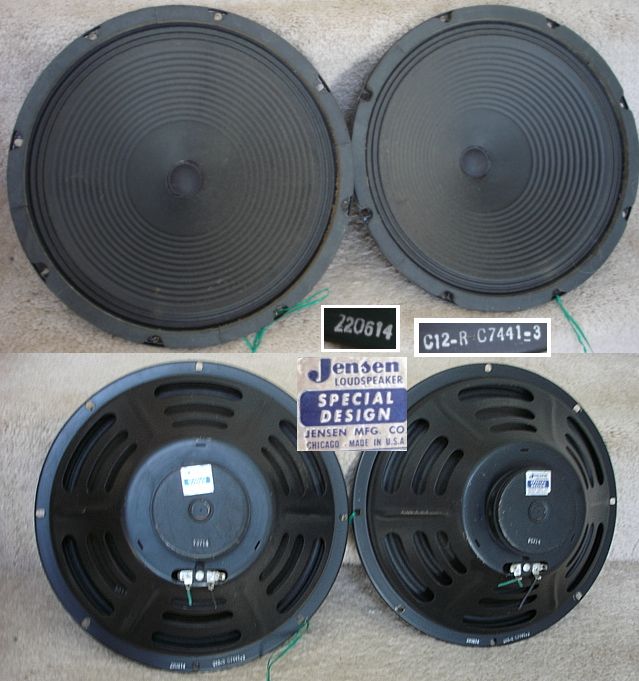
1966 Jensens
C12R, I can only find one of these so one available. Barely used and
beautiful shape. Removed from a closed-back Cordovox accordion amp cabinet that
looked as if had never been used which is likely if the owner never had the
"brain" that worked this complicated unit. These are the real deal,
41 years old, made the 14th week of 1966 and are original spec for Ampegs of
the era including Jet, Reverbojet, and Reverberocket - or would be an excellent
choice for many other vintage amps compared with most new replacement Jensens.
Look on Gbase (link)
and you'll see these reconed for $125-$150 each. These are original cone,
beautiful shape, and priced at just $99/each (only one available).
2.
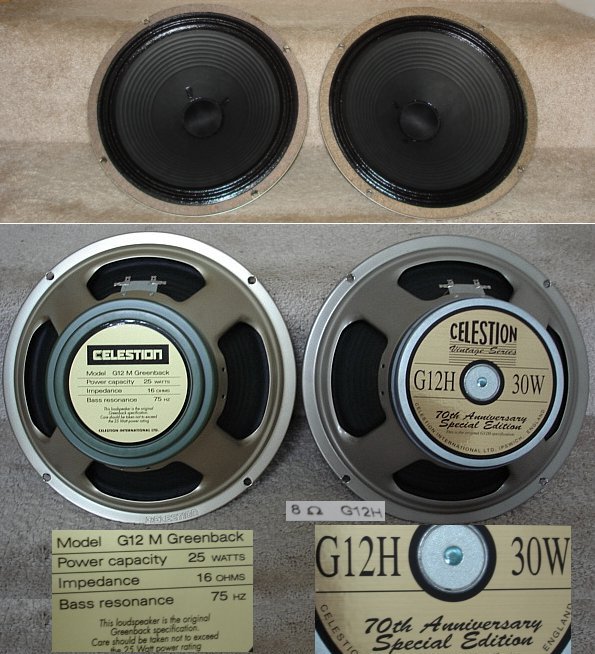
Celestion
G12M Greenback and G12H30 70th Anniversary Pair. With the warmth of the 25W
Greenback and the focused, tight bottom of the G12H 30W Anniversary, these
speakers really complement each other and are paired by several manufacturers.
With the Greenback at 16 ohms and the Anniversary at 8, you're looking at a
load of 12 ohms, wire in series, so I'd recommend the
16 ohm setting on your amp. Both of these speakers are perfect for low-mid
powered amps, providing some speaker break-up at 25/30 watts compared to a 75w
or 90W speaker which has to be played at ear-bleeding levels to break up. There
is a proliferation of budget combo's, nearly all having a major weak spot with
the speaker. $105 for the G12H; $89 for the Greenback.
3.
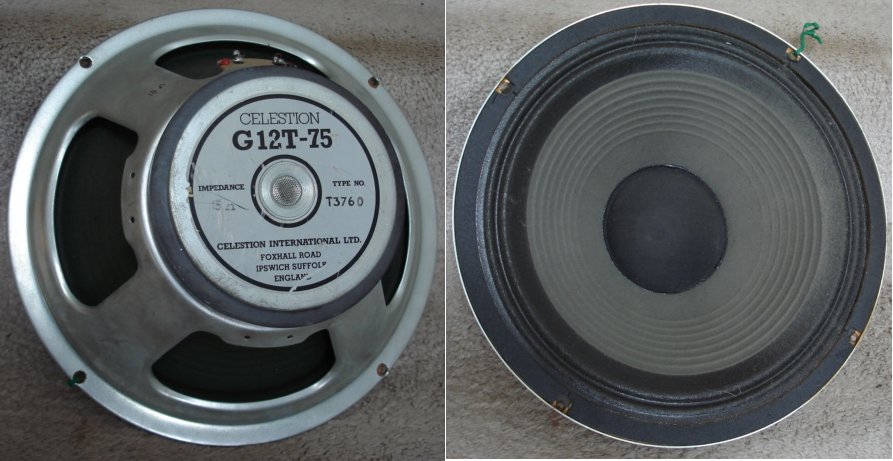
1984
Celestion G12T-75. UK made, from Marshall's JCM800 era, works perfectly,
15/16 ohm. If you're restoring an old Marshall, you'll want the right speaker
and this one is less than a new Chinese model at $95.
4.
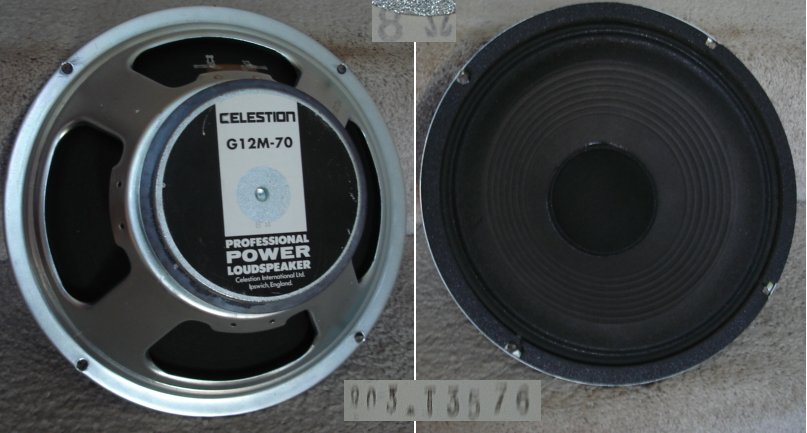
Celestion
G12M-70. A classic in the Celestion catalog for decades. 8 ohms, nice
shape, works perfectly. $50.
5.
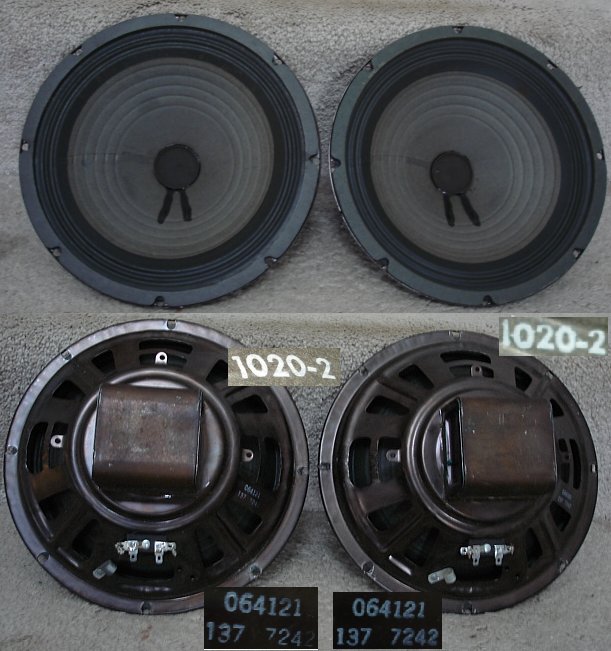
1972 CTS 10"
8 ohm Speakers. Very clean pair of CTS 10's for various Fender amps such as
Vibrolux Reverb and Super Reverb, or sounds good in any Fender with a 10".
Original cones in very nice vintage condition. CTS manufactured in '72, 42nd
week (137 7242), manufactured for Fender (064121). One of these works perfect,
the other doesn't meter but there is no scratchiness if you press in the cone
so it may not need a recone. If you need original equipment to restore your
valuable vintage Fender amp, here's a nice pair: $125 for the working speaker,
$50 for the one that needs attention, possibly a recone.
6.
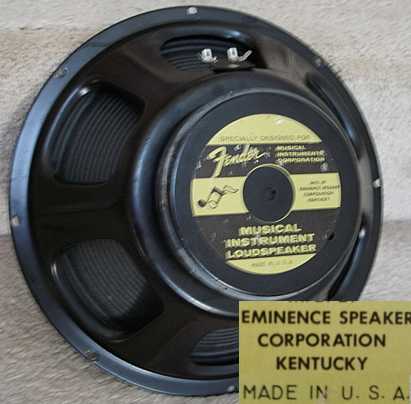
Fender 12"
Speaker From Hot Rod Deluxe, good shape, $39
7.
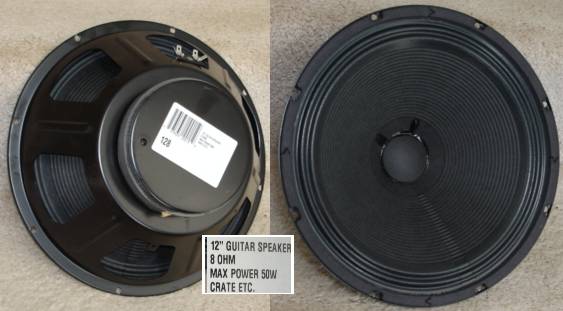
New Crate 12"
Speaker Very good quality replacement speaker, Eminence made, 50W, heavy
voice coil, 8 ohms, new in the box and never installed, $35.