Home          E-mail          Ordering/Contact Info     

PRS     Fender     Gibson   Ibanez  Acoustic & Ac/Elec    Misc Electric    Archtops    Basses    Lefty   

Amplifiers   Misc Instruments    Guitar Effects    Keyboards Pro-Sound   Parts   Links   Repairs

GIBSON GUITARS

(click on blue underlined text to view picture)

LES PAULS

  1. 2011 Gibson Custom Shop Marc Bolan Tribute Les Paul VOS Serial #18,  (front1 front2), (back1  back2), (headstock), (aged hardware), (cert.), (case/etc.).  Although note quite the household name of a Jimmy Page or Peter Green, Marc Bolan was one of the premier rock guitarists in the late 60's/early 70's, fronting the Glam/Pop Metal band "T-Rex".  Like so many of his contemporaries in the 70's, Marc's life ended too early, just shy of his 30th birthday, in 1977.  His catchy lead hooks and crunchy rhythm on songs like "Bang A Gong" influenced a generation of guitarists and helped propel the Les Paul into its current iconic status.  Marc's guitar was very much a personalized axe and this model catches all the major details.  It began life as a late 50's Les Paul Standard but when its neck was broken in the early 70's, he had the neck replaced with a 70's Les Paul Custom neck, thus the black finish.  The body was also stripped at some point and refinished in a tinted lacquer which was called "Bolan Chablis".  The pickup covers were removed from Marc's guitar so it features a zebra neck and black bridge pickup.  The original Kluson tuners were replaced with Grovers.  In keeping this guitar real, Gibson chose to impress the Kluson "footprint" and screws in the headstock prior to installing the Grovers, thus you can see the original outline of the Klusons and extra tuner holes.  It also features mismatched nickel-plated ABR-1 bridge and gold-plated aluminum stopbar tailpiece, but with the hardware so heavily aged, the tailpiece is almost nickel in appearance.  Similarly, much of the gold plating worn off the tailpiece with heavy wear to the tuners as well.  Although they didn't scratch up the body, the two back plates are covered in fine scratches, which looks very authentic for a well worn vintage LP.  Other features include:  Bolan Chablis Finish, Maple Top with 1-Piece Solid Mahogany Back, Mahogany Neck, Ebony Fretboard, 24-3/4" Scale Length, 12" Fretboard Radius, 1.687" Nut Width, Thin Rounded Neck Profile, 22 Medium Jumbo Frets, Mother-of-Pearl Block Inlays, Gibson Logo Mother-of-Pearl Inlay, PLEK-cut Corian nut, Holly Head Veneer with Split Diamond Mother-of-Pearl Inlay, Gibson Custom Bucker Pickups, Dual Volume and Tone Controls, 500k Audio-Tape, 022mF “Bumble Bee” Tone Caps, Three-Way Switchcraft Toggle with Vintage Cream Toggle Cap, Nickel Plated Tune-O-Matic (ABR-1) Bridge, Gold Plated Lightweight Aluminum Stopbar Tailpiece, Gold Plated Grover Kidney Tuners.   Gibson made special uncovered Custom Buckers to recreate the sound of the original guitar, featuring slightly mismatched coils wound with accurate turns of 42 AWG Enamel-coated wire and Alnico III bar magnets. It also features the long neck tenon, spec for 50's Les Pauls, which contributes to better transfer of energy from the neck to the body.  This guitar appears to be "VOS Mint", which means we haven't noted any non-factory flaws. Like most Customs, the set up is very low.  The Marc Bolan Les Paul was a limited edition model, with production of only 100 hand-aged pieces selling at $8K, and just 350 with the custom shop VOS (i.e. this model).  With a list of $7957, this model sells in stores for $4999.  If you're a Bolan fan, or simply want a very unique Les Paul "Custom", this is indeed a nice one - and $1800 less than a new one $3199.  Includes special custom shop folder with a facsimile signature on the front, a pic of Marc playing his guitar, and the #18 of 350 certificate.  Also includes signature Custom Shop case and the usual mess of paperwork.  

  2. 1998 Gibson '57 Historic Les Paul Junior, (front), (headstock), (back), (upgrades), (case).   Upgraded with pro-installed bone nut, Pigtail studs, 500K CTS pots, and Russian oil/paper cap. My favorite model Historic, virtually unchanged from the mid-50's Juniors that started it all.   To me this is the ultimate - Classic Vintage Sunburst finish on an all-mahogany guitar, wraparound tailpiece, single P90, and volume/tone.   The single-cutaway Junior, which debuted in '54, was changed to a double-cutaway body shape in '58 and the stock finish changed from Vintage Sunburst to a Vintage Cherry finish, eventually changing body shapes one more time in '62 and renamed the SG Junior.  For me the Junior is perhaps the ultimate rock guitar.  People have asked if P90's are good for rock music and my reply?  Just listed to Leslie West on his old "Mountain" albums for one of the definitive rock guitar tones of all time...done on a 50's Les Paul Junior.  Mick Jones of the Clash, Frampton, and Bob Marley are a few others who chose these as a main axe but nearly every top artist has used one on their recordings.  My man Martin was extremely impressed with this particular Junior, citing a great tone and remarkable resonance.  When he was doing set-up and buffing it out, he also hand-polished the frets so bends are as smooth as glass.  At 7.2 lbs., it's the perfect weight for one of these.  The Pigtail studs are made of the same material as the original 50's models, rather than nickel plated brass.  Between the 500K pots and new cap this guitar is brighter but the cap rounds out the highs for a sweet, "open" tone  You also have more taper on the tone pot and the tone pot is much more effective.  A perfect tone for me is with the tone turned back to 3-4 where you get a very fat tone with loads of bottom end, but it's not muddy.  We can restore to stock electronics if desired but this really does sound fantastic.  Be warned, this have the baseball bat necks so if you like the 60's thin taper, you might want to pass on this one.  They don't make the single-cut '57 any longer but the double-cut '58 is selling new for $2799.  This one's in beautiful shape, one of the best one's I've had, and $1100 cheaper than a new Junior double-cut at $1699(HOLD-Sam 11/21) - or add an new authentic Pigtail bridge ($129 online) for $85(HOLD-Sam 11/21) if desired.  Includes custom shop case Les Paul that fits perfectly except for the neck angle and requires a little padding under the body for the neck to rest against both neck supports. 

  3. 2007 1957 Les Paul Custom VOS - Faded Cherry (LPB-7), (front), (headstock), (back), (case/acc.).  A superb recreation of the '57 Les Paul Custom, which was a milestone year in that it introduced the PAF humbuckers for the first time.  Then, as now, the Custom has been the hallmark of the Les Paul line, with premier appointments like multi-ply body binding, bound neck, gold hardware, mother of pearl logo and split-diamond headstock inlays, Ebony fretboard and pearl block fretboard inlays.  Above all, the Custom plays like no other.  As fine as the Historic LP Standards are, I've never had one that set up like a Custom.  The necks are incredibly stable and the neck angle almost seems to be a degree greater, allowing the strings to be cut deep in the nut and the lowest possible action from the first fret to the 22nd.  Now that Gibson is using a Plek machine on their higher end guitars, they're playability is better than ever, but the Custom still remains a cut above.  Likewise, the sleek feel of an Ebony fretboard lends itself to more fluid playing and a crisper attack.  Aside from their cosmetic differences, the primary difference between the Custom and Standard is the Custom's all-mahogany body, whereas the Standard features a maple cap over mahogany.  The mahogany cap doesn't have the snap of maple but it does have more warmth and fatness, which many players prefer.  Features of this fine guitar include carved mahogany top, one-piece solid mahogany back, historically accurate neck tenon for superior sustain, Bumblebee capacitors and period-correct routing, historically accurate reproductions of original PAF humbuckers (Burstbucker 1/2), Tortoise dot markers on the side of the neck, ABR-1 bridge and lightweight aluminum stopbar tailpiece, Holly headstock veneer, period-correct stain and filler, one-piece Mahogany neck with long neck tenon, Ebony fingerboard, Pearl block inlays, single-ply white binding, early 50s rounded neck profile, 24.75" scale, 1-11/16-inch nut, vintage tulip tuners and 100% nitro-cellulose lacquer finishes with no added plasticizers.  This VOS model features lightly aged hardware which gives it more of a broken in feel, and this model is offered with either an aged finish or a full gloss, and comes in a choice of Black (Ebony) or Faded Cherry.  This guitar has the full gloss finish and in near immaculate condition.  With a list price of $6351, the LPB-7 currently sells for $4499.  Why not buy this beautiful R7 Custom for for $1800 less?  Just $2699(HOLD-Michael C 10/18) for this beauty.  

  4. 2006 Gibson 1956 Les Paul Goldtop VOS, (front), (back), (headstock), (case).    Hey P90 lovers!  Love these VOS (Vintage Original Spec) models and I feel that Gibson really nailed it better than ever before.  This 2006 was the first year for the VOS models. Not quite a relic, they nonetheless still have the dull patina of a vintage guitar with a thin nitrocellulose finish and the nickel hardware are also dulled as you would expect on an original example that had been kept under the bed since new.  The '56 Goldtop is significant mainly because it marked the introduction of the ABR-1 Tuneomatic bridge, which became the standard on Gibson guitars the following year, up to today.  Specs of the R6 VOS include: carved maple top over a solid (non-weight relieved) mahogany body, early '50s rounded neck profile, single coil P90 pickups, low-wide vintage frets, nickel hardware, 24-3/4" scale, and 1-11/16" nut width.  This one is beautiful shape with no discernable non-factory wear, with perfect frets and beautiful setup and at 8.6 lbs., it's lightweight for an R6.  This model currently sells new for $3699 ($5174 List) but the smart money is on this barely used beauty is $1200 cheaper; just $2499(HOLD-Bill B 9/13).  Includes original case, certificate, serialized hangtags, vintage tags and assorted paperwork.  

  5. 2005 Gibson '60 Historic Les Paul Standard Plain Top w/Aged Hardware, (front/back), (headstock), (case/accessories), (Burstbuckers/cavity).  If you want to talk about realistic looking 'Bursts, most of the Historics aren't as authentic as this Lemonburst with a plain top.  Most of the real '60's I've seen have faded to a color very close to this and many were very plain maple, much like this one  To add to the look, Gibson used aged nickel hardware (shown here), much like old hardware that's been exposed to the elements for a few decades.  The one-piece mahogany neck is topped with a lovely rosewood fretboard outfitted with acrylic trapezoid inlays with shape and color true to the original.  Pickups are BurstBucker 1 and 2, which are medium output, just under 8K, like the original PAF's.  In addition to the carved maple top, this model features a one-piece mahogany back finished in cherry.  The cherry finish on the neck has bled into the binding and I see so many of these that I tend to believe it's a factory thing, designed to add to the vintage appeal.  This model is a Guitar Center exclusive, identified with the "G" prefix in the serial number, and was originally a run of just a few hundred pieces.  I don't believe a certificate was issued with the first run, although it appears that their current run includes one.  Cosmetically, this guitar hasn't seen a lot of playing time but there are enough cosmetic issues that collectors may want to pass on it.  There are tiny specs on the finish, over the top and headstock which are visible only on close inspection from the right angle (shown here from two angles).   There's also a long scratch, in the clearcoat only, on the back (shown here) and a few minor finish impressions here and there.  Frets are pretty much perfect which tells me this guitar wasn't played as much as the original owner wasn't very meticulous  The set-up is fantastic with low action and no buzz - and the tone is fat and wonderful.  G.C. and M.F. still sell this model for $3699 ($5174 list) - or, if you like large necks you can get a '58 Plain Top VOS at any Gibson dealer for the same price.  Or, better yet, this one has a little extra vintage vibe for $1200 less at just $2499(HOLD-Ron L 10/23).  Includes custom shop case, manual, etc. 

  6. 2008 Gibson Robot Les Paul Studio Ltd., (front), (back/jack), (headstock), (Tuning Knob), (bound ebony board), (bridge/tailpiece), (case/acc.).  Flawless condition, killer player, works perfectly.  For those of you who have followed this innovative model you'll note that this original Ltd. '08 model is nicer than the current model which features regular Studio specs (unbound neck, screened logo, unbound headstock, "Studio" truss rod cover, and no headstock inlay).  This model is identical to the original Limited Edition in Blue Silverburst, including a bound neck, bound headstock, and inlaid logo and flower pot inlay, no pickguard, and was offered in Green Metallic and Purple Metallic only.  Rather than a long description here, click here for more details on the current model.  These Robots are too cool for words. Unlike the VG Strat or Line 6 Variax, which digitally transposes alternate tunings, the Robot mechanically changes pitch via motorized tuners, and you can select any one of 6 alternative tuners at the touch of a button or, of course, simply tune your guitar to correct pitch.  With the looks of a very traditional Les Paul Standard, Green Metallic finished in nitrocellulose lacquer, it's "magic" is rather transparent - tuners look normal from the audience perspective, and Gibson opted for a push/pull tone pot to control the guitar's tuning options.  While the four knobs do provide the standard tone and volume controls for each of the two pickups, the Multi-Control Knob (MCK) - the one with the illuminated top - serves as the master control for all aspects of the Robot's self-tuning system. The MCK is a push-pull knob - in the normal position (down), it behaves as a regular tone pot but when pulled out, the Robot's tuning capabilities are activated and ready for use. It immediately places the guitar in standard tuning mode (A440) but a quick turn of the MCK presents six factory presets, all of which can be customized. An LED display on top of the MCK lets you know when a string is out of tune, or when all strings are in tune, and even when the tuners are turning to get them in tune. It even guides the setting of accurate intonation. At the end of the tuning process, the blue lights on top of the MCK flash. Push the MCK back in and it's ready to go. You can go from a standard E to Open Am, Open D, Dm, etc. tunings in around 15 seconds and unlike the VG Strat/Variax, there isn't a hint of artificial sound since there's nothing digital about the tuning.  Other features include: solid Mahogany body with Maple cap, Mahogany neck with Ebony fretboard, Trapezoid inlays, white bound fingerboard, 490R and 498T pickups, large control pock with Smoky transparent acrylic cover, 17 headstock pitch, Corian nut that's Pre-radiused, 1.695" nut, 12" fretboard radius, Holly Headstock Overlay, Nickel plated truss rod nut, Chrome hardware, Powertune Stop Bar tailpiece - Powertune bridge, Powerheads tuners with brass sleeves, and a very smart move - a Neutrik output jack which keeps the cable securely in place. Neck is a hand-shaped 50's rounded neck profile.  The installed rechargeable batteries hold their charge for 200 tunings and just plug it into the charger when it runs down.  For YouTube demo's, click here for Gibson, here for Wired, and here for stuffTV.  The Robot Les Paul Studio, again without the upscale cosmetics of this early model, lists for $3999 and can be found online for around $2399.  This is a much nicer model, and more expensive to build, is offered in mint condition for $1599, which is worth the price even without the Robotics.  Includes original case with charger & power plug, battery pack (installed), comprehensive manual.  

  7. 2004 Gibson Les Paul Studio Vintage Mahogany - Worn Brown, (front), (back), (headstock).  Somebody called on this and I told them it must have been sold.  Wrong, I found it...  Commonly known as the "Faded Les Paul Studio", it's sort of a meeting of the old and the new.  The most notable feature is the carved mahogany top on a mahogany back, which has its roots in the 50's with the all-mahogany Les Paul Custom which, oddly, was more high end than the Standard, although the Standard body was more expensive to manufacture due to the maple cap.  The thing you'll immediately notice with an all-mahogany Paul is the "roundness" and warmth of the tone.  While it doesn't quite have the note definition of a maple cap, it is definitely a fatter sounding guitar.  Gibson used some great pickups with this model with their Alnico V BurstBucker Pro humbuckers.  Another notable feature is the nicely rounded '59 mahogany neck which will appeal to players who want something more substantial than the '60 thin taper.  From a luthier standpoint, my man Martin says that these finishes contribute to maximum sustain - as opposed to any lacquer which only serves to deaden the tone.  The neck has a very organic, natural feel, and gets better and better the more you play it. With our quality in-house set-up, this guitar will play as good or better than Pauls costing 3X the price.   For a set neck Les Paul with Burstbuckers, this is hard to beat at $679(HOLD-Chip 6/30) with gigbag, or $750 with Gibson case.  

  8. 1997 Gibson Les Paul Studio - Wine & Chrome, (front), (back), (headstock).  Sort of the LP mate to the SG above, also finished in transparent red and from the same '97 production year, a quality era for Gibson.   You might remember this guitar, which was originally listed as a great player but in rough condition (before-1before-2 and before-3) with miscellaneous finish chips and wear around the edges, but no structural issues.  Martin touched up the rough areas with some "Wine" stain, lacquer over the areas, and buffed out the body.  While it's certainly not mint, it is a very presentable guitar.   The Studio's remain the best value in the "real" Les Paul line, i.e. gloss finish, carved maple cap over mahogany body, trapezoid inlays, 490R and 498T Alnico humbucker, Gibson deluxe tuners, etc.  Basic construction is the same as the Standard with the exception of cosmetic appointments such as body and neck binding.  The original Studio's, back in the early 80's, were a more distinct model, with an all mahogany body and dot inlays.  Following that came the "Studio Standard" with binding, dots, and maple cap - and finally in the late 80's this model.   It's a great playing Paul with very minor fret wear (pic) and no structural issues, no cracks, etc., and for a lacquer finish Studio a nice buy, especially for the many players who are looking for a non-chambered Studio, which are becoming harder to find.  Just $839 with Gibson deluxe gigbag or $899 with a new, excellent quality, TKL wood/Tolex hardshell case. 

  9. 2008 Gibson Les Paul Swamp Ash Studio, (front/back), (headstock), (case and box).  Never retailed - unplayed condition and ships in original box.  Gibson started their "Smartwood" Series in the mid-90's, utilizing sustainable woods which are both tonally acceptable, and eco-friendly.  While many of these were exotic woods (such as Muira Piranga) we had never heard of, this is one of the newer models featuring good old Swamp Ash, a name that's been synonymous with guitars since the 50's.  The Swamp Ash Les Paul is a limited edition model, although Gibson hasn't released total production numbers.  The tone isn't radically different from a "regular" mahogany/maple body, but it does seem to have more punch, more pronounced in the mid-range; Billy Gibbons comes to mind.   Most remarkably, this guitar weighs in at a remarkable 6.4 lbs., which would be light for a Strat or Tele, and unheard of for a Les Paul.  Features include:  satin natural finish, figured swamp ash cap over swamp ash body, rounded mahogany neck with rosewood fretboard, 490R and 498T Alnico II humbuckers, rosewood fretboard, chrome hardware, green leaf truss rod cover, dot inlays, Gibson Deluxe tuners, and satin finished Mahogany neck.  A regular black Studio is going to run you $1319 and will probably weigh around 9 pounds or more.  This beauty  is immaculate and at 6.4 lbs. is one of the lightest guitars, much less Les Pauls, you'll ever play - for just $1179.  If you're looking for a Paul that you can play for 3 long sets without any shoulder fatigue, this is it.  Includes black reptile case, manual, and paperwork. 

  10. 2002 Gibson Les Paul Studio - Black& Chrome, (front/back), (headstock), (case).  Since the early 80's the Studio has remained the best value in the "real" Les Paul line, i.e. carved maple cap over mahogany body, gloss finish, trapezoid inlays, 490R and 498T Alnico humbucker, and replacement Grover tuners.  Other than a few cosmetic appointments, this model is identical to the Standard but it's stripped down cosmetics means around a 40% savings compared to the Standard.  The original Studio's, back in the early 80's, were a more distinct model, with a carved top all mahogany body and dot inlays.  I'm seeing more and more "stars" playing Studio's on TV, and these are guys who can have any Gibson they want.  Following that came the "Studio Standard" with binding, dots, and maple cap - and finally in the late 80's this model.  Depending on the year, these came with Rosewood or Ebony fretboards; this one's Rosewood.  Two changes to this guitar:  a Graph-Tech nut has been pro installed, and Grover tuners replace the original Gibson deluxe; 6 small tuner screw holes were plugged and tinted so the change is barely noticeable.  It's also been outfitted with Dunlop strap pins, with the strap locks in the case.   Overall this guitar is in nice shape, around an 8, with some buckle scratches and other flaws in the clear coat only.  The frets are perfect so I would guess it hasn't seen much actual playing time.  It has an excellent setup, and a nice weight for a non-weight-relived body.  The neck is fairly substantial.  Not quite as fat as the current '59 profile but definitely thicker than the 60's slim profile, and very well rounded in the back.  With a list of $2169, gloss finish Studio's are now running $1319 new.  This '02 is in very nice shape for a used guitar and a sweet Paul for just $850(HOLD-Brian T 3/21). 

  11. 2007 Gibson Les Paul Studio, (front/back), (headstock), (case).  Since 1983 Gibson has offered the Studio as an affordable alternative to the Standard, with all the tone and playability, but without the fancy cosmetic appointments.  Although initially it was an all-mahogany body, it soon evolved into the maple cap that made it even closer to the standard.  At one point in the mid-80's they even made a "Studio Standard" which had a bound body and neck, but still with dot inlays and screened logo.  A decade or so later Gibson added trapezoid fretboard inlays which makes the guitar look very much like a Standard from the audience perspective.  It remains to this day and excellent and more affordable alternative to players who could care less about binding and inlaid logos.  Features include solid mahogany body with maple cap, rounded neck profile, rosewood fretboard, 490R and 498T Alnico II humbuckers, dual volume and tone controls with 3-way selector, Tuneomatic bridge with stop bar tailpiece, Gibson Deluxe tuners, gloss lacquer finish, and chrome hardware.  Judging by the clean condition of the frets and overall appearance, this guitar hasn't been played very much but at least for one night it had a careless owner with a mean belt buckle (as shown here).  If you're a player who doesn't mind a little bit of character, sort of like pre-washed jeans, this is an excellent playing Les Paul and easy on the wallet at $850.  Note: I also have a few of the vintage mahogany Studio's with Burstbucker Pro's, fresh in the box, for less.  

  12. Gibson Les Paul Vintage Mahogany - Faded Cherry and Gibson Les Paul Vintage Mahogany - Worn Brown (Cherry front/back), (Brown front/back), (headstock), (Black Reptile Case/Acc).  Several in stock.  This model is sort of a meeting of the old and the new.  The most notable feature is the carved mahogany top on a mahogany back, which has its roots in the 50's with the all-mahogany Les Paul Custom which, oddly, was more high end than the Standard, although the Standard body was more expensive to manufacture due to the maple cap.  The thing you'll immediately notice with an all-mahogany Paul is the "roundness" and warmth of the tone.  While it doesn't quite have the note definition of a maple cap, it is definitely a fatter sounding guitar.  Gibson used some great pickups with this model with their Alnico V BurstBucker Pro humbuckers.  Another notable feature is the nicely rounded '59 mahogany neck which will appeal to players who want something more substantial than the '60 thin taper.  From a luthier standpoint, my man Martin says that these finishes contribute to maximum sustain - as opposed to any lacquer which only serves to deaden the tone.  The neck has a very organic, natural feel, and gets better and better the more you play it.  These are both un-played and were received with factory sealed boxes.  We've opened them up to do a setup we can be proud of but, otherwise, they are untouched by human hands.  The new lower list price on these is $1199, which is remarkable for a carved top Les Paul with Burstbuckers, but a better deal is buying one of ours with a proper setup so it arrives ready to take to the gig.  For the Cherry models, $759 with gigbag; Worn Brown $779 with gigbag.  ...or add $75 to substitute a Gibson case.  

  13. 2008 Gibson Les Paul Push Tone #083, (additional view), (headstock),  (Detail-back), (Extra pickups), (Case/Acc.).  This is one cool idea, great innovation aside, it's a great Les Paul...  Gibson's Guitar of the Month (GOTM) for May '08.  Never retailed and offered in mint condition.  In '08 Gibson offered a unique collection of monthly limited editions, with production limited to just 1000/each, an idea that was previously used with their Showcase Editions (link here) in 1988.  Clean examples of Showcases go for significantly higher than their regular production counterparts and these guitars are destined to be good investment pieces, much like the Showcases have proven.  The Les Paul Push Tone's defining feature are easily switchable pickups (click here for a demo) and each guitar comes with a pair of BurstBucker Pro's AND a pair of P-94's that attach wirelessly to the body using strong magnets.  Burstbucker Pro's for the classic fat Paul sound you know and love, while the P94's are actually P90 single coils that are designed to fit in a regular humbucker slot - giving you 4 mix-and-match pickup combinations for loads of tonal flexibility.   The pickups load through the back and each is complete with the pickup already attached to the mounting bracket, and each comes with a quick-connect plug.  In addition to this unique pickup options this is a killer Les Paul with a lacquer finish  in Antique Natural with a beautiful AAA flamed maple top.  Other unique options of this model include: Maple fretboard inlays, Ebony fretboard, 50's rounded neck profile, Grover tuners, Neutrik locking output jack, commemorative case with commemorative interior shroud, and a very "clean" look without a pickguard, pickup rings, or selector ring.  Other specs are the same as a regular Les Paul Standard.  This was one of the more expensive GOTM models with a list price of $4399, discounted to $2899.  This one is better than new, totally untouched except for a killer setup by Martin, inevitably better than factory, and priced $400 less than a regular Standard Plus at just $2399(HOLD-Michael M 1/10).  For full specs click here for Gibson's site. 

  14. 2005 Gibson Class 5 Les Paul, (pic2), (pic3).  Gibson's Class 5 set the new standard for rating their maple tops.  Rather than the AAA top, they wanted a new term befitting the finest quilted maple they had to offer...thus the AAAAA (5A - Class 5) was born.  Other than the fantastic top - which is described as the bottom of storm clouds just before a tornado - and their most choice mahogany - it's just an extremely well built Les Paul Standard, with a pair of Burstbucker pickups, long neck tenon, bound body and neck, mother of pearl fretboard inlays, and vintage tulip tuners.  Gibson's top luthiers build their custom shop guitars and details such as matching the "wings" on the headstock (pic) and perfectly inlaid binding are evident.  The dark mahogany back is some of the nicest I've seen on a Les Paul and, likewise, the mahogany neck is nicely figured with dark veins running the length.  This model now sells for $4399 ($6704 list) which is lot of cash.  If you don't mind being the 2nd owner, this 2005 model is immaculate, without a hint of wear or use, and is $1400 cheaper.  Just $2999.  Includes velvet-lined Gibson custom shop case.  

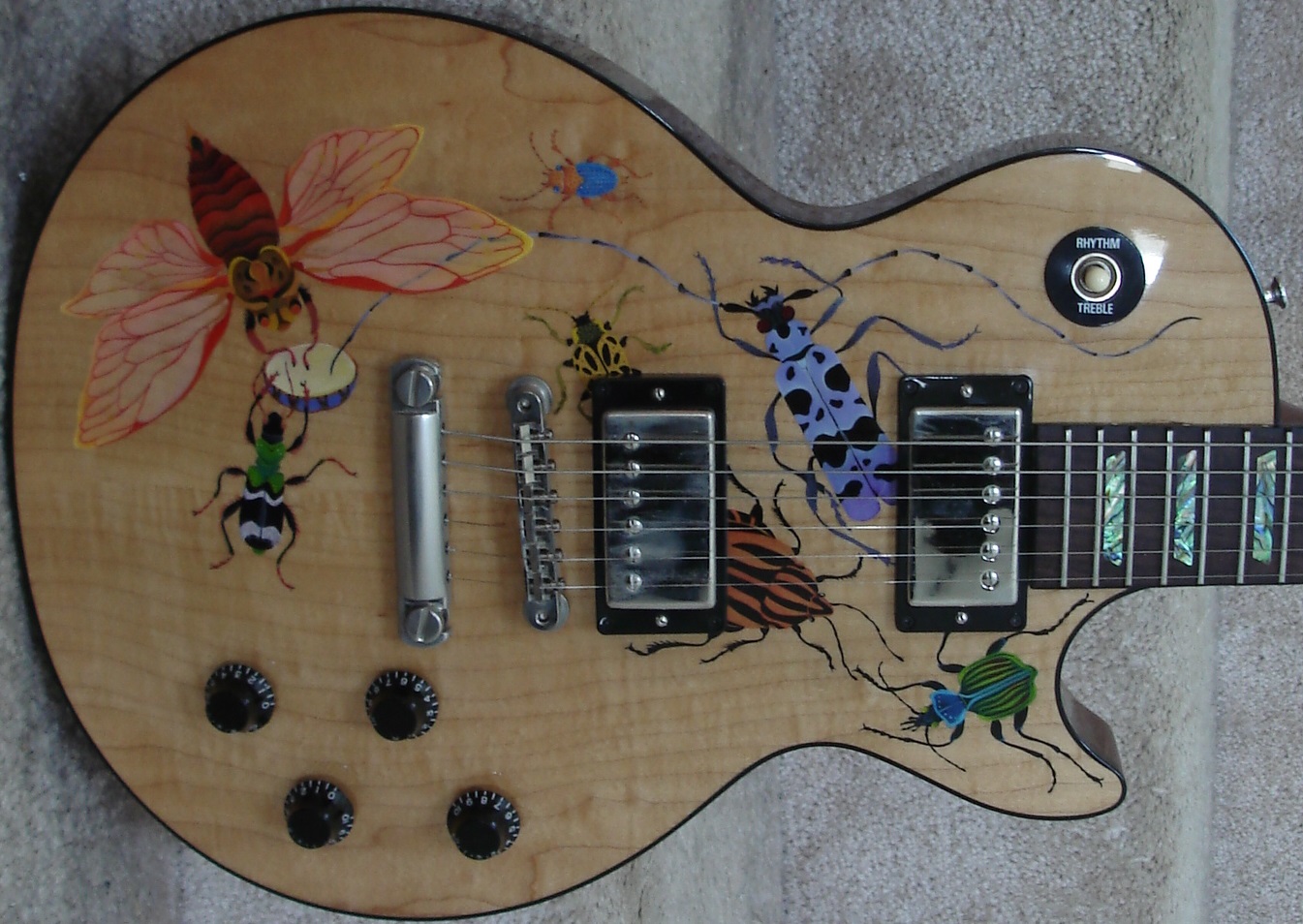
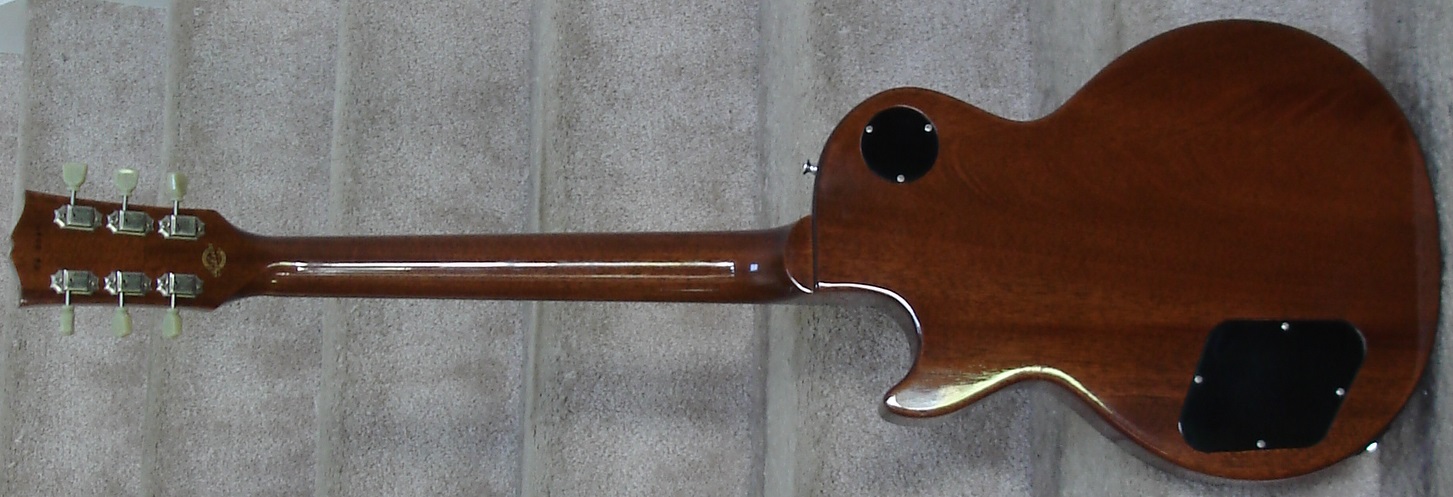
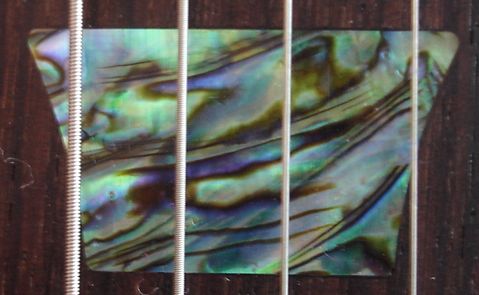
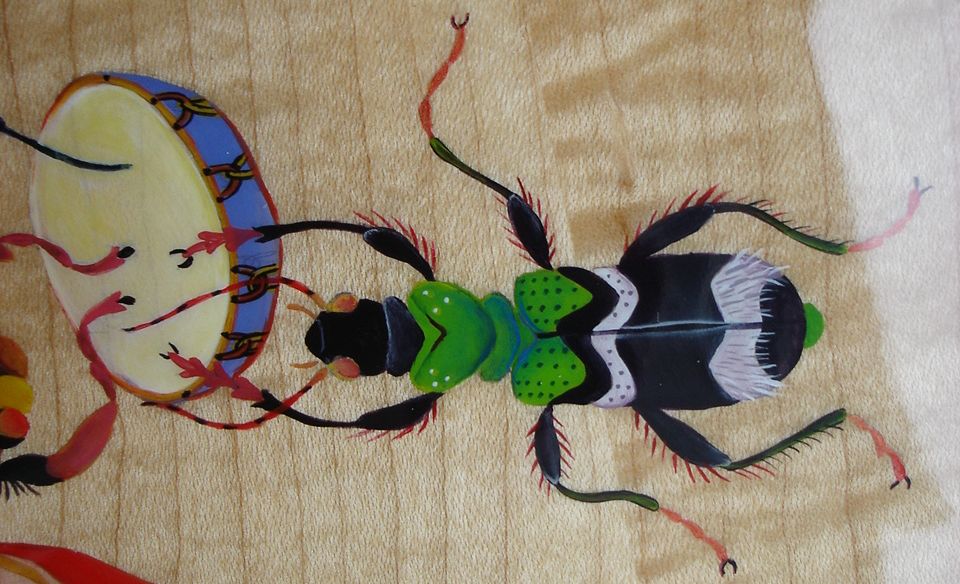
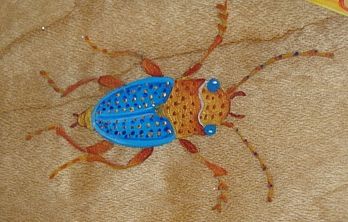
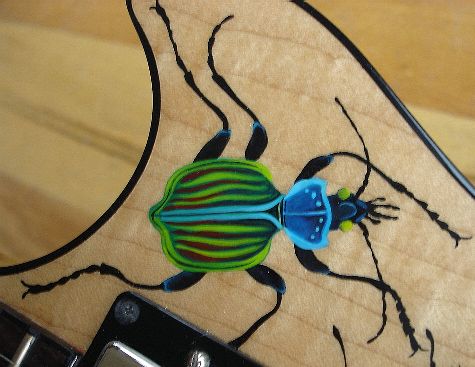
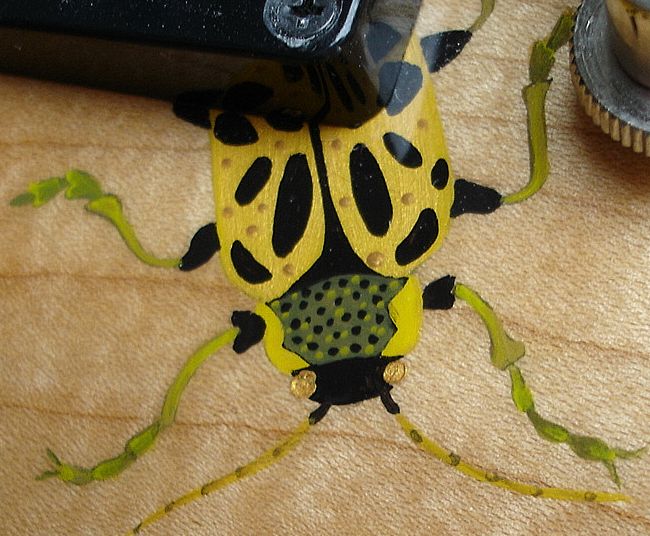
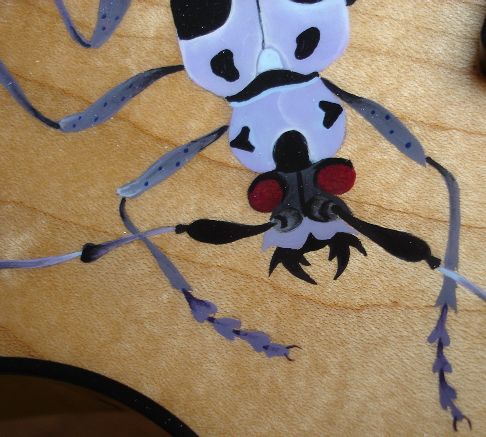
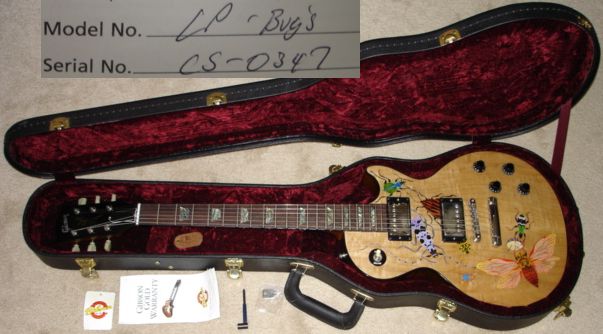
  15. Gibson Les Paul "Bugs", okay, here's a model you've never had a shot at - because it's the only one in existence.  Available only through Gibson's "Custom Direct" service, where your $500 membership gives you access to the rarest of the rare.  For this particular guitar, Gibson commissioned noted artist Carol Paulsen as part of their "Art of the Guitar II" to paint two "bug" guitars - this Les Paul and an ES-5 ( the ES-5 subsequently sustained a damaged neck, never retailed, and was blown out in a charity auction).  As much a work of art as it is a playable instrument, the "Bugs" features a Les Paul Standard with hand-painted bugs on the top, as well as the highest quality Abalone fretboard inlays.  It's hard to capture the the beauty and intricacy of her paining in great detail but here are some attempts:  pic3, pic4, pic5, pic6, pic7, pic8.  Includes original case and warranty card.  This guitar was collector owned, unplayed, and mint condition other than very sight tarnish on the edges of the pickups - we can replace the pickup covers if desired.  This guitar was obtained through an IRS auction where the original owner, with the finest collection imaginable, was forced to sell off dozens of highly-prized guitars, most of which remained unplayed.  Cost to the original owner on this guitar was $10,000.  There was not a list price, that was the actual selling price. Offered here, at my humble site, for just $7000.  One of these days I hope to contact Ms. Paulsen and, hopefully, offer it on her site as well.    


SG’S

  1. 1963 Gibson SG Junior (back),  (front1 front2),  (back1 back2), (headstock), (checking), (case).  Ah, the beauty of the Junior.  There's something wonderful about the simplicity of a single P90, with just a volume and tone, and wraparound tailpiece.  You only have one sound, but what a sound it is, and most of us tend to stick with our favorite tone 90% of the time.  I can't remember ever using the neck pickup on a Tele.   Equally simple is the single stud tailpiece, which is compensated for better intonation unlike the 50's studs which were a straight bar.  The wraparound is extremely comfortable and effective for string muting or playing staccato passages.  As they have since the 50's, the Junior (formerly Les Paul Junior with slab body) features all-mahogany construction which is a very warm, full tone that marries perfectly with the single-coil P90, which is a high output single coil, and is essentially the same guitar as the higher end SG Standard, including thickness, beveled edges, etc.  As you can see in the 2nd pic above, the body still has a strong cherry color, with the back of the neck being the only area that's faded to a brownish red.  This baby is 100% original including finish, electronics, and hardware.  There are no cracks or repairs.  Worst flaws are normal finish checking, some light finish rubs such as on the edge of the headstock, and some fine spots on the top which are visible only if viewed from the perfect angle, probably caused by using some spray cleaner and letting it soak in without polishing right away.  The pickguard has typical cracks at the 4 points, with only the treble point missing a small piece of plastic.  There are no stress cracks which are common around the jack and neck joint; electronics are all original with all factory solder.  The neck isn't the extremely chunky one found on some early 60's, nor a thin taper, it' very much a medium neck.  It's 1 11/16" at the nut, which for most players is more comfortable than the narrow 1 5/8".   Some players would make this their main guitar but for those of you who take an arsenal to a gig, this one can do your P90 tone beautifully.  Gbase price on a '63 Junior with no issues would be around $3800-$4500 but get this one that's reality priced.  Just $2700 for this baby.  Includes Gibson brown case that's missing the combo latch. 

  2. 1962 Gibson SG Special, (front), (headstock/neck/frets), (back), (controls), (finish checking), (cosmetic flaws), (headstock repair).  For the player who likes 48-year-old Specials but doesn't have $6K to spare, the best value is a headstock or heel repair.  If done correctly these are excellent utility guitars whose playability and tone are unaffected.  Many times you'll see repaired Gibsons which have been cannibalized of pickups, pots, bridges, knobs, etc. but this one hasn't been raped and features all original electronics with factory solder joints, original pickups, original nickel compensated bridge, and knobs.  The tuners were changed but that was done as a practical upgrade to a set of Grovers that stay in tune perfectly, rather than ancient Klusons.  This came in with a very solid repair, but the area hadn't been finished cosmetically.  Martin did a superb job of finishing the repair with the proper Gibson stain and multiple coats of nitro lacquer over the repaired area.  The result is a repair that most people would never spot unless they were looking for it.  I'm not real clear on why these were never called a "Les Paul Special", since other same-year models with the SG body shape were called "Les Paul Junior" or "Les Paul Custom" but the fact is these are correctly called SG and not LP/SG.  The Special was more than a 2-pickup Junior and had upscale features such as a bound neck and inlaid mother of pearl logo rather than a decal.  As you can see in the pics, the color is very strong, a very vibrant red rather than the faded cherry or almost walnut look that these guitars frequently develop.  Overall it's in very clean shape, other than some rubs around the edge shown in the pic above.  The body is checked front and back but not excessively.  Original frets are in great shape, fretboard doesn't have any deep gouges, and the action is low and very comfortable.  This guitar has a very thin neck, a tad thinner than, say, a '60 Classic or "thin taper".  Under a blacklight, the guitar has a strong glow other than the repaired area (shown here).  The tone of these P90's, combined with very well aged Mahogany, produces a warm, very fat tone, that's tailor made for rock music - Pete Townsend was one of the famous players of the Special back in the 60s - but anybody who likes the P90 tone will love this guitar.  No wood sounds like old wood.  If you're a working guitarist, or a collector who doesn't ignore value-priced classic guitars, this is one great Special.  At $2250 it's well under 50% of a comparable condition Special without a headstock fix and it undoubtedly plays and sounds at least as nice.  Included will be your choice of a recent model Gibson brown case or an aftermarket high quality black tolex case  

  3. 2009 Gibson SG Standard,  (front), (back), (headstock), (Custom Shop Case/Cert.).  Your basic classic SG, largely unchanged since 1961, when it was released as the "new" Les Paul style.  It has been in production continuously since that year which I believe makes it the longest running solid body model in Gibson history.   Apparently due to mix-up at the store I suspect, this one comes with a Custom Shop case and '09 Custom Shop SG certificate!  Features include all-mahogany construction finished in gloss Heritage Cherry lacquer, solid quarter-sawn mahogany neck, rosewood fretboard with 12" radius, trapezoid inlays, Corian nut, 1 11/16" nut width, bound fretboard, 22 medium jumbo frets, Gibson Deluxe tuners with Keystone buttons, holly headstock overlay with mother-of-pearl inlaid logo and crown inlays, black top hat knobs with silver inserts, Tuneomatic ABR-1 bridge and Gibson's most popular pickups, the 490R/498T Alnico humbuckers, which .  The SG Standard's remarkable sustain is due largely to two unique features:  the mortis & tenon neck joint which binds the neck to body so that the two pieces form one solid unit, employing the long tenon found on earlier SGs - plus the traditional 17 degree headstock angle, which increases pressure on the strings which maximizes string vibration between the nut and the tuners.  It features the neck profile of the mid-60's, not at all chunky as the 50's style, but nicely rounded.  Famous players of the SG Standard is a who's-who of rock music greats including Clapton during the "Cream" era, Tony Iommi and Angus Young both users for over 30 years, and Derek Trucks, who also uses extensive slide work in his playing.   This guitar is in showroom condition, as clean as anything hanging in your local super store and includes Gibson's top of the line case, with deep burgundy crushed velvet interior, and matching-year custom shop certificate, all for $1050(HOLD-Charlie D 1/20).  

  4. 2001 Gibson SG Special - Gloss Black, (front), (headstock), (back), (gigbag).   The SG Special provides the classic SG tone, but without the cosmetic features of a Standard, it's a better bargain.  It features an un-bound neck, dot inlays, screened logo, and uncovered pickups, but is otherwise the same guitar.  Its all mahogany construction with unmistakable beveled edges gives it that classic warm SG tone that has helped define the sound of rock, most notably with Angus Young.  The light weight, thin body, and deep cutaways make it one of the most comfortable guitars to play.  Pickups are 490R/490T Alnico humbuckers.  The neck is well rounded and on the chunky side, but not as chunky as a 50's style.  Don't confuse this with the faded series, which are good guitars in their own right, but this is the gloss finish model which sells new for a $1K.  For more info click here for Gibson's site.  A new Special in black or cherry is going to set you back $999 but this one's in excellent condition with a great set up for just $679 with the older & better Gibson wedge-shaped gigbag.

  5. 2003 Gibson Faded SG Special, (front), (back), (headstock/neck), (gigbag/etc.).   The Faded SG Special is a no-frills axe with the same woods, silhouette, electronics, and hardware as the higher end SG Standard, but with a satin finish, dot inlays, and unbound neck.  This one, in worn cherry finish looks like a well played old SG that has lost its luster from years of wear.  I think these are the best value in a USA Gibson SG and, arguably, it sounds better than an SG Standard at twice the price.  The thin satin finish allows the guitar to resonate better, for increased sustain and a more pure voice - plus it gives the guitar a cozy, broken in feel that most players will appreciate.  Finish aside, it's very much a traditional SG, with all solid mahogany construction including body and neck, tune-o-matic bridge/stopbar tailpiece, and Alnico 490R and 490T humbuckers, controlled by dual volume and tone controls with 3-way selector.  Neck profile is the 50's rounded style which is not overly chunky but not recommend for players who only like the flatter-back thin taper neck. Cosmetically there are some light finish impressions on the body, and this is a good thing, the back of the neck has been stripped of the sticky satin finish and now has the slick feel of natural wood.  If you've ever played one of these, you know what an improvement that is.  Lightweight and fun to play, these sell new discounted to $699 but this one plays killer, sounds great, and is a good buy for $499(HOLD-Robert N 1/29).  Includes original gigbag, inspection list, and manual.  

  6. 1997 Gibson SG Standard - Heritage Cherry, (front), (back), (headstock), (case).   Nice used condition, no issues, fantastic playing SG.  The SG silhouette is one of the most recognizable guitars of all time, from Pete Townsend in the 60's to Angus Young from the 70's until...forever, it is truly a rock and roll icon.  Starting in 1961, when it was the "new" Les Paul style, it has been in production continuously since that year which I believe makes it the longest running solid body model in Gibson history as well as the best selling Gibson.  Basic features have changed very little over the years - high gloss nitrocellulose lacquer finish, all Mahogany construction with featherweight thin body with sleek, sculpted edges, and deep cutaways to allow very easy access to the upper frets, and a very thin mahogany neck that's one of the fastest playing necks made, chrome hardware, Tuneomatic ABR-1 bridge and 490R/498T Alnico humbuckers.  Cosmetically it features Gibson's higher end appointments including antique cream neck binding with acrylic trapezoid inlays, holly headstock veneer with mother of pearl logo and "crest" (aka "flower pot").  All original except for Dunlop strap lock pins.  This guitar hasn't spent its life in the case and there is average player's wear  (as shown here):  some buckle rash in the clear coat only, minor dings in the clear coat, a few finish touch-ups to the top of the headstock with a proper Gibson touch-up pen, and the bottom of the truss rod cover has a minor chip.  On the plus side, no breaks or repairs, no cosmetic flaws down to the wood, frets are in excellent shape (shown here), and it has the killer set up these guitars are noted for.  Even more importantly, the 90's were an excellent era for Gibson, producing some of the best guitars from the prior 20 years.  I would take this over a recent model any time.  For full specs on the SG Standard, as well as audio and video clips, click here for Gibson's Site.  Gibson dropped the street price on this model over $200 around year ago, now heavily discounted at $1199.  If you're a player who doesn't need a museum piece to make music, this is an even better deal at $799(HOLD-Carlos 5/24).  Includes original brown case with the locking latch missing but otherwise totally serviceable.  

  7. 2003 Gibson SG Special Limited Edition, (front), (headstock), (back), (gigbag).    Very unique SG - Limited Edition Platinum with all chrome/platinum parts (pic here) including body, plastic, and hardware.  All mahogany construction gives it that classic warm SG tone that has helped define the sound of rock, most notably with Angus Young.  This model also features an Ebony fretboard, usually reserved for higher-end models, which gives it a little more snap on the attack than rosewood.  Pickups are 490R/498T Alnico II humbuckers.  You Fallout Boy fans might remember front man and guitarist Patrick Stump playing this model when they were becoming huge, before his jump to Gretsch.  If you like low action - you'll love this guitar.  It's got a great neck which allowed us to set the action very low.  The neck's a tad on the chunky side, much closer to a 50's rounded neck than a 60's thin taper.   Don't confuse this with the faded series.  This is the gloss finish model and it sold in stores for $1049 during its last year of production 6 years ago.  This one is pretty much immaculate - no scratches, dings, or fret wear, an easy 9.8 - and wouldn't look out of place hanging with brand new guitars in your local store.  A new Special in black or cherry is going to set you back $999 but for $200 less you can have this beautiful and rare Ltd Ed Platinum model.  $799  includes original gigbag.

  8. 2007 Gibson '61 Les Paul/ SG Standard VOS - White, (front/back), (headstock), (case/acc.).   I've said it before but...I love these VOS models.  They're not only built to the exact spec's of the original model but they also have the patina of a 45-year-old guitar and aged hardware.  You get the feeling that you're playing a an actual vintage instrument rather than a shiny new guitar that obvious just rolled off the assembly line.  1961 was a pivotal year for the Les Paul.  Gone was the single cutaway model that had been around since the early 50's - and which was less than an overwhelming success - replaced by the new all-mahogany double-cut body with beveled edges, which eventually was renamed the "SG" for Spanish Guitar.   Everything was different about this "new" model Les Paul and for the player, access to the upper frets was markedly improved which along with the new lightweight design, made this guitar a joy to play.  Unlike the original Les Paul model, which disappeared from '61 to '67, the SG design has stayed in the Gibson line for 48 straight years.  Spec's of this model include Mahogany body, Set one-piece mahogany neck with long tenon, 22-fret rosewood fretboard, Burstbucker 1 & 2 humbucking pickups, Stop bar tailpiece with tuneomatic bridge, 24-3/4" scale length, and wide 1-11/16" nut width.  The only flaw on this guitar is a small red mark on the back of the neck (shown here) which was a reaction from the Nitro finish and a rubberized guitar stand.  This model, properly called a "Les Paul"  is still being made, although it's lost the "Les Paul" name and called merely "Gibson Custom SG Standard Reissue VOS", (shown here) which sells for $3399 ($4774 list).  For $1000 less, you can have this wonderful guitar, in unplayed condition with plastic still on the pickguard and not a hint of use.  $2399. 

  9. 2008 Gibson SG Diablo, (front/back), (German carve - detail), (headstock), (case).  Never retailed - unplayed condition and ships in original box.   One of 1000 made for Gibson's "Guitar of the Month" series (Jan '08).  Upon quick inspection looks like a '62 SG in a custom color (Metallic Silver), but up close you can see the very unique body cut that makes this truly a unique SG.  Both the top and back have a German carve, rather than the slab top of a standard SG.  This technique provides an attractive 3D effect to the guitar, while reducing weight and making it more comfortable to play.  A few other changes you'll notice include a matching headstock, a simple 2-knob layout with the volume knob being closer to allow volume swells with your pinky finger, and most importantly, a 24-fret neck rather than the usual 22 frets.  Features include: Burstbucker Pro 1 (neck) and Pro 2 (bridge) humbuckers, hand-carved mahogany body, mahogany neck with rounded profile, 1.687" fret width, 12" fretboard radius, Nashville bridge, Grover tuners, chrome hardware, and Grover tuners. Lastly, this model features a nitrocellulose finish, which is an expensive process due to the hand work required and the very long drying time between coats. Nitro is a very thin finish and one which Gibson has been employing since the 1800's. It allows the guitar to resonate more freely than a thick poly finish, which is one of the reasons that old Gibsons sound so good.  Likewise, the paint on this guitar is very thin, and you can easily see the mahogany grain.  My personal opinion of this model - some of the best sounding SG's that I've played with the fatness you want from a dual humbucker guitar, while retaining excellent not clarity and plenty of top end.  The last time I recall Gibson doing monthly limited editions was the Showcase Editions in 1988 (link here).  These guitars have proven to be very good investment pieces, fetching 50% or more over comparable regular production models from the same year.  Click here for a bizarre demo from GearWire.  The Diablo listed at $3249, selling at discount for $2119.  If you missed one of these during their run in '08, here another chance to get one, out of the box only for our setup and otherwise untouched, for 50% off list, just $1699.  (I may be out of these but feel free to inquire.  Hold one for Michael H 12/16)


GIBSON OR USA EPI SEMI-HOLLOW & ARCHTOPS:  

  1. 2003 Gibson ES-135 w/Classic '57's, (front/back), (headstock), (case).  Recently discontinued but the 135 was always a hot seller for me during it's 10+ year run as the most affordable Gibson semi-hollow in their catalog  This one is somewhat rare, starting with a very cool "Blues Burst" finish, but also lacking the F-holes found on most of these and a stock non-pickguard model.  Although the tone is very similar to the F-hole model, this solidbody (although semi-hollow inside)  is more resistant to feedback and has a very rich tone with the stock Classic '57 pickups.  Features include 16" laminated maple/poplar/maple body with satin finish, Mahogany center block, 1959 rounded maple neck with rosewood fretboard, bound body, Grover keystone tuners, and chrome hardware.  I've had this exact same model with a "Limited Edition" stamp on the back of the headstock but, inexplicably, this guitar doesn't sport the Ltd Ed seal.  Overall excellent condition with the only modification being the strap pin on the upper bout was moved 3/4" to a stronger spot, but the original hole has been finished over and barely noticeable.  All in all, this guitar is an excellent value in a Gibson archtop for $939(SOLD-Candy 9/20).  It plays extremely nice and would be an excellent choice for stage use where higher gain settings and feedback would be a concern.  Includes original Gibson case in clean shape except for combo lock latch doesn't work.  

  2. 1999 Gibson ES-135 Limited Edition, (front), (headstock), (back/side), (case).  First one of these I've had in the Limited Edition "Blonde" finish with gold hardware, trapeze tailpiece, '57 Classic humbuckers, and Grover tuners.  The stock model for this year had P100 pickups and Gibson Deluxe tuners with chrome hardware.  Throughout the run of the 135 it came in a number of iterations, most of which were outfitted with P100 soapbar pickups while other differences included tailpiece (trapeze, Bigsby, or Tuneomatic/Stopbar), pickups (P100, P90, and PAF), full back/back with control plate, F-holes or no F-holes, and center block (Chromyte and Balsa).  This particular model features the best of all features in my opinion, and is closest to the 60's ES-125TDC which it is generally patterned after, although the 135 has a slightly thicker body and is a semi-hollow while the 125TDC is a full hollowbody.  It has the same Florentine cutaway, white body binding, screened logo, and dot inlays.  The later models with the control plate on back, solid top (i.e. no f-holes), and Balsa wood center block was an attempt to keep the cost down on a guitar that wasn't exactly flying off the shelves.  This model, however, is a stellar semi-hollow and stands up against the old ES-125TDC's that I've had.  It plays wonderfully, sounds rich, and is resistant to feedback.  Cosmetically the guitar is in stunning condition overall, with jut some very slight gold wear and two very small finish chips on the headstock.  In my opinion, it's much closer to a "real" Gibson than any of the others and an excellent value at $1299.  Includes similarly clean Gibson brown case.  

  3. 1995 Gibson Chet Atkins Tennessean, (front/back), (headstock), (side), (case).  One of my favorite Gibson thinlines of all time, first introduced in 1990 and, inexplicably, discontinued around 5 years ago along with the entire Chet Atkins line.  While the Chet Country Gent had a larger body and was overall a fancier guitar, the Tennessean feels more comfortable to me and is more suitable for nearly any style of music.  With it's 16 1/4" body that's just 1 5/8" deep, it's nearly identical to the ES-335 in size but it's longer (25.5") Fender scale will appeal to many players who aren't fans of the shorter (24.75") Gibson scale.  In addition, it's 1 3/4" nut should appeal to players with big hands or those who prefer a wider spacing. Overall this guitar is in nice shape for a used guitar, top has some light scratches, most of which will buff out, back has some buckle scratches in the clearcoat only, and the tip of pickguard has a repaired crack (shown here) - no major issues such as scratches through the clear coat or wood cracks.  Features include single rounded cutaway body with binding front and back, dual humbuckers, stopbar tailpiece with Tuneomatic bridge, laminated maple top/back/sides, ebony fretboard with offset dot inlays, plastic arm rest, inlaid headstock logo with screened Chet signature, black pickguard with model name, master volume on treble upper bout, dual volume with master tone, 3-way pickup selector, and Gibson Deluxe tuners with plastic tulip buttons.  Finished in "Country Gentleman Brown", which is a transparent finish over a nicely figured maple body.  Due to the dark stain the figured maple isn't terribly pronounced except in direct lighting or daylight.  It's always been my opinion that the 90's were an excellent era for Gibson as they weren't forced to churn out the kind of numbers that followed in recent years.  I can't remember ever having one with major set up issues but, regardless, this one is set up very well and has a very rich, clear tone.  Priced at $1399(HOLD-Chris D 11/16) with original brown case with pink shroud. 

 GIBSON ACOUSTICS:

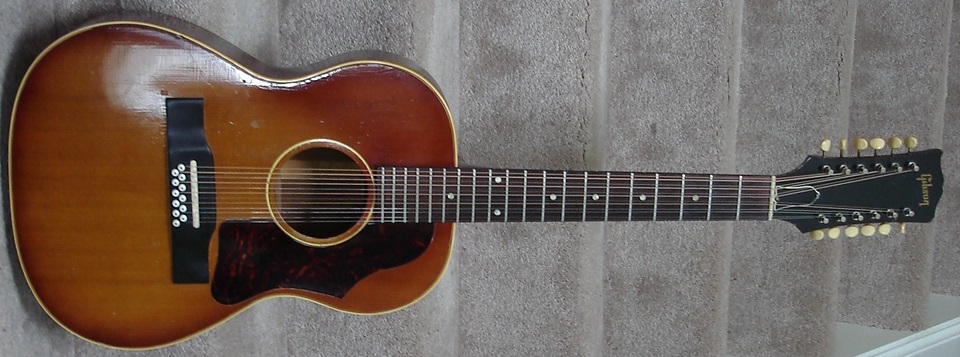
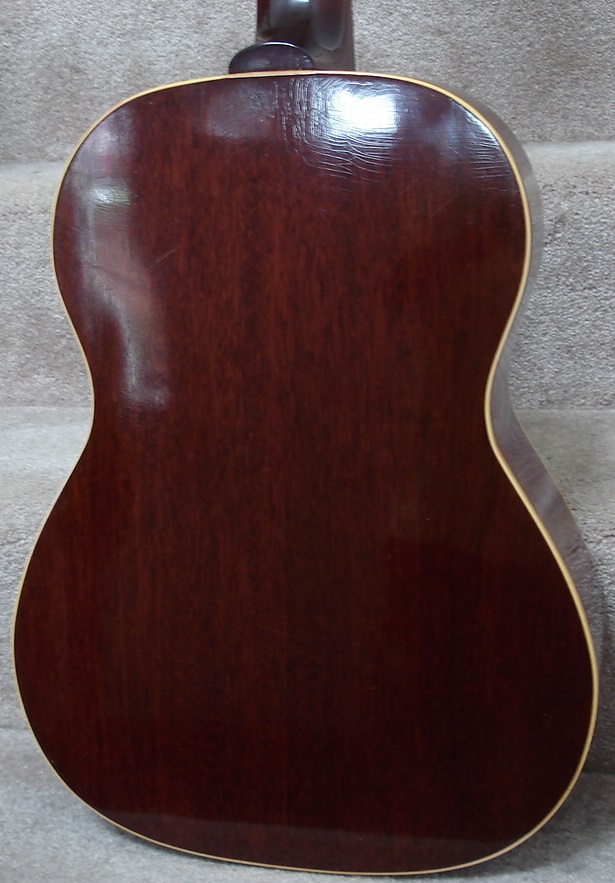
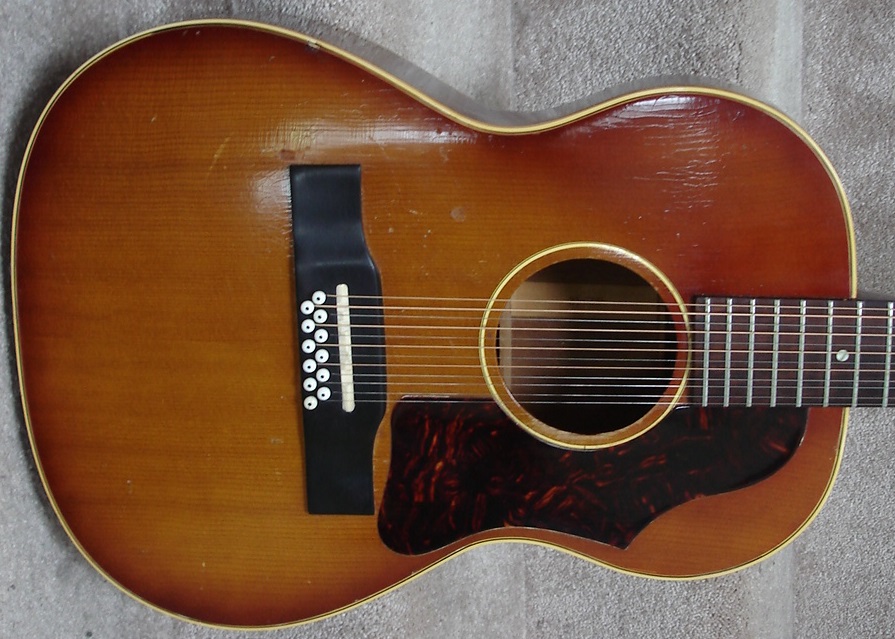
  1. 1963 Gibson B25-12,  (front), (back/sides), (headstock), (finish checking).  Made during the early part of the folk boom in the 60's, the B-25-12 is appointed like a budget model with dot inlays and no ornamentation on the headstock, and unbound neck, although it does have a double-bound body.  This is a nice old 00-size small bodied (14 1/2" lower bout) Gibson flattop, with a solid Spruce top, solid mahogany back, and laminated sides.  Other features include multi-ply binding on top, bound back, ebony bridge, long tortoise pickguard, 2" nut width, 24 3/4" scale, and Kluson strip tuners. This one has seen an average amount of playing time I would guess, but was taken care of by any previous owners.  The only glaring flaw is a small chip out of the front corner of the headstock (shown here).  It does indeed look like a 47-year-old guitar with plenty of finish checking and a slightly dull finish which we can buff out at no cost - but no cracks or repairs.  The tone is just what you'd expect from a small Mahogany body - very warm tone with plenty of mid-range - but surprisingly crisp and bright.  Its a fun guitar to play, especially comfortable when sitting around the living room and like an old parlor guitar, doesn't look out of place with the decor.  Later in the 60's Gibson went to a small bridge with a trapeze tailpiece but this is the more desirable model with standard bridge with acoustic string pins.  The only non-original aspect of this guitar is a replacement bridge, but it's the proper belly bridge - plus a compensated saddle replaces the wooden one.  Most of the bridges from this era look identical, but have adjustment screws for the saddle height, plus 2 pearloid plugs that cover the hold-down screws that Gibson used on their bridges (I've never figured out why Gibson couldn't glue down their bridges properly without the use of these screws.)  Since most players accused he adjustable bridge in this era as being a "tone robber", it wasn't uncommon for players to do away with this feature.  Bottom line though, is this guitar is loud with good sustain, and that may be in part due to the removal of the adjustable saddle.  This guitar has a good neck angle and a straight neck so the set up is very comfortable for a 12-string, even with barre chords.  This is a great example of affordable vintage, priced way under what a reissue would sell for, should they ever make one.  It's guaranteed to go up as the years pass but unlike a stock or CD, it's something you can enjoy.  Gbase prices for 60's B-25-12's, even the trapeze models, are running $2K-$2900.  This one might  be a little more played than the high-priced models, but I think at $1099, it's a steal for an early 60's Gibson acoustic that plays and sounds well.  Includes aftermarket hardshell case.  
  2. 2008 Gibson J-45 Ltd. Ed. Master Archetype - African Zebrawood, (back/inside), (headstock), (case/etc.), (cert.), (label).  Another fine creation by Gibson's Master Builder Ren Ferguson and one of only twelve built with this beautiful African Zebrawood sides and back.  Rather than type in a very long description, here are some descriptive links of this model:  link1, link2, link3.  I've had dozens of J-45's over the years, plus a few 50's SJ's, and this one stands as the finest I've had thus far.  As you would expect, it's not your average sounding J-45.  It has a quick transient response, much like maple, but is much warmer sounding.  It has great snap and a bell-like tone that make it a good choice for fingerstyle players or strumming.  It holds up well under hard strumming and is equally at home in a bluegrass acoustic jam or an auditorium.  Ren has done other runs, at least one in Macasser Ebony, and I've personally had two of his acoustics before.  They have all been fine guitars.  Collector owned since new, it appears to have been unplayed since new and has a very comfortable setup, with plenty of saddle and a perfect neck set.  List price was $5799, which is reasonable for this model.  A stock J-45 is running $2399 but for just a bit more you can own this truly fine instrument. $2899 takes it home.  Includes a super nice case that is arched on top and bottom (pic).  
  3. 2004 Gibson Hound Dog 60 Square Neck Dobro - with pickup, (front/back), (headstock/serial), (sides), (case).  Don't confuse with the newer import line - this is the real deal USA model made in Nashville, and while it's understandably not as cheap as the import, it's the best bang for the buck to ever come from Gibson or Dobro.  Being a square neck, this guitar is made strictly for slide play, and nothing sounds like a good old spider cone played slide style.  A cousin to Gibson's Model 60 D Classic Dobro, the Hound Dog, aka Model 60 S, features a square neck with 12 frets clear of the body and a high nut for slide-style playing as well as two sound holes to enhance clarity and projection.  The body is made of nicely figured laminated Maple, with the original style spider bridge and 10 1/2 in. resonator.  Other features include hand-rubbed vintage brown finish, black binding on top and back, slotted headstock, fan cover plate, Spider resonator, nickel plated hardware, and Fishman resonator pickup with end-pin output jack.  For specs, pics, and press release, click here for Gibson's site.  This is an very good sounding resonator guitar for the money and is in very near mint 9.8 condition with no player's wear whatsoever.  Recently discontinued but sold originally at Zzounds for $1377 with *gigbag* but this one's $500 less AND includes a quality *Dobro case*.  $877 for this one. 


OTHER USA GIBSONS: MELODY MAKERS, NIGHTHAWKS, FIRBIRDS, EXPLORERS, V’S, ETC.:  

  1. 1983 Gibson Spirit I,  (front), (back), (headstock), (neck tenon/pickup/color), (finish checking), (case).  Looking for super low action, with the vibe of a Les Paul Junior?  The Spirit I is a very cool model that had a brief run of just a few years, ca. '82-'85.  The Spirit came in a I and II, with the II having dual pickups, plus a Spirit XPL, which was a different animal altogether.  The Spirit I is nearly identical to the '60 Les Paul Junior (comparison pic), except with a humbucker instead of P90, joins the body at the 20th fret instead of 22nd, and an adjustable tailpiece instead of the compensated wraparound tailpiece.  The Schaller 455 tailpiece has six intonatable brass and employ the same large studs without a separate tailpiece, factors which I feel are tone enhancements.  Also, instead of all mahogany, this model uses a poplar body, which is a perfect compromise between warmth and brightness.  Okay, it's not identical to a Junior but it's definitely the same vibe.  As shown in the 4th picture above, this model has a long and thick neck tenon, since it doesn't have to be cut around a neck pickup route, which gives the guitar great stability and transfer of energy.  You can also see in the pic the original silver color under the pickguard area, which was silver, while the rest of the finish has faded to a green.  Also shown in the pic is the original patent-engraved humbucker, which is a medium output, excellent sounding pickup.  Cosmetically, the finish has check lines on the body, neck, and headstock, but definitely no cracks or repairs and the worst flaw being a few finish chips on the top edge of the headstock.  All original except for Schaller strap pins and tuners were replaced with a relic-looking set of Gibson Deluxe with oval buttons, for that Junior appearance.  They have the exact same footprint as the originals, which had keystone plastic buttons.  For fans of low action, it rarely gets better than this.  Frets have had a dressing so they're in great shape and with a perfectly straight neck, this guitar has low action from the nut to the top fret.  The neck profile is very shallow, at least as thin as a 60's thin taper and perhaps even thinner.  If you're looking for a great relic vibe, the cool simplicity of a Junior with the fat tone of a humbucker, this one plays fantastic, sounds great, and is an excellent value in a 28-year-old Gibson at $850.  Includes hardshell case and matching strap.  
  2. 1988 Gibson Chet Atkins SST, (front/back), (headstock/saddle), (controls), (case).  2nd year model and getting harder to find.  The SST was one of the first solidbody acoustic models, designed especially for stage use, i.e. to allow for higher volume before feedback.  First introduced as a nylon string model (Chet Atkins CE or CEC) in 1981, the steel string SST joined the line in 1987, gaining instant popularity among pro players such as Dave Matthews who played a black SST as his main stage guitar from '92 to '99.  The SST was a simple but very well designed guitar.  It features a solid Spruce top, Mahogany back with Chromyte (as used on ES-335's) reinforcement, Ebony bridge, and Mahogany slim-taper neck with Ebony fretboard.  Cosmetic appointments include inlaid logo and star inlay, star fretboard markers, bridge with star inlays and Ebony pins with pearloid dots, multi-ply body binding, and gold hardware.  Electronics are simple and are located, unobtrusively, on the side of the bass upper bout and include volume, bass, and treble.  Again, this model is very resistant to feedback and these simple controls seem to handle it well.  This guitar features a very wide neck (around 2" at the nut), long 25.5" scale (3/4" longer than normal Gibson scale), medium jumbo frets, and up to 24 frets (on the 1st/2nd strings).  For all the spec's on this model check out Gibson's site here.  As far as cosmetics, there are areas of lacquer crack along the bottom of the fretboard an in the side dots (shown here), which is strictly a cosmetic flaw.  There is one structural flaw, although it's really a non issue - this guitar has 4 top cracks in the spruce top.  The good news is the spruce is just a veneer that's glued to a solid mahogany body which is completely intact so it's really not a concern and has no effect on the performance.   Frets are near perfect and other than the spruce cracks, it shows very little player's wear and is otherwise a very clean guitar.   After a long run of 19 years, the SST was discontinued in '06 and considering the popularity of this guitar they will likely become harder to find as the years go by.   If you're looking for an excellent stage guitar, there are few better in terms of comfort, tone, and playability than the SST and at $999(HOLD-Eddie CA 10/3), it's truly a pro model for a modest price.  Includes original brown case in nice shape and Dunlop strap locks and pins (pic) are included.  
  3. 2001 Gibson Explorer, (Front/Back), (headstock),  (case).   AKA '67 Reissue finished in a attractive Heritage Cherry.  Just like the black one I posted recently, this this Explorer is as new - dead mint condition.  The Explorer became a true classic from Gibson...eventually. It was one of the failed futuristic guitars that Gibson unveiled in the late 50's, which were discontinued until the timing was right, and they started reissuing them around ca. '67.  Like the Flying V, and ill-fated Moderne, the Explorer features set-neck construction, with a mahogany neck set in to a mahogany body, with dual humbuckers (496-R and 500-T) and unbound body and neck.  It has an exaggerated "Z" shaped body, the original "hockey stick" headstock with 6/line Grover tuners, vol-vol-tone knobs in line, with a 3-way selector on the upper treble bout.  A cool guitar for the Metallica/Skynard/etc. fan, or anybody who wants to delve into one of the original metal axes, designed 30 years before metal was even invented.  For players who do a lot of lead work on the low strings in the upper register, no guitar provides easier access.  Set up with low action with a fat, warm tone that will fit any type of music.  With a new black Explorer running $1399 ($2399 list), here's one in unplayed condition for $1050.  Includes original Gibson brown case in similarly mint condition. 
  4. 1974 Gibson Marauder, (front/back), (headstock), (pickups pickups/pots), (case).   Excellent example of affordable vintage.  For players who don't want to pony up a few grand for a Junior or Special, these guitars have all the quality at less than 1/2 the price.  Marauders are excellent  utility guitars, with quality tone, a good variety of tones, excellent playability. and a cool vibe.  The Marauder was one of Gibson's attempts to steal some of Fender's market, just as Fender was trying to grab some of Gibsons.  The body shape is similar to a Les Paul, but the Marauder, along with the single coil bridge pickup, sports a very un-Gibson bolt-on neck.  While the Marauder series ran from around '74 to '79, a fancier Custom (bound neck and rosewood fretboard with block inlays ) was only produced in '75 and '76.  Pickups were custom built by Bill Lawrence and sealed in clear epoxy, a feature which was considered ahead of its time, and these pickups are highly prized for their excellent tone.  The neck pickup on this guitar is a replacement - an old DiMarzio PAF.  Pickup layout is like a Tele Custom, with a humbucker in the neck position and a slanted single-coil, solid-blade style in the bridge position. This layout along with the overall construction, gives this guitar a tone and feel that's very similar to a Tele.  Pickup selector on these early models was a simple 3-way switch, which was later changed to a continuously variable rotary switch around '76.   It also sports a Schaller "wide travel" tuneomatic bridge, black dot inlays including 1st fret inlay, black screened logo, 3/side tuners on a Flying V style headstock.  Original tuners on this era Gibson aren't the best and tuners are a common mod.  This one has a very old set of Patent Applied For Grovers.  There have been a few notable players of the Marauder, past and present, including Paul Stanley of Kiss (shown in this ad), as well as Thurston Moore of Sonic Youth, Joshua Homme of Queens of the Stone Age, Deryck Whibley of Sum 41, and others.  Dating Gibsons can be somewhat futile.  300,000 series serials can be '74-'75.  The serial number of this guitar is 399010 and the pots are from early (12th week) of '74. The body stamp appears to be 1974 (pic of neck butt and cavity).  Bottom line is I think it's a '75 due to the fact that the finish of this one is "Natural Satin," which began in 1975.  Only one Marauder was shipped in 1974, and it happened to be a Natural, but in a gloss finish.  For more info, click here for some good Gibson archive stuff.  Cosmetically this guitar is in average condition for its age with typical buckle wear and scratches, but nothing horrible like wood chips or cracks.  The frets have had a recent dressing and the set up is very comfortable with low action and no fretting out.  I don't know if they'll ever go crazy on the vintage market but that's almost a moot point.  It's a good value in strictly the utility value of a nice sounding, nice playing American guitar.  I'm offering it with the Gibson Faultless case (pictured above) which is identical to a Les Paul Model case from this era for $799 - or with an old generic hardshell case at $699(HOLD-David B, local).   
  5. 2008 Gibson Shred V Flying V, (front/back), (headstock), (Kahler), (Case/Acc.).  Gibson's Guitar of the Month (GOTM) for August '08.  Never retailed and offered in mint condition.  Last year Gibson offered a unique collection of monthly limited editions, with production limited to just 1000/each, an idea that was previously used with their Showcase Editions (link here) in 1988.  Clean examples of Showcases go for significantly higher than their regular production counterparts and these guitars should also prove to be good investment pieces.  The original Flying V, first released in 1958, wasn't well received by the public and production was discontinued within a year.  It was later resurrected in 1967 where it has stayed in production since that time, eventually finding its niche as one of the premier rock/metal axes.  With this in mind, Gibson has created the definitive metal V with the Shred V, with features such as a pair of EMG 85 pickups, perfect for aggressive hard rock and metal, and a Kahler 2215K tremolo to withstand aggressive playing and dive bombs tricks.  In place of a locking nut, Gibson opted for Grover locking tuners, which keep the guitar in tune nicely, without the hassle of locking the strings down.  Other features include all-mahogany construction, black chrome hardware, Ebony finish that enhances the futuristic vibe - and metal look, one-piece mahogany with '50s rounded contour, Ebony fingerboard with black acrylic dot inlays unique only to the Shred-V, wide 1 11/16" nut, flat 12" fretboard radius, master volume and tone, and standard 3-way pickup selector.  The Shred V carried a list price of $3499, selling at discount for $2299.  This one is better than new, totally untouched except for a killer setup by Martin, inevitably better than factory, and nicely priced at just $1899.  For full specs click here for Gibson's site. Trades on Fender Custom Shop and PRS are desired.  
  6. 1984 Gibson Designer Series Explorer, (front/back), (headstock), (bridge), (case), (1984 Flyer).   Speaking of rare custom finishes, check out this beauty.  I've had a few of the Designer Series before but this is the first of the black&gold Explorers that I've seen.  The thought that immediately strikes you is, "that's one elegant looking Explorer."  Pics don't do it justice but the overall look is very striking, especially with the gold hardware in such clean shape.  Gibson called this graphic a "Style 20" as shown in the flyer above, offered as were all custom finishes, at an upcharge over standard finishes.  Specs are the same as Gibson's standard Explorer with the exception of the finish - plus this one was built with optional factory locking tremolo system which works very well.  This guitar is extremely clean and appears to lived in the case much of it's 24-year life, easily a 9+ condition.  Even the gold hardware retains most of it's plating with little to no gold-wear or pitting.  Set-up is spectacular and it has the fat tone you'd expect on a dual humbucker mahogany Gibson.  Custom finishes have always proven to be good investments.  What may have been only 5-10% upcharge at the time of original sale can translate to 200% or more as evidenced by a Fiesta Red Strat vs. a Sunburst - or in the Gibson line, a Golden Mist Poly over a sunburst.  For a guitar in this condition, rarity, and just plain coolness, this is a super buy at $1799.  

 EPIPHONES

  1. 2006 Epiphone SG Standard G-400 With EMG's and Gigbag, (front/back), (headstock), (gigbag).  New and first quality in Classic Alpine White Finish!  New upscale Ltd. Ed. model from Epi, using the increasingly poplar Zakk Wylde setup of active EMG's with an 81/85 combination.  Features include solid mahogany body with set-in mahogany neck, Grover tuners, slim-taper neck has a rosewood fretboard with pearloid trapezoid inlays, with a deep double-cutaway allowing easy access to the upper frets.  Don't judge this guitar by one you may have played in a store.  With a proper set up, they play with ease and the fret ends are perfectly dressed.   With a list of $999, these are a very good value in a set-neck guitar with the EMG 81/85 setup at just $499.  Includes, manual, cable, poster, etc., plus a very well padded Levy's EM7P gigbag with ¾" foam padding and headliner lining, accessory pocket and twin shoulder straps. 
  2. 2009 Epiphone Les Paul Standard Plus, (front), (back), (headstock).  Excellent value in a gloss finish Les Paul with a figured finish.  All the vibe and playability of a Gibson flame top Paul at around 1/5 the price.  I've also noted the quality control on Epi's is as good or better than their more expensive USA counterparts.  Frets are well dressed and with few exceptions they set up perfectly.  This one has low action and notes ring true during bends.  A pair of Alnico Classic humbuckers give you the fat, warm tones you want in a Paul.  The mahogany body with carved top and flame maple veneer gives you remarkable warmth - and great looks with a perfectly bookmatched top.  The slim-tapered neck profile is the choice of most players and is very easy to get around on.  A new Standard Plus is running $549.  This one is "as new" with the plastic still on the pickguard and no player's wear anywhere, and a sweet deal at $399.  Add the new "tuxedo" model Gibson gigbag (black with white trim and white interior) for $25 if desired (pic here).  
  3. 1998 Epiphone Casino, (front), (back/side), (headstock), (case) (Casino poster).  A great guitar for both the player or Beatles fan, and a quality Korean made model.  This guitar has the features of John Lennon's "Revolution" Casino, which was originally sunburst before John stripped it to its natural finish (as shown here).  George and Paul both played Casino's, although with Bigsby's, at various times.  As you may know, Epi's archtops paralleled Gibsons during the 60's and the Casino was Epi's version of the Gibson ES-330.  Features include an all-maple laminated body, fully hollowbody (no center block) thinline, which give it improved acoustic properties compared to an ES-335 Dot with a center block in the body, although more prone to feedback using higher gain settings.  Other features include excellent sounding Alnico P-90-pickups; mahogany neck, bound rosewood fretboard with parallelogram inlays; layered pickguard with "e" emblem; top binding; and chrome hardware.  Like the Supernova above, this one was made in Korea, in the Peerless factory.  Fit and finish are top notch and it's an excellent guitar in all regards.  The Casino is in excellent condition with a great set up and would make a fairly inexpensive addition to your Beatles gear collection, or a nice gigging hollowbody.   If you've tried the new Casinos and weren't very impressed, I'm fairly sure this beautiful '98 Korean model will do it for you.  $599(HOLD-Curtis R 10/18) includes a nice Epi case, tags, and a full-size poster with the Casino on one side and Epi's entire archtop lineup on the reverse. 
  4. Epiphone AJ-200SR Solid Top Acoustic, (front/back), (headstock), (neck).  NOS, unplayed, and perfect.  Perhaps the best value we've had in a solid spruce top acoustic.  The AJ-200S features Gibson's classic Advance Jumbo body size, more of a dreadnought shape than a standard jumbo like the J-200.  We have several of these and, as is normal, they came with "average' factory setups.  With some detailed nut work, properly adjusted saddle, and truss rod adjustment, they set up much nicer than factory specs, which inherently are set to allow the maximum guitars to pass through final inspection.  As I've said many times, there's no reason an inexpensive guitar has to play badly, it just comes down to some fine tuning by a skilled luthier.  Current specs call for mahogany sides and back but I bought these NOS 2006 models because, in addition to the solid Spruce top, these still had the rosewood sides and back, which provide a much richer tone and is generally a more expensive wood - and gold Grover tuners.  I played one of the '08 models with mahogany body and chrome tuners and it just didn't compare in terms of tone, or looks.  We don't have a super blow-out price on these but at $198 ($332 List) you're getting a guitar that's properly set-up and, I feel, a nicer model than current production.   Includes manual, poster, truss wrench, etc.  (several in stock as of Feb 2010)
  5. Epiphone Hummingbird, (full length), I have several of these earlier Korean-made Hummingbirds in stock which supposedly had cosmetic flaws but appear flawless now.  Features solid spruce top and mahogany back/sides, basically the mahogany equivalent of the Epi Doves on my acoustics page.  Like the Dove, the Hummingbird is a recreation of the Gibson classic with the looks and tone of a vintage classic.  Nicely appointed with multi-layer bound body, bound neck, dual parallelogram fretboard inlays.  The list price on these when they were Korean made was $665 and as with most Epi's, they fairly dropped the list to $582  when production was moved to China.  I have a few of these  for less than the new Chinese models; $325.  If you need amplification, we can send you one with a Fishman Acoustic Matrix (pic2) saddle transducer installed for $99 more (sells new for $129, not counting installation).  The Matrix is designed for a slight boost in the bass range which, on a full size dreadnought like the Hummingbird, gives it incredible bottom end, but clear note definition throughout.  The cool thing about these units is the entire preamp is built into the elongated output jack, rather than having a separate preamp stuck to the back or side of the guitar.  Runs on 9V battery with a battery life of over 6,000 hours.   Whether you choose an acoustic, or with the Fishman upgrade, it will be better than the current Chinese model plus it will receive Martin's personal setup which guarantees it will play easily and the frets properly dressed. 
  6. Epiphone G-400 Gothic Series SG, (front/back), (headstock).  I just got a few more of these in and from the first batch I they have proven to be the best value in a set-neck, all-mahogany SG.  Based upon Gibson's very successful "Gothic" line, the Epiphone Goth Collection features the same Satin-Black finish and Black hardware for a look that's obviously aimed at the rock/metal player.  Features include Grover tuners, Ebony fretboard with side markers, black chrome hardware, Roman numeral "XII" inlay on the 12th fret, a Celtic Cross on the headstock, and Epi ''57 Classic Alnico-V exposed-coil humbuckers.  These guitars are stamped to indicate cosmetic 2nd (pic) for reasons we cannot discern - they're totally flawless.  With a new list of $499, these are excellent value at $249, especially considering a pro-setup that makes them play better than anything you'll find from the super stores.   If you want the pro upgrade, we can install a clean set of Gibson pickups such as a 496R/500T, which sell new for $160/pair, for just $140 more, including parts and labor, and the original pickups included in the box.   
  7. 2006 Epiphone SG Standard G-400 With EMG's, (pic2), (pic3).  New and first quality in Classic Alpine White Finish!  New upscale Ltd. Ed. model from Epi, using the increasingly poplar Zakk Wylde setup of active EMG's with an 81/85 combination.  Features include solid mahogany body with set-in mahogany neck, Grover tuners, slim-taper neck has a rosewood fretboard with pearloid trapezoid inlays, with a deep double-cutaway allowing easy access to the upper frets.  I have two of these, both new, old stock and perfect, inevitably set up better than factory.  With a list of $999, these are a very good value in a set-neck guitar with the EMG 81/85 setup at just $499.  Includes, manual, cable, poster, etc.  
  8. Epiphone AJ-1 Advance Jumbo, 2004 NOS, new in the box and best value in a SJ round-shoulder style flattop.  Features select Spruce top, with the warmth of mahogany sides and back.  Natural gloss finish and body binding give this a simple, but elegant look.  The design of this guitar gives it very ample bass response, and a pleasing tone for strumming with friends on the front porch.  With factory setups these guitars are only so-so but when Martin does his magic, you'll have a guitar that's a joy to play with comfortable action throughout the register.  Lists at $232 but this one's new in the box AND set-up to play for just $149.   
  9. Epiphone Les Paul Pee Wee Package, Unlike the Ibanez kit above this is a smaller guitar aimed at younger players and includes everything your little rocker needs to get started on guitar including a Les Paul Pee Wee electric guitar (picture 2), amplifier, strap, cable, pics, and instructions.  The Les Paul Pee Wee is 1/2 the size of a regular guitar but with a full width neck, suitable for both kids but also adults looking to take the party anywhere.  This pack includes the Epiphone Studio Mini amp that's also portable and features a shoulder strap and runs on either a 9V battery or via 9V adapter (not included).  The amp features volume and tone controls, with a switch to choose clean or  overdrive channel plus a headphone jack for private practice.  Due to the short scale we recommend tuning them up around a fifth which also allows them to occupy the frequency range of a mandolin, which really stands out in a jam session.  Don't think you're going to get a crappy playing guitar because of the cost.  All of these short scale V's and LP's we've had actually set up with excellent action and even an accomplished player should be happy with the playability.  With a list price of $252, this is a fairly inexpensive way to get Junior started on a real guitar setup at just $149, set up and ready to jam as soon as you open the box.  
  10. 2004 Zakk Wylde Signature Les Paul Custom, (pic2), (pic3).  I'm on my second order of these - cosmetic 2nds but don't let that throw you - Any flaw is so miniscule that it's virtually invisible. Overall, these are extremely impressive and priced just a little higher than a stock Epi LP Custom.  Immaculate bulls-eye paint job, and all the LP Custom feaures such as multi-ply binding, gold hardware, pearloid block inlays (and not cheesy looking brushed chrome ones), and the classic split diamond headstock overlay.  What really sets this apart though are the EMG HZ 4 and HZ4A humbuckers, which are the passive version of the EMG81and 85.  It also has an extremely chunky neck which has an unfinished feel as found on Zakk's prized LP.  If you're not into big necks, you don't want this guitar, but the bare (only a sealer coat) baseball bat feel is perfect for my hands.  We looked these over closely and I give up on trying to find the blem on most of these - about the only blem I can see is the "2nd" stamp on the back of the headstock.  Unlike new ones you might buy online or at your local store, these guitars will be shipped fully set-up with playability that will rival the $3800 Gibson model.  This model lists at $1332 and sells online at $799.  If you can live with a guitar with what is likely an invisible cosmetic flaw, save some nice cash right here, at $629.
  11. Epiphone Goth G-400 SG, new-old-stock and perfect.  All the features you love in an SG - in an all-black look.  Set-neck construction of all mahogany, a pair of quality Alnico V humbuckers, EBONY Fretboard, gothic cross headstock inlay, and special XII inlay at the 12th fret (XII is Roman for 12...get it).  New and unplayed and an excellent value in a set-neck Epi.  With a list of $599, these sell online for $429-$449 at your favorite online store. This one is first quality stock, setup better than factory, and a sweet deal at $399.
  12. 2003 Epiphone Les Paul Baritone, Red Oval finish.  I just got in several of these, unplayed, straight out of the box.  They are overstocks so the serial was partially obliterated, but they are first quality and are not stamped "used" or "2nd' - all first quality Epiphone.  Les Paul Standard Baritone is a long-scale guitar that adds beefy, bottom-end tones to the LP tone you already know and love.  The most notable features is the long 27.75-inch scale length, 3 inches longer than a standard Les Paul, that lets you play 1/2 an octave below normal.  The result is one helluva beefy sounding guitar.  It also features black hardware, satin finish, simplified control layout, Grover tuners, and some very upscale pickups that sound great, by Gibson USA, which tout Alnico magnets, "double vacuum wax dipped", and "enamel coated wire".  With a list of $831, these sell everywhere for $499.  This one is perfect, set up BETTER than factory, and you'll have save enough dough to score a nice amp with the difference, just $379 while they last.  
  13. Epiphone Collegiate Les Paul Juniors, (Sample of Univ of North Carolina), I have these in Kentucky, Texas, North Carolina, Florida State, and Florida.  These are nice playing guitars with a cool look and nice tone via an Epiphone high-output humbucker.  With a list of  $499 you'll see them discounted to $299 but I have a dozen or so at $250 while they last.  Includes matching gigbag, strap, cable, etc.  
  14. Epiphone Demons, new-old stock, choice of metalic black or metalic red, solid wood body, rosewood fretboard, string thru body, “ultra-hot” humbuckers, very cool vibe for small change, full specs at Epiphone's Site, List $499, Sale $225

USED EPIPHONES

 (ask about our “hot rod” job to install new pickups, Sperzel tuners, etc., prior to shipping.  For $130 (INCLUDING labor) you can get a pair of Gibson, or other similar quality pickups and or for $60 parts/labor, a set of Sperzel/Grover/Gibson tuners. These upgrades will likely run you over $300 at your local store.

  1. 1999 Epiphone ES-295, (close-up), (headstock), (side/back), (case).  Fairly rare model that's been discontinued, beautiful condition, excellent archtop in all regards.  The original ES-295 ('52-'58) had a short but distinguished history.  First released by Gibson in '52 with the "matching" Les Paul Model, which was also gold with cream parts, although it was originally an "all-gold" model, fitted with gold hardware.  Once considered the ultimate rockabilly guitar, thanks to the 295 being the guitar of choice by the great Scotty Moore (Elvis' guitarist) and because of him the model received a lot of high profile visibility on TV shows and concerts.  In '57 it received the "new" humbucking pickups but was discontinued a year later.  The Gibson model was resurrected in 1990 as part of the "Reissue" series, later called "historic".  Likewise, the Epiphone version was extremely short-lived, running from 1998 to 2000.  Features include Metallic Gold finish, laminated maple body with Florentine cutaway,  mahogany neck (set neck), Alnico V P90 pickups, Tuneomatic bridge with rosewood base, rosewood fretboard with split-parallelogram inlays, nickel-plated Epiphone/Bigsby tremolo, dual f-hole, bound body and neck, gloss black headstock with logo and crown inlays, Kluson-style vintage tuners, cream plastic parts, screened floral pattern on pickguard, 1 11/16" nut, 24 3/4" scale.  This guitar receives great reviews on Harmony-Central (link), with a 9.6 overall rating.  A few H-C reviewers claim that it was a Japan-made model but I can't find anything to substantiate that, other than the serial number which lists the specific factory, followed by the serial number.  In this case it is an "R", which indicates the Peerless plant in Korea, followed by the year "99", followed by an "F", which in normal nomenclature indicates the FujiGen factory in Japan.  Perhaps this was a joint venture, such as Fender's California Series (Mexico/USA), or perhaps the "F" has nothing to do with the factory and is just a serial system I'm not familiar with.  Regardless of its origin, it's a quality instrument with a fantastic setup, quality tone, and beautiful condition no flaws to speak of, 9.9 condition.  The last retail price when discontinued in 2000 was $1499, and Epi's are generally priced without case.  With an original Epiphone case, this is a smoking deal on a fantastic and rare Epi, just $699(HOLD-Mike W 7/20).  
  2. 1999 Epiphone Les Paul Standard Plus, (front/back), (headstock), (fretboard).   Killer player; desirable crafted in Korea model.  If you're looking for low action, the kind of guitar that almost plays itself, you don't have to pay $700 or more, all you need is a straight neck with the nut cut properly and a pro setup.  This came in as a mediocre player, the kind you'll find among a "full wall" at your super store.  Martin did some of his magic and, boy, what a difference.  It now plays as nice as good as a Gibson LP Standard and even stock Alnico humbuckers sound good.  Also features vintage Kluson style tuners, inlaid logo, trapezoid inlays, bound body and neck, and chrome hardware.  Although this guitar presents very well from the front, there are some touch-ups with a Gibson touch-up pen around the edges (as shown here), but the frets are perfect and overall it's in nice shape for a used guitar.  As a plus model this has a nicely flamed top and, quite by accident, one of the best looking fretboards I've seen on an Epi - looks like the fretboard wood they use on Gibson's Historic series.  The new Epi LP's are made in China and they dropped the list around $100 from the Korean Standard Plus.  If you're a player who is looking for the best playing Paul for your money and don't mind a few minor flaws, you can get this great MIK model for $200 less than a new Chinese Plus.  Just $349 for this one.  New deluxe gigbags available for $25.
  3. 2006 Epiphone Zakk Wylde Les Paul Custom Camo with Maple Fretboard, (front/back), (headstock/neck). Another great guitar that pays tribute to both Les Paul, RIP and Zakk Wylde, and one of the few Les Paul models ever made with maple neck and fretboard. The neck on this model feels great, with unfinished maple, which is about as sleek as it comes. With the Camo finish, this model is a variation of the earlier Zakk Wylde Bullseye with similar features including mahogany body with maple top, gold hardware, EMG humbucking pickups (HZ H4), tune-o-matic bridge, multi-ply body binding front and back, multi-ply headstock binding, split diamond headstock inlay and pearloid Epiphone logo. This guitar has obviously seen very little use. Frets are perfect and there are no scratches or wear anywhere on this guitar, virtually immaculate condition. With a list of $1389, the Zakk Camo sells new for $799 but this one is barely touched and just $579. Add a super nice quality SKB case (pic here), sold online for $129, that supports the entire length of the neck for just $75 more. 
  4. 1997 Epiphone Les Paul LP300 with upgrades and case, (front/back), (headstock), (Duncans), (Detail), (case).  Upscale bolt-on and a very well crafted Korean Les Paul.  Has all the usual Les Paul features including bound body, bound neck, carved top, and trapezoid fretboard inlays.  Pickguard was removed to show off the top and did not come with the guitar.  Sporting a nice flamed maple top, these were slightly cheaper than a Standard Plus, but not by much, selling for around $500.  This one has a pro upgrade with a pair of Seymour Duncan pickups installed and the tone will blow away just about anything else in this price range.  Not mint but cleaner than the average used guitar and with an Epiphone case, a good value with the Duncans at $429.  
  5. 2004 Epiphone Zakk Wylde Les Paul Custom with EMG-81/85, (pic2).  This guitar is located on my Gibson page but I just got in a mint pair of EMG-81/85 (pictured) which we offer as an upgrade on this model when I have the pickups in stock.  It's pictured with the stock EMG HZ's, which are very good pickups in their own right, but for the real Zakk tone, you have to have the active EMG's.  Click here for Harmony-Central reviews where they score a remarkable 9.8 avg. mark in tone with 16 reviews.  This guitar sells new for $799 with the stock pickup setup.  The one I'm offering was never retailed and virtually flawless, although it is a cosmetic 2nd for a flaw that we can't find.  It's offered at $629 in stock condition but we can upgrade it to the 81/85 set and sell at $799. 
  6. 2004 Epiphone Les Paul Classic Birdseye, (pic2), (pic3).  Extremely cool looks with an amber maple top, loaded with birdseye.  Mahogany body is chambered to keep the weight at a very nice 7.8 lbs., around a pound or two less than the non-chambered models.  Has all the normal LP Classic features including dual humbuckers without covers, bound body and neck, Mahogany body with a maple top, Mahogany neck with rosewood fretboard and trapezoid inlays, black headstock veneer with inlaid Epiphone logo, tuneomatic bridge with stop bar tailpiece, and 3-way selector with dual volume and tone controls.  This one has had the pickguard removed to better show off the top.  I think it looks better this way but if desired we can order a pickguard for it.  Overall a few cosmetic flaws but very nice overall.   Martin did his magic on this guitar.  When it came in it was far from fun to play but 90 minutes on the bench and it now plays as good as any Gibson you'll pick up; really nice.  Good deal on a great playing Les Paul at $375.    Note:  We can install pickups from a Gibson LP Classic for $125 parts and labor.  
  7. Epiphone EC-20 Classical, (pic2).  ca. mid-70's and a very good quality made in Japan classical.  Features Spruce top with Mahogany back and sides, Rosewood fretboard, nickel silver frets, scrolled gold-plated tuners, and Ivoroid tuner buttons. This guitar has a pleasing tone and cosmetically, in stunning condition.  Very thin finish is near immaculate and you'll find it hard to believe that it's 30 years old.  Good quality for low bucks, just $159(Tentative - Bob A 9/30). 
  8. Epiphone Bully SG Special, one of the discontinued E-series, it's basically an SG Special with slim taper neck, upgraded E-series open coil humbuckers, and E-Dovewing headstock and logo.  Very clean shape and nice setup - for $165.  
  9. Epiphone AJ-200, Advance Jumbo model is a throwback to the 50’s days of Epi and Gibson, with round-shoulder dreadnought design, bound spruce top, mahogany back and sides, nice player with a nice tone for something in this price range.  Stamped “Used” but it’s in essence new and with a list of $299, better than new as it’s set-up to optimum playability for just $165
  10. 2002 Epiphone Les Paul Studio, good quality set-neck Paul at a killer price, Heritage Cherry Sunburst, features of a LP Standard except for black pickguard and binding and slightly slimmer body - same great playability and tone and an absolute feather weight.  Very clean shape with no major flaws and fairly rare.  Get the tone and vibe of an LP at a better price, $325 w/gigbag.