Home E-mail Ordering/Contact Info
PRS Fender Gibson Ibanez Acoustic & Ac/Elec Misc
Electric Archtops Basses Lefty
Amplifiers Misc Instruments Guitar Effects Keyboards Pro-Sound Parts Links Repairs
MORE RECENT ARRIVALS
(note: I'm slowing moving this gear to the proper pages
(Fender, Pro-Sound, Amps, etc.)
Back to
MAIN PAGE
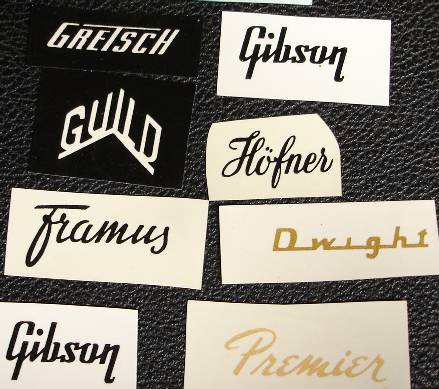
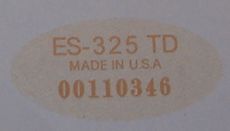
VINTAGE DECALS Just
in! a 1976 ES-325 logo. Most are
the real deal from the 70's, all are the highest quality waterslide available
and, when installed, indistinguishable from original factory decals. Most are
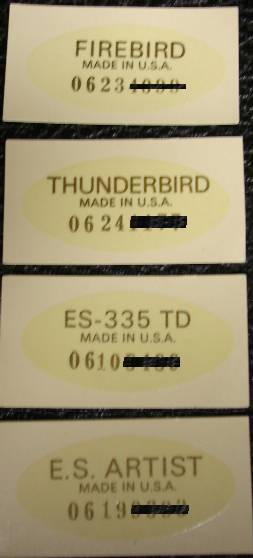
priced at $20 but some, like these genuine 1977 Gibson
(ES-336, Firebird, E.S. Artist only - Note that the Thunderbird was sold) are
priced at $50. If you're restoring a $1500 vintage guitar, don't go cheap on
the decal - get the real deal. I also have a bunch of spaghetti Broadcasters
($20) on blue grid paper that I'm told are original Fender.
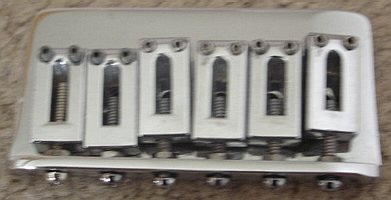
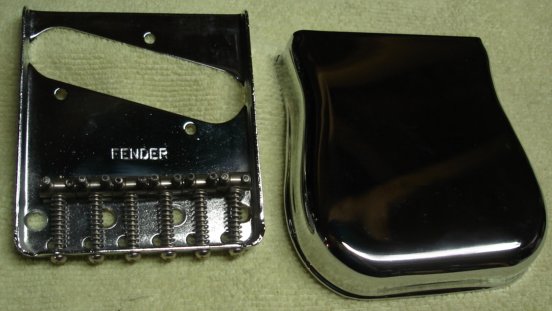
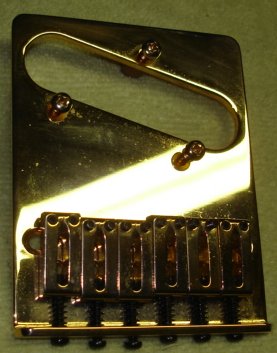
Hardtail Stratbridge.
Looks like a Gotoh. Chrome plating is great shape. $15 or more if you want
Graph Tech graphite or bone
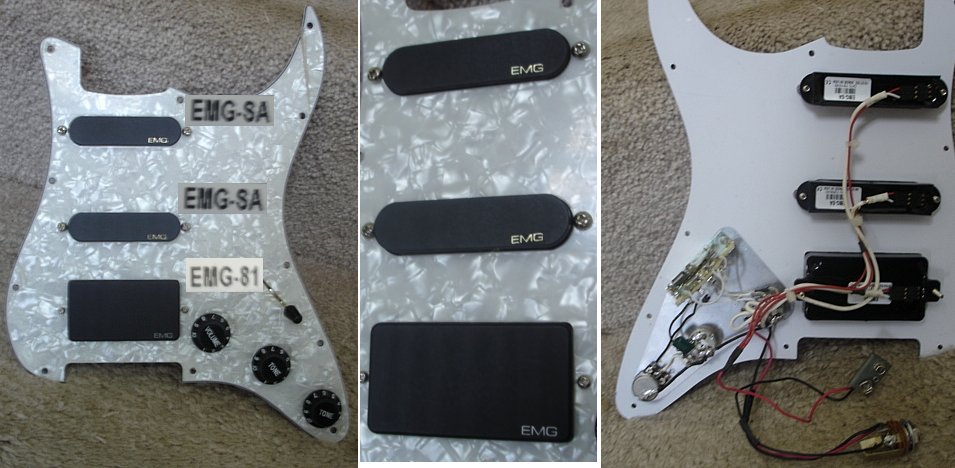
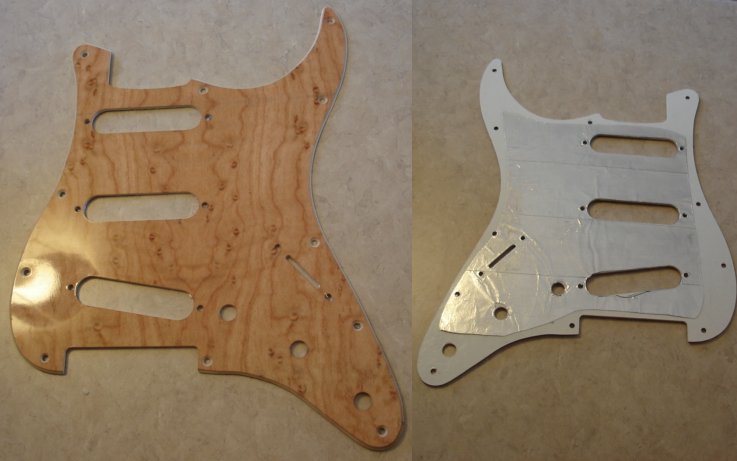
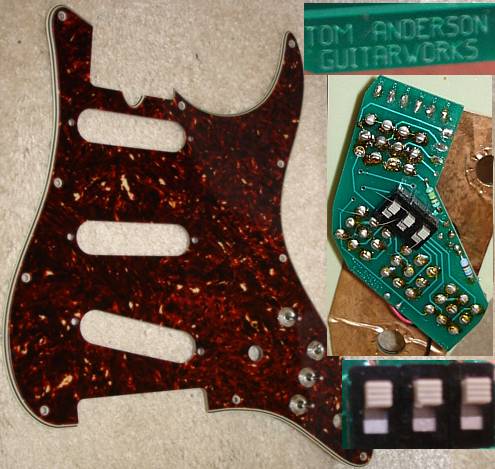
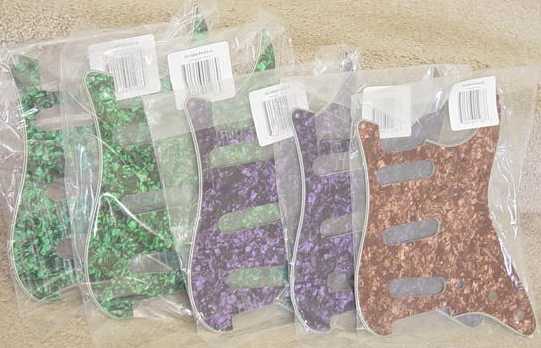
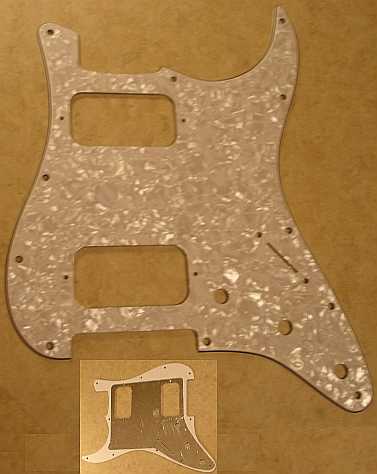
EMG HSS Loaded Pickguard.
One of EMG's most popular combinations, the EMG81 bridge with a pair of
EMG-SA's. Since EMG's are quiet, you'll get noiseless performance on all 5
settings of the pickup selector. Find out what many of the pro players love
about EMG's including clarity, wide dynamic range, and no noise. Includes
quick-disconnect wiring, mounted on a new white pearl pickguard with black
knobs and tip. It's drop-in ready so just plug in a 9V battery and screw in the
jack and you're up and running. Clean shape and price at what you'll pay for
just a pair of SA's. $159(SOLD-Squire 1/11/20).
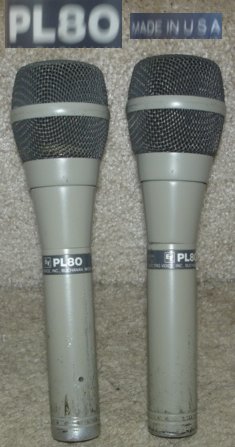
Electro-Voice EV PL-80 Supercardiod Dynamic Mics. Back in the mid-80's at Hotlicks we sold almost as many PL-80's as we did Shure
SM-58's. At the time the USA made 58's were $119; the PL-80 was $80, and many
who did an A/B test liked the 80 better. Since that time EV has come out with
some other versions of the 80 such as the PL80C and the Chinese PL80a, but
these old USA models are some of the most roadworthy mics
ever made. Decidedly, these aren't the most sexy looking mics
ever made, but we usually don't buy mics based on
looks. With its hypercardioid pattern and an extended
range that exceeds most dynamic mics, it's excellent
for vocals but also performs well on snare drum, guitar cabinet, and acoustic
guitar. I've got a pair of these (maybe three) for $59/each, or a pair for
$100.
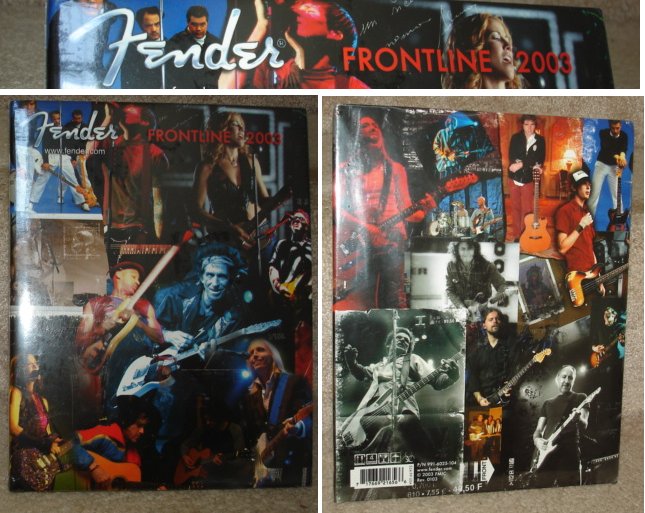
· Fender Frontline 2003 BOOK.
Everybody has the magazine-style soft cover Frontlines, but this was a limited
run hardcover edition, fully bound and factory sealed in clear wrap. Has the
full Fender product line and some informative articles. $15.
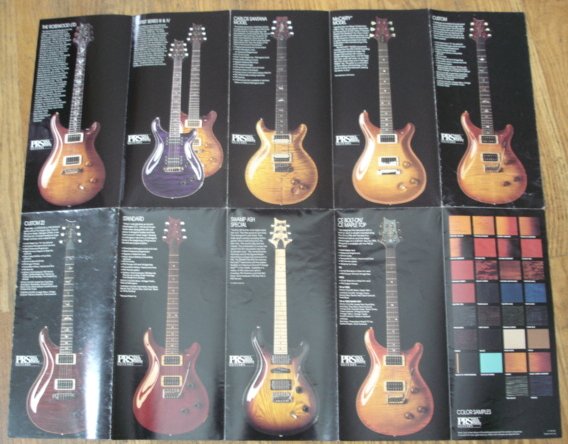
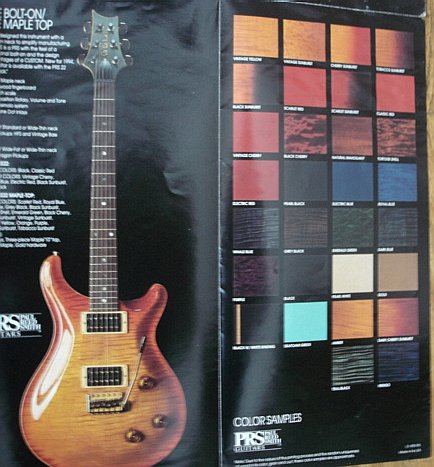
· 1996 PRS 4-fold Catalog/Poster,(poster side), (close-up) Catalog/Poster with Ross
Childress (Collective Soul) on one side, full line specs on reverse. Contains
full specs on each model as well as well as 1996 color chart.Excellent
source of info and cheap for vintage paper. $12.
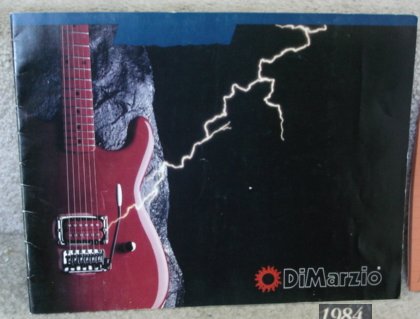
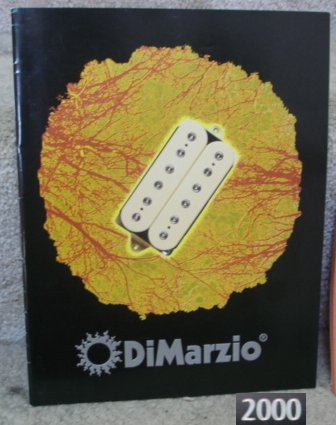
· 1984 DiMarzio Catalog, (pic2) and 2000 DiMarzio Catalog. In 1984 DiMarzio
was more of a parts company than just pickups and plastic accessories, carrying
a full line of enough parts to build a complete guitar. 18 pages with detailed
info on their full line of pickups, plus bodies, necks, bridges, tuners, etc.
I'm including the 2000 DiMarzio catalog (24 pages) in mint condition. $20 takes
the pair.
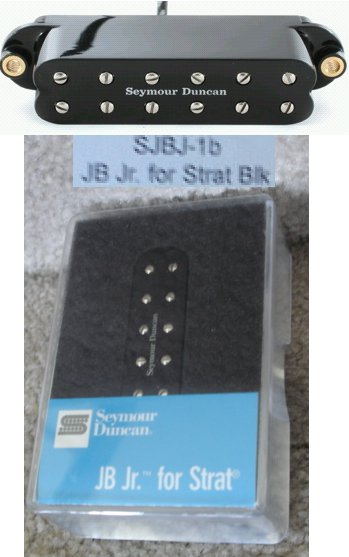
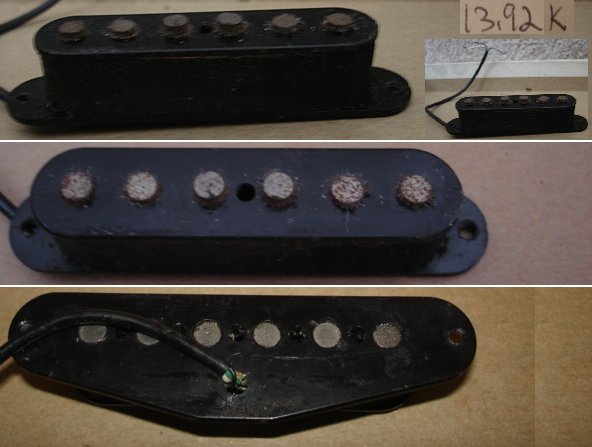
Seymour Duncan JB Jr. Bridge Pickup.
Duncan's most popular stacked humbucker for Strats, the JB Jr. retains the
performance of the PAF style JB, in a stacked format. Transforms your Strat
into a more versatile instrument with a minimum of effort and cost. Sells new
for $75.99 but this one's mint in the box with all paperwork and $52.99.
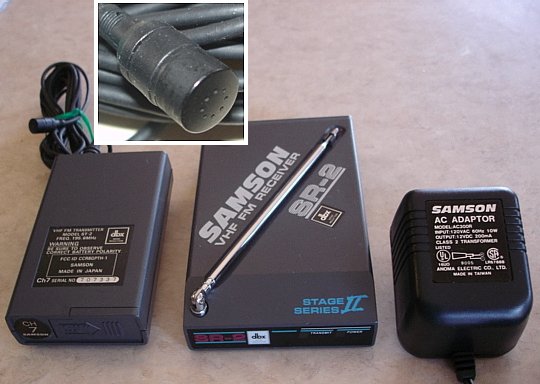
Samson SR-2 lavalier wireless,
Samson Ch. 7. I've used the SR-2 model for guitars on numerous occasions with
no dropout or interference. An excellent choice for the money. $75
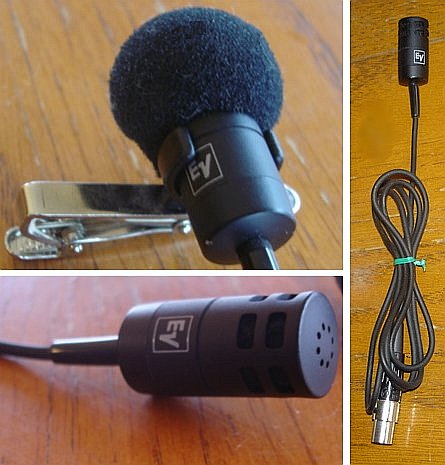
EV Lavalier
Wireless Mic, (stock pic).
Model OLM-10. Plug works for Telex or EV transmitters. $29.
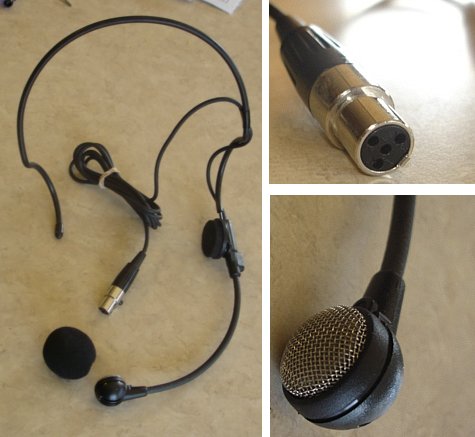
Headset Wireless Mic.
I don't know the maker but it's a comfortable headset mounted mic, especially
good for drummers. Plug works for Telex or EV transmitters.$25.
Behringer UCA-202 Computer Audio Interface,
(stock pic). When used as a
professional interface between a mixing console and your computer options
include connecting the UCA202 RCA Outputs to the Tape Input jacks of your
mixer, to powered monitors, or to your mixer. Connecting to the mixer input
channels allows you to use your mixer’s Aux Send
feature to build an extremely versatile monitor mix for recording sessions. Click here to read
about all the possibilities. Mint in the box, appears to never have been used.
$15.
M-Audio "FastTrack" Pro Tools Recording Studio, (stock pic), (software screenshot).
Guitar/Mic recording interface for computer recording. 2-input, 2-output audio
interface that's compatible with most popular recording software including Pro
Tools M-Powered. Plug-and-play USB connection (USB 2.0 compatible); XLR
microphone input with gain control and 48V phantom power; 1/4" instrument
input with gain control; 1/4" stereo headphone output; RCA stereo speaker
outputs; Output level knob for adjusting volume of headphones and speaker
outputs; Direct monitoring button; Powered by USB - no power adapter required;
Includes Pro Tools SE. Mint in the box, appears to never have been used. Very
useful tool if you do computer recording and just $89.
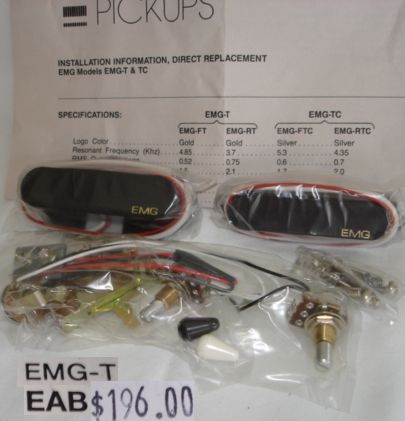
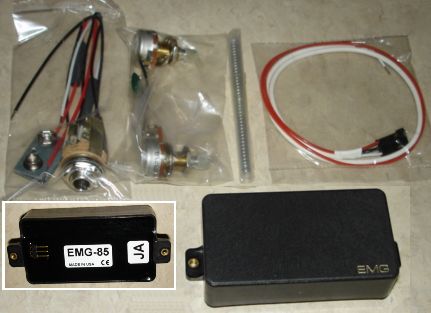
EMG Pickups and Parts:
I've had these for around 17 years and most were 5 year old NOS when I got
them. We've robbed some parts over the years so I'll discount a bit if you
don't need pots and/or jack. Boxes may be shop worn but all are new, old stock,
and include instructions/spec sheets. Some have quick disconnect wiring; some
are the earlier hard-wired. Enjoy the quiet operation of a 9V system with
traditional single coil tone, for 50% off list. NOTE: Many of these were sold
but I probably have others in stock. Will remove them eventually.
· EMG
T Set - Black. New, old stock, in the box. Direct replacement for
Telecaster Guitars, Alnico magnets. $209 list, $169 online, but these are NOS
and just $105 for set, $59 for singles.
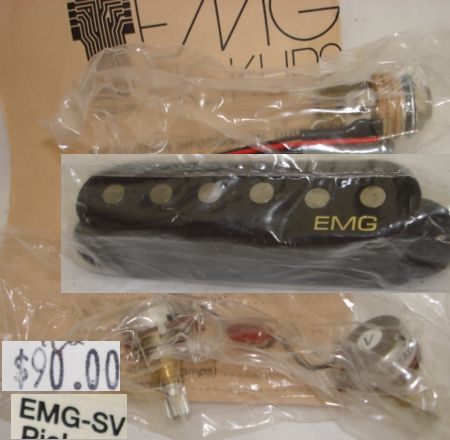
· EMG-SV
Strat - Black. New, old stock, in the box. Vintage looking Strat pickup
with staggered Alnico poles. $99 list, $79 online, but these are NOS and just
$49.
· EMG-S
Strat - Black. New, old stock, in the box. Traditional EMG look with
ceramic magnets. $99 list, $79 online, but these are NOS and just $49.
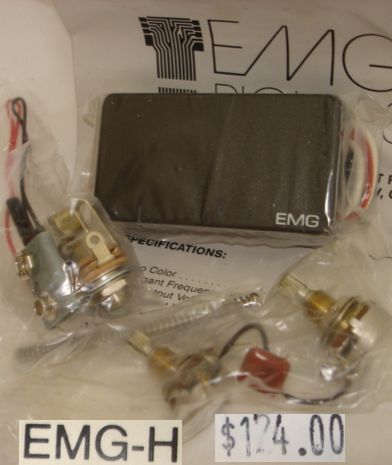
· EMG-H
Single Coil In a Humbucker. New, old stock, in the box. Enjoy the tone and
articulation of a ceramic single coil in your humbucker guitar. The H is a
single coil pickup designed to fit directly into a humbucker route without
modification.
· EMG-91
Archtop. New, old stock, in the box. Floating pickup for archtop guitars,
mounting at the end of the fingerboard without interfering with string or top
vibrations. $149 list, $119 online, but these are NOS and just $75.
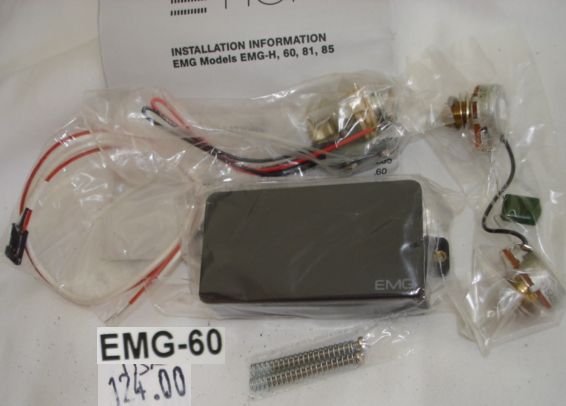
· EMG-60.
New, old stock, in the box. Not as well known as the 81/85/89, but probably the
most versatile among EMG's humbucker line. James Hetfield's
signature ESP uses these as their distinctive crunch sets any rhythm player
apart from the midrange mix of Metallica. Can be used in either position but
it's used frequently as a rhythm pickup with an EMG-81 in the bridge.
· EMG-45P 6-String Bass, (pic2).
New, old stock, in the box. The 45P is used on some high end 6-string basses
and is a fantastic upgrade on lower line 6-strings like an Ibanez SR406, etc.
The 45P design has two offset coils that result in more low end with brilliant
highs. It uses short, squat coils that have very little resistance and plenty of
inductance. Modern looks, easy to install, sounds great. Lists for
$134.99/each, selling new in stores for $99. Save cash and transform your
6-string for just $67/each. Buy a 6-string bass from us and we'll include labor
for $25 or less.
· EMG-40CS.
New, old stock, in the box. The 40CS is made especially for 5-string basses and
with its ceramic magnets is warmer as a result of the higher inductance of the
steel, with a smoother attack and a flatter high end. Modern looks, easy to
install, sounds great. Lists for $134.99, selling new in stores for $99. Save
cash and transform your 6-string for just $67. Buy a 5-string bass from us and
we'll include labor for $25 or less.
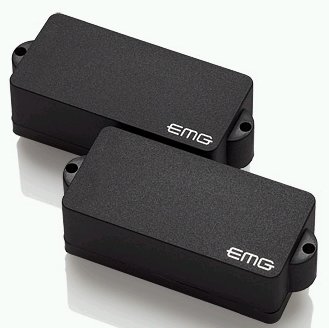
· EMG-P
Precision. New, old stock, in the box. Very popular replacement pickup for
any bass that uses the split coil design of a P-bass. Lists for $129.99,
selling new in stores for $99. Save cash and transform your 4-string for just
$65. Buy your bass from us and we'll include labor for $18 or less.
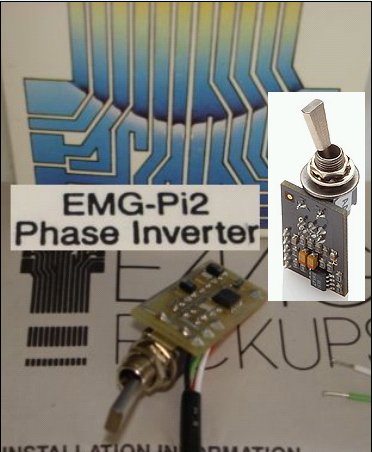
· EMG Pi2
Switch. New, old stock, in the box. Made especially for EMG pickups the Pi2
is a switch with a circuit board attached which acts as a phase reversal switch
on a guitar with two or more EMG pickups. Lists for $39.99; these are just
$19.99.
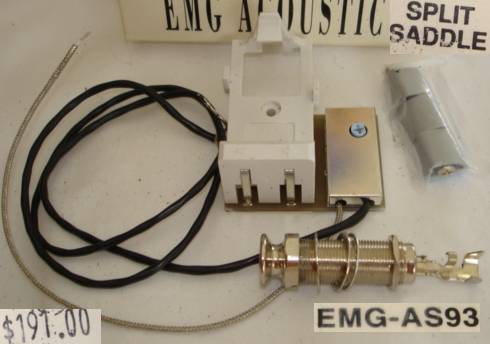
· EMG
AS93 Acoustic Preamp or AS125 Acoustic Preamp.
New, old stock, in the box. These are the earlier versions with a separate
preamp and output jack (later ones had preamp integrated into the jack). The
AS93 is for traditional saddle widths (3/32) such as Martins; the AS125 is for
1/8" saddles. Both 2.70" in length. List price $159; take one of
these for just $79.
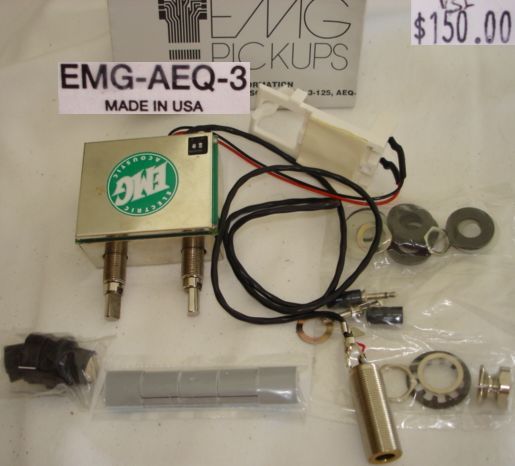
· EMG
AEQ-3 Acoustic Preamp. New, old stock, in the box. For more tone tweaking,
you can install the AEQ-3 3-band equalization system which features dual
stacked knobs for independent treble, mid, bass and volume controls right on
your instrument. List price was $395; this one's a blowout special for just
$150.
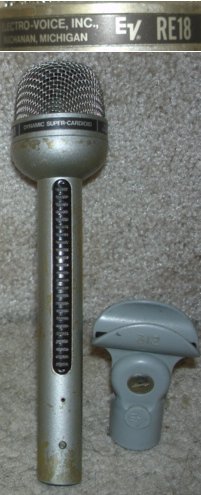
Electrovoice RE18 Supercardioid Dynamic Microphone. Classic mic for
studio and broadcast, the RE18 is built to last and sound great, day after day.
For full specs, click here
coutant.org, a great reference for vintage mics.
Includes EV mic clip for $85.
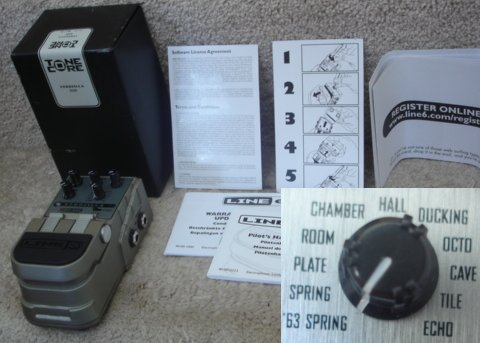
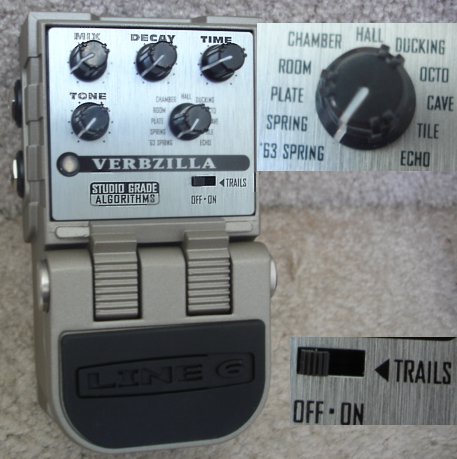
Line 6 Tonecore Verbzilla Reverb, (pic2).
Get the versatility of the old tube reverb units in a modern, great sounding
stomp box. The Verbzilla actually features a bunch of
quality reverb tones including '63 Spring, Spring, Plate, Room, Hall, Chamber,
Ducking, Octo, Cave, Tile, and Echo. It also features
a handy Trails switch that lets reverb decay - or cut off - when you bypass the
unit. Sells for $149 new; this one's mint in the box for $99.
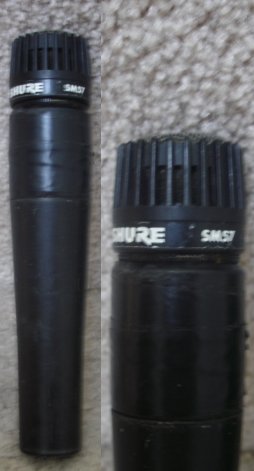
Shure SM57 Dynamic Mic. Since 1965, the
SM57 has been an industry standard in performance mics.
The most rugged mic ever built, 57's will take decades of road abuse and keep
on performing night after night. The SM57 has also appeared on more stages and
studios than any other instrument mic, as an industry standard for drum (snare
and toms) and guitar cabinet sound reproduction, plus it's an excellent vocal
mic with past users including Billy Squier and--get this--every president from
Lyndon Johnson to Obama (link)
has used 57's for their speeches. This one's in well-used condition but still
works perfectly and is just $59.
Wide Bout Solidbody Case.
Black tolex over wood with leather ends and white piping. Large storage
compartment and long neck rest. Pic shows extra width with a Strat style inside.Tits a 14" lower bout easily. Top quality with
nice brown velvet interior. Excellent condition. $115.
A Few Pickups:
· Seymour Duncan Strat Antiquity Bridge.
These look so much like the real thing it's scary. Has been installed in a
guitar so leads already cut to proper length for bridge. $77 new but this used
one's just $52.
· Seymour Duncan-Designed HB-102 Pair.
Includes HB-102N and 102B (neck and bridge), which is the import version of
Duncan's JB/Jazz set. Alnico 5 magnets, but hotter winding spec, based on the
most popular hot-rodded PAF. Bridge pickup is F-spaced. Removed when new so
mint condition with plastic still on one of them. Top notch construction and
design - not obviously inferior like Epi and other import pickups. Along with
PRS, Duncan Designed are the best import pickups and are an upgrade for most
import guitars. $49 for this mint set.
· Seymour Duncan Classic Stack Strat
Neck. Stacked humbucker that looks like a single coil. Patent applied for
design to remove hum and preserve traditional single coil tone. 4-conductor for
wiring single/humbucker if desired. $77/each new but get this clean pair for
just $90.
· Seymour Duncan Classic Stack Plus -
Strat Bridge. Stacked humbucker that looks like a single coil. Patent
applied for design to remove hum and preserve traditional single coil tone.
4-conductor for wiring single/humbucker if desired. $77 new, this clean used
one's $49 - or $45 with the Classic Stack pair above.
· EMG-81
- White. An older hard-wired 81 that's barely used. The patina has yellowed
but the lettering is nearly perfect. For you guys rebuilding 80's boutique
guitars, this is a hard to find nice example in white and just $75.
· Gibson
P100 Set. Get that great P90 single coil tone in a stacked noiseless
configuration. No covers but they're available online. $90/pair.
· Gibson P100 Pickup. As above except
includes soapbar cover. $49.
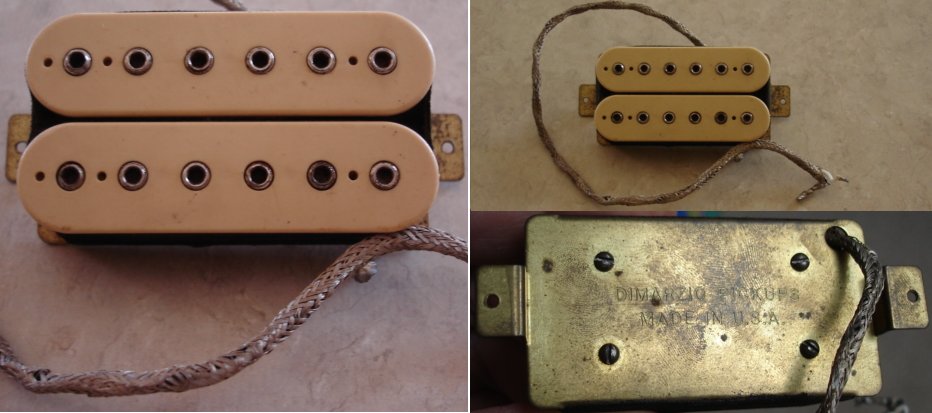
· DiMarzio Copy by Gotoh. Stamped
"Patent Applied For" and "made by goto"
(note the missing "h", common to all of these). These pickups were
used in many of the 70's/80's "lawsuit" guitars by Greco, Tokai,
Edwards, etc., and are excellent sounding pickups in their own right. Double
cream bobbins with two rows of hex screws, just like DiMarzio. If you need one
of these, here you go. $79.
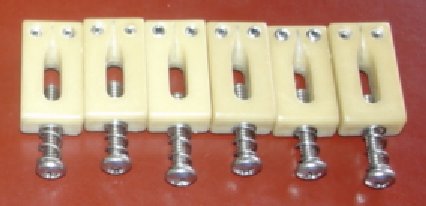
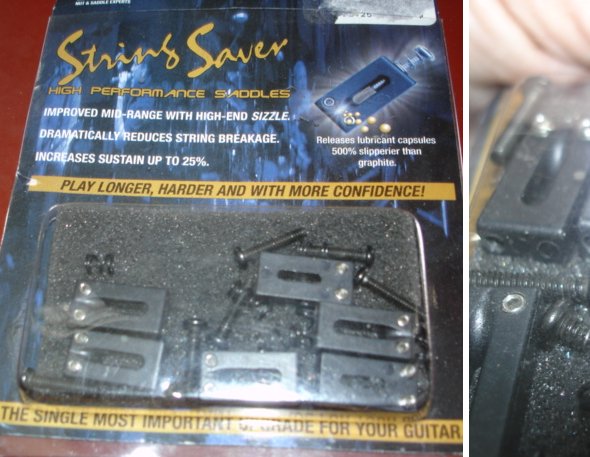
Graph Tech FerraGlide Saddles for Vintage Fender. Centered
intonation screw for Fender Vintage style bridges (see below for
American Standard/Series). High quality replacement saddles for your
vintage-style Strat bridge. You're probably used to the black graphite saddles
Graph Tech has made for years. These are the same idea - reduced string
breakage and increased sustain - but they look more like stock saddles. Each
saddle insert, is impregnated with Teflon, the slipperiest substance on earth,
which eases the grip between the saddle and string, spreading the stress over a
greater portion of the string, thus eliminating string breakage. Teflon is 500%
more slippery than graphite and is impregnated throughout the String Saver
material, so its lubricating properties will never wear out. New, $39.
Graph Tech Tusq Saddles for
Vintage Fender. Centered intonation screw for Fender Vintage style
bridges (see below for American Standard/Series). High quality replacement
saddles which offer lower friction for less string breakage without losing
tone. To my ears these seem to even out the highs for a more mellow, balanced
tone. $25.
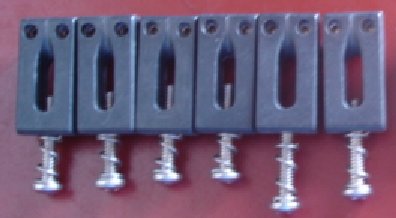
Graph Tech Graphite Saddles
for Vintage Fender. Centered intonation screw for Fender Vintage style
bridges (see below for American Standard/Series). High quality replacement
saddles which offer lower friction for less string breakage without losing
tone. To my ears these seem to even out the highs for a more mellow, balanced
tone. $25.
Graph Tech Graphite Saddles
for Modern Fender. Offset intonation screw for American
Standard/American Series style bridges. High quality replacement saddles
which offer lower friction for less string breakage without losing tone. To my
ears these seem to even out the highs for a more mellow, balanced tone. $25.
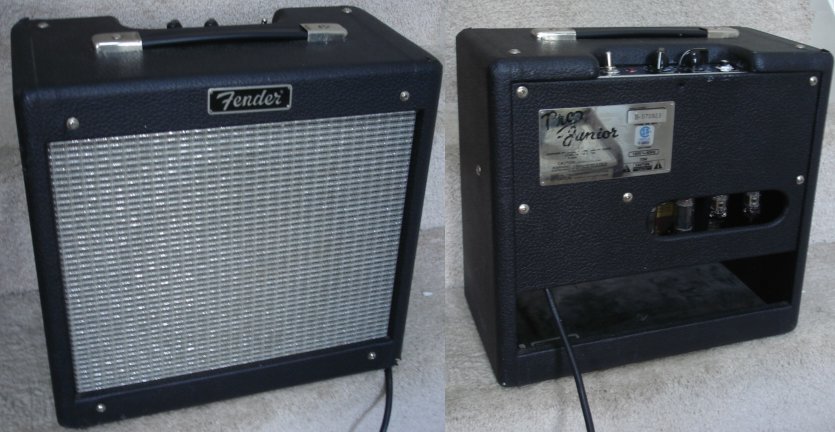
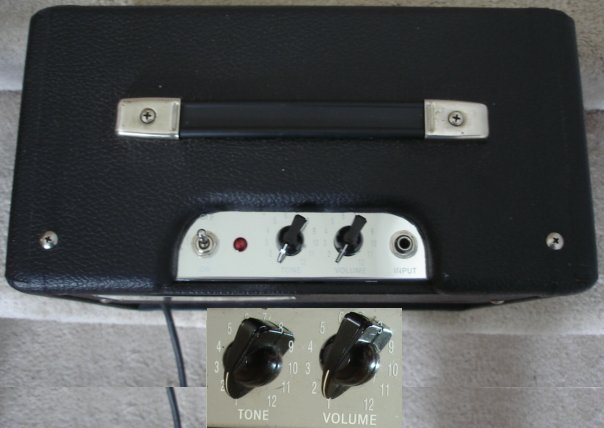
Fender Pro Junior #2, (top). Early USA model. In recent
years I've had a variety of hand-wired boutique 10" combo's and a bunch of
the recent budget 5-waters by Epi, Vox, Fender Champion 600, etc. The hand
wired boutique combo's sound great but they're expensive; the budget combos,
well, you get what you pay for. Dollar for dollar, it's hard to beat the Pro
Junior for quality tone in a solidly built amp. With simply a volume and tone
control, the Pro Junior won't waste any of your time trying to dial in the
"perfect" tone. Just crank it up and let 'er
rip. The Pro Junior is powered by a pair of EL84's putting out 15 watts, but 15
*tube* watts is quite loud, along the lines of a 35 watt solid state, only
better sounding. It also features a pair of 12AX7 preamp tubes. With a fairly
heavy Fender/Eminence 10" speaker, this amp carries the guitar spectrum
very well, with sufficient lows as to sound like a "real" amp, not
just a practice amp. Put one of these on a barstool, put a mic in front of it,
and you'll have the whole club jumping. Designed to work with your guitar's
volume - sounds clean with your guitar turned down and gets dirtier as you turn
up your axe. The look is very much vintage Fender, with classic black tolex,
vintage style badge, vintage style handle, chrome panel, and chicken head
knobs. The new Mexican-made Pro Junior sells new for $394 ($589 list) and it
appears to be the same except for the speaker out jack on the new model, and
they also changed the panel to black with white knobs which, to me, only
detracts from the vintage vibe.An excellent sounding
amp and hard to beat at $325.
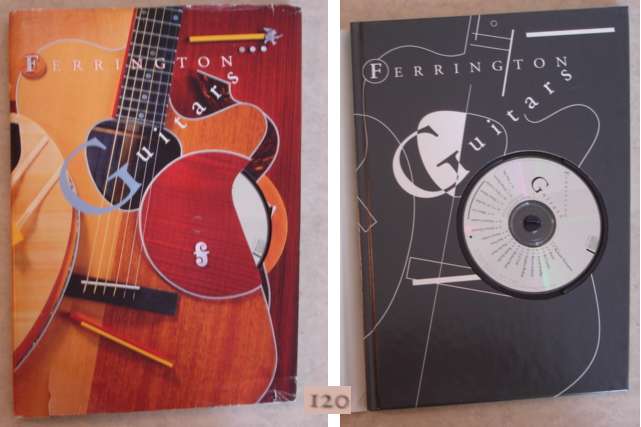
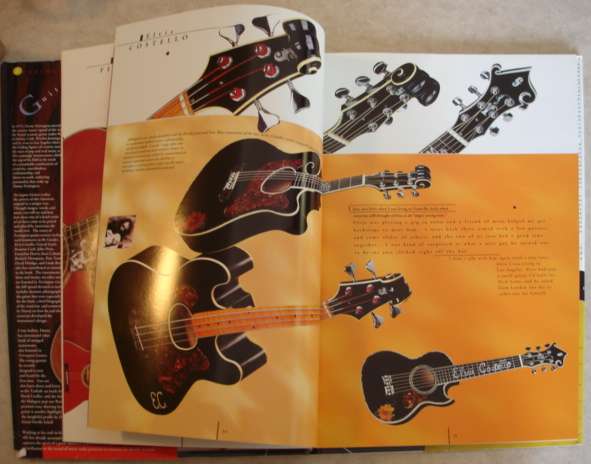
Ferrington Guitars Book and CD (shown with and without
dust cover) inside pages, All you
wanted to know about the innovative guitars of Danny Ferrington,
written by Danny, Nancy Skolos, and Thomas Wedell. Includes book and CD artist. More than 150 photographs in
this hardcover edition with unique shape (top of book a few inches longer than
bottom) of thirty guitars and the celebrity musicians that own them--as well as
an original CD--highlight the work of one of America's premier creators of
handmade, one-of-a-kind guitars that are prized by musicians the world over. CD
is seated in the top cover. Dust sleeve a little worn around the edges but book
itself is perfect. $18 include postal shipping.
Boss RV-5 Digital Reverb, Thought by many
to be the best digital reverb made, at least in stomp box form. Sounds as 90%
as good as the finest rackmount units at 1/10th the price. Following the RV-2
and RV-3, the RV-5 is the newest and most powerful of Boss' popular RV series
with six of Boss’ best reverbs in an all-new stereo
effects pedal. New reverbs include convincing spring reverb emulation and a
high-quality gate reverb, plus an all-new Modulate mode for spacious detuned
reverb sounds. One of the cool things about this reverb is the "Time"
control, which lets you adjust the reverb decay. You can use a thick wash of
spring reverb, for instance, but unlike most amps, which turn into a big mush,
you can set it to 1 second or so. There are a bunch of YouTube demo's; Click
Here and take your pick. New these are $149 but this nice used one's just
$99.
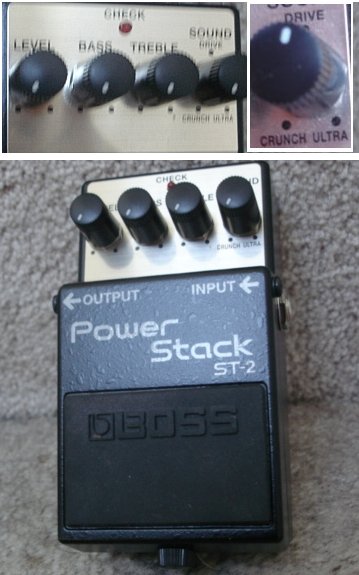
BOSS ST-2 Power Stack. Boss's new
"stack in a box" and a good choice for players who aren't thrilled
with their amp tone. With the ST-2 you can get fat crunch - or ultra high-gain
distortion - by tweaking the Sound, which blends in the gain amount and sound
character. Tweak the distortion by dialing in the 2-band EQ. Has a cool
textured black finish and is in excellent condition. Don't plunk down $99 for a
new one when you can have this nice used one for just $59.
PICKUP DAY!!!
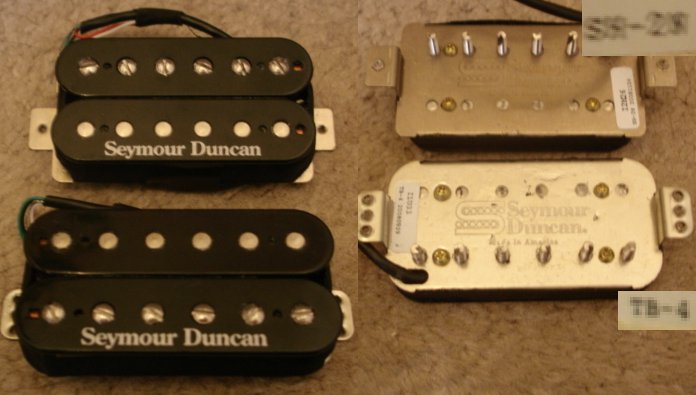
· Seymour Duncan JB and Jazz
Set. This is Seymour's personal favorite pickup combination, which says a
lot, coming from a true pickup connoisseur who has built over 100 models and
1000's of combinations. The TB4
JB Trembucker JB (i.e. JB with wider spacing for Floyd Rose and vintage
trems) and the SH2N
Jazz neck are 4-conductor for coil splitting, if desired. A killer upgrade
for just $99, including Pri Mail shipping. (I have a
few sets of these, hold one for Dennis K 1/8)
· Seymour Duncan JB Trembucker - Zebra.
Duncan's most popular pickup. The TB4
JB Trembucker JB is the same as the SH4 except with wider spacing for Floyd
Rose and vintage trems. 4-conductor for coil splitting, if desired. Zebras are
cool; own this one for $55, including Pri Mail
shipping.
· American Standard Tele Set. Removed from
an '09 Ltd Ed Tele but they're stock USA pickups. Classic Tele twang for just
$75/pair including Pri Mail shipping.
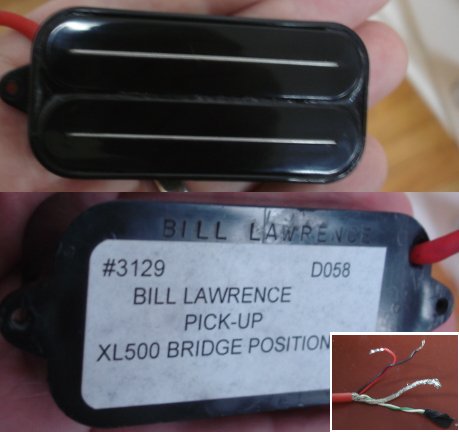
· Bill Lawrence XL500 Bridge Humbucker.
Excellent sounding hot humbucker for rock music. Jackson uses these as a stock
pickup on their custom shop guitars now. 4-conductor for multiple applications.
This is an older model in nice shape and a cheap upgrade at $39.
· Rickenbacker Hi Gain Set. These are
optional on Ricks such as the 2010 360 they came out of. Single coil with
adjustable pole pieces. Clean shape. $115/set includes Pri
Mail shipping.
· Fender Lace Sensor - Gold. Acquired
for an upgrade that never occurred, thus new and never installed. The most
popular of the Laces, Gold is the classic Vintage 50's Strat sound with glassy
bell like tones, slightly hotter than the originals but much more quiet. This
model was used on the original Eric Clapton, Buddy Guy, and Jeff Beck
Stratocasters, and a bunch of custom shop models. New in the box for $49(HOLD-Mark
P 4/11), which includes Pri Mail
shipping.
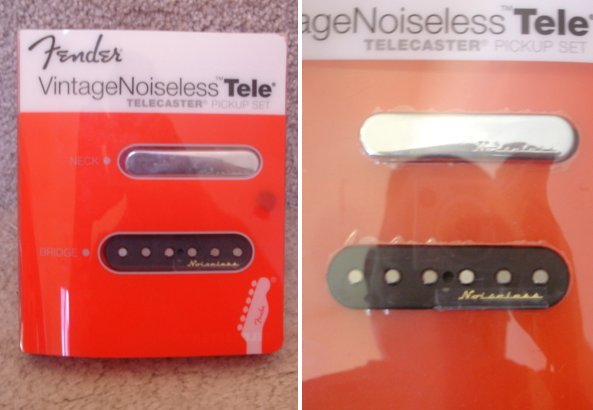
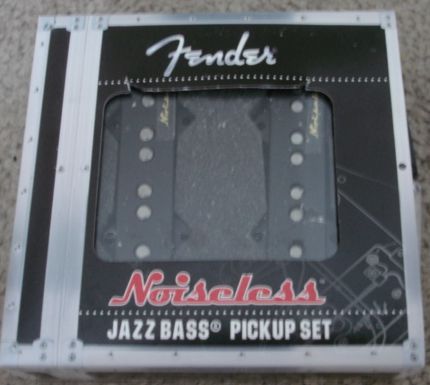
· Fender Telecaster Vintage
Noiseless Set. Classic vintage Tele tone without the vintage noise. Love
these in both Strats and Teles. New these are $159. This has a new bridge and
used--but clean--neck. Just $115 which includes Pri
Mail shipping.
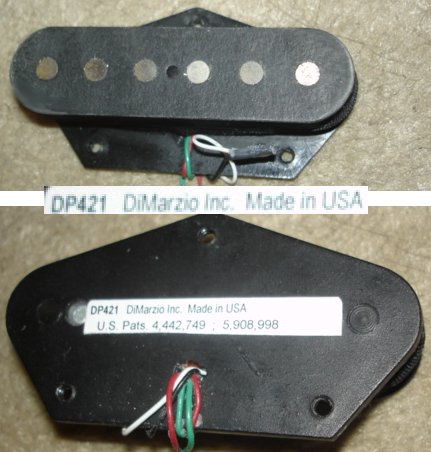
· DiMarzio Hot Area T Bridge DP421.
4-conductor upgrade for your Tele bridge. Humbucker with a tone that lies
between a P90 single coil and a PAF. Works with either 250K or 500K pots. ().
Clean shape and just $55, including Pri Mail
shipping.
· 1980's Gibson Bridge. Rare Gibson
bridge used on ca. '82/'83 E2 Explorers and perhaps others. Although most of
these had gold hardware, you might still need the saddles, since they are long
out of production. $65/each.
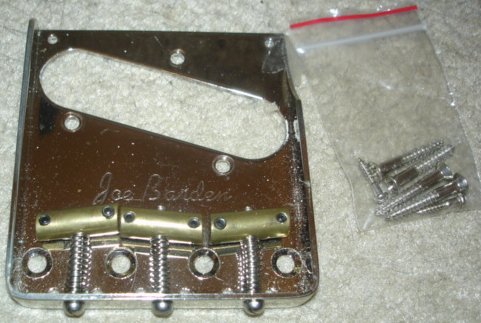
· Joe Barden Tele Bridge. Vintage
Tele bridge plate with compensated brass saddles. Upgrade your Tele with this
quality Barden accessory. Bridge is very clean; saddles have some vintage
patina. $45 includes Priority Mail.
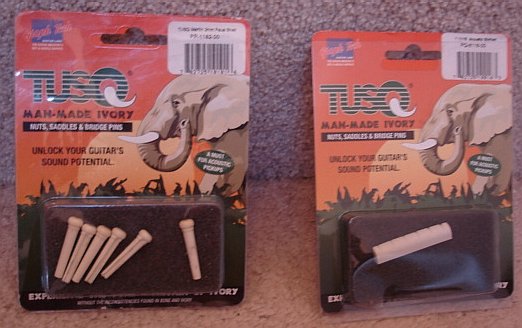
Tusq Ivory Acoustic Bridge Pins and
Nut. Nice upgrade for your budget acoustic. Sounds much better than
plastic. New in the box, $25/all.
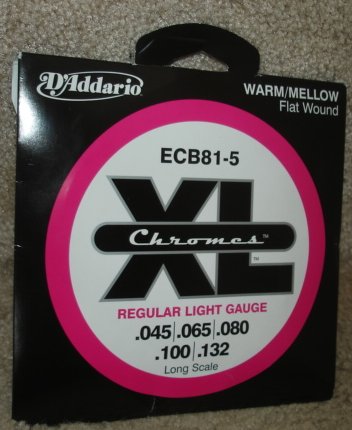
D'Addario ECB8-5 5-String Flat
Wound Strings. Long scale, gauges .045 to .132. If you don't need the 5th
string, just use the .045-.100 as a 4-string set. Get that vintage flat wound
tone for just $28 including shipping.
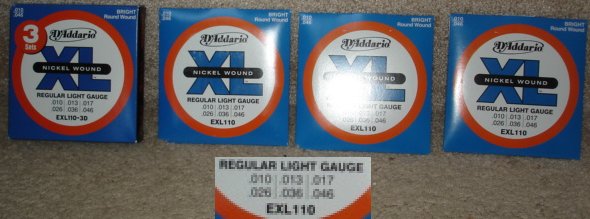
D'Addario EXL110 10 ga. strings. One of the most popular guitar strings
made. One 3-pack and 3 single packs = 6 packs total, for $19.
Hendrix Strings by Dean Markley.
Light ga. 9-38 or Medium 11-52. 10 packs for $39,
including shipping. If you buy these strings you should be able to play just
like Jimi!
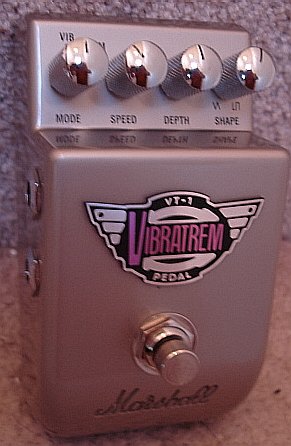
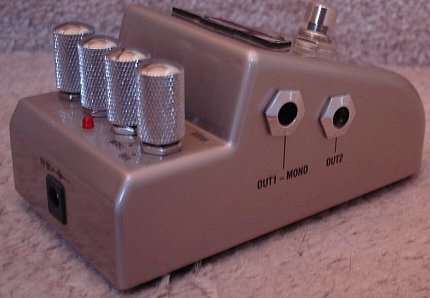
Marshall VT-1 Vibratrem
Vibrato/Tremolo, (Pic2).
Good sounding 2-in-1 pedal with your choice of tremolo or vibrato, patterned
after a 60's tube driven model. Has the normal speed and depth controls, plus a
shape control to change the wave shape for a subtle effect or something more
dramatic. Here's a brief YouTube demo (link).
Sounds good, built like a tank, and a good value on a dual-purpose unit. It's
in excellent condition and priced at $59.
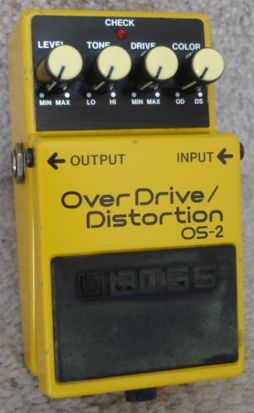
Boss OS-2 Overdrive/Distortion, choice of
Overdrive or Distortion from one pedal. Good choice for players who do anything
from 70's rock and blues to Metal. With the color knob in the all the way to
the left, it produces pure overdrive; turn it to the right and the overdrive
will be gradually mixed with distortion until the overdrive tones are
completely gone in the max position. This is perhaps Boss's most versatile gain
inducing pedal and one of the longest running, having been introduced in 1990.
The circuit is the same as it was 20+ years ago. These are $79 new but this
used one's in beautiful condition in original box and
just $49.
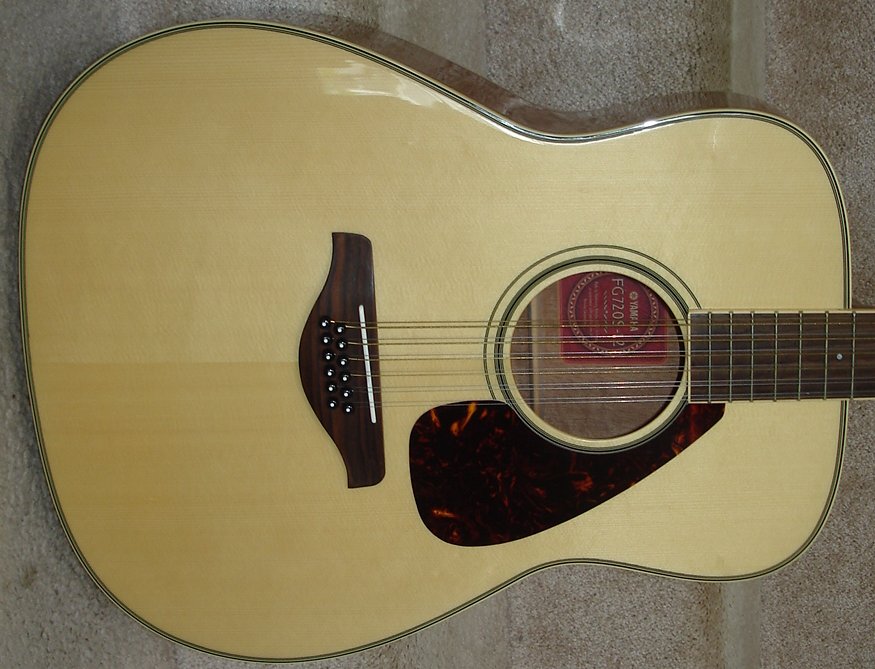
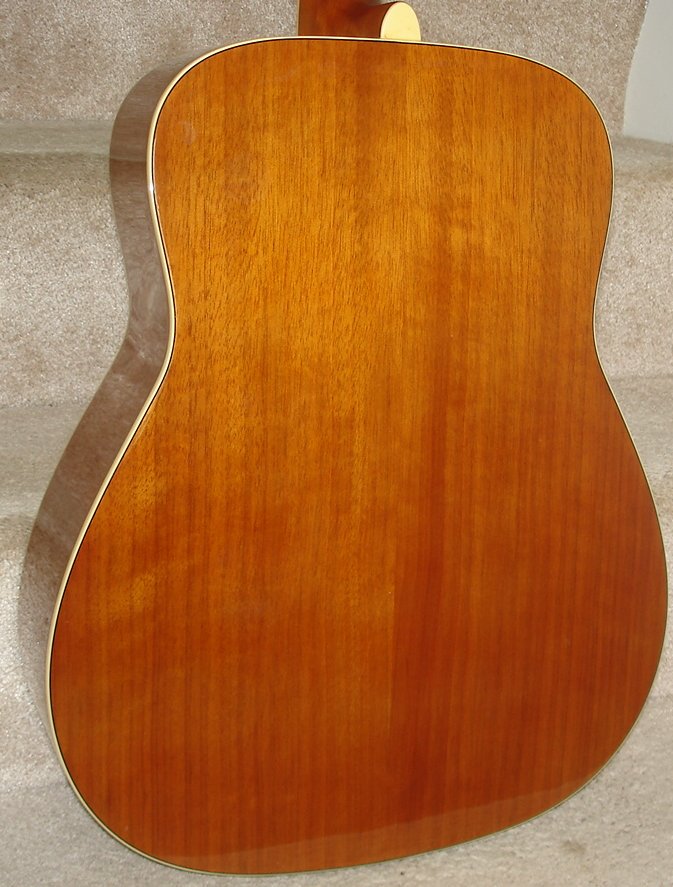
Yamaha FG720S-12, (front), (back),
(headstock/binding). Nicely appointed,
excellent player, mint condition. Most notably, the FG720S-12 features a solid
spruce top which is remarkable for a 12-string with a retail price of just
$523. Features include solid Sitka spruce top, nato back and sides, rosewood
fingerboard and bridge, white/black body and neck binding, die-cast tuners, and
tortoise pickguard. This guitar appears to have seen little to no playing time
and is in perfect condition. With a great in-house setup, it will arrive ready
to jam, without the finger pain frequently associated with a 12-string. It's
summertime when you need a 12-string for the front porch jams. At $259 this is
a modest cost for an extra guitar and it'll play better than anything from the
major warehouse stores.
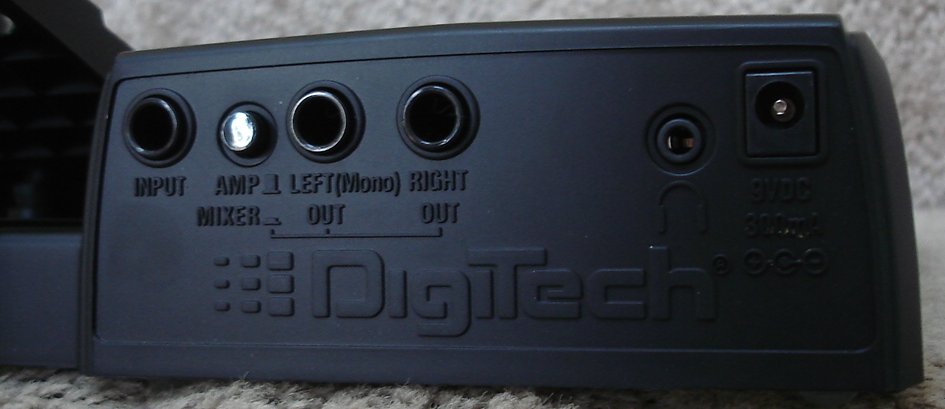
Digitech BP-90 Bass Multi-effect, (front), (side). Full featured
multi-effect for the price of a single stomp box worth it for the price of the
Whammy effect alone. The BP-90 is more than just an effects box, it's also an
easy to use practice device with 40 high-quality drum patterns to practice with
while adding a built-in chromatic tuner and headphone jack for silent
practicing. The BP90 features 27 effects, 11 amps, 5 cabinets, and 5 stompboxes
with 100 presets locations (50 user and 50 factory). The built-in expression
pedal gives you real time control over wah, volume, and DigiTech
Whammy effects. This is a very good sounding unit that's capable of nailing
virtually any bass tone you've heard on recorded music. Sells new for $99 but
this one's dead mint for $59, including original power supply and manual.
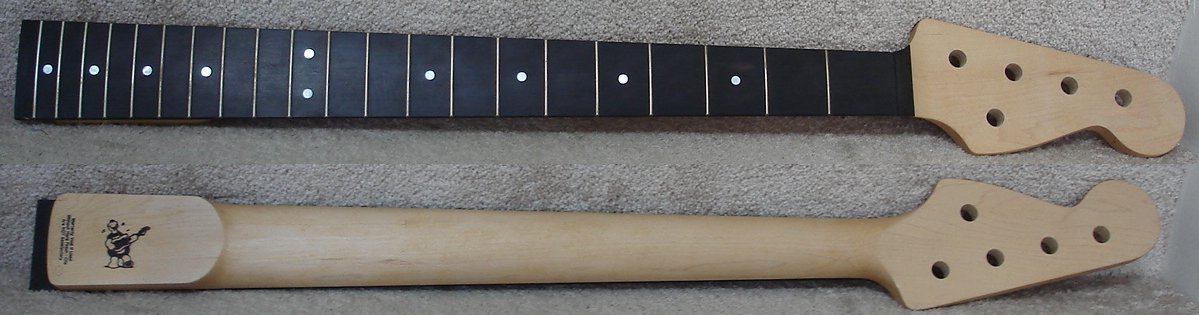
Warmoth 5-string Bass Neck,
(pic2). New, never installed, ordered for a project that never came to be.
Maple neck with ebony fretboard. Fender scale and a direct retrofit for
5-string Fender bodies, but will work with others. If you have a bad neck on
your 5-string, or want the slick feel and extra snap of an ebony, this one's an
easy fix at just $149.
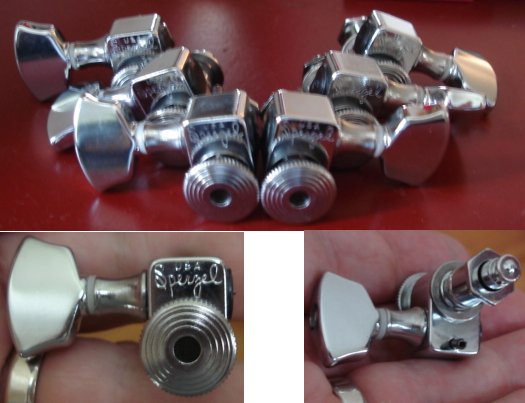
Sperzel 3+3 Locking Tuners - Chrome.
Hard to find set in chrome (not brushed chrome0 for your Les Paul or other 3+3
headstock. Nice shape, $49.
Gibson Humbucking Set - 496R/500T -
with covers. Classic combination used in many Gibsons from Flying V's to
Les Pauls. Neck comes in at a vintage output of around 8.5K; bridge is
overwound at around 16K for a modern tone. These run $109/each new - without
the covers, but this set is in clean shape, has had chrome covers added, and
are just $125 for the pair.
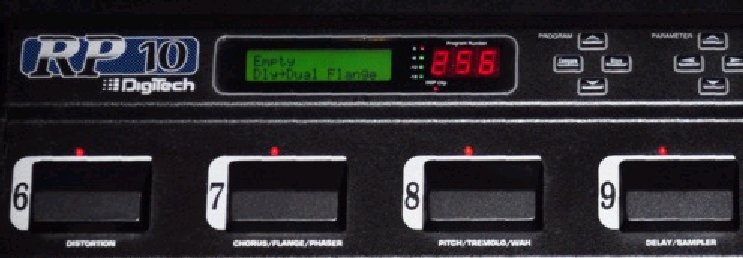
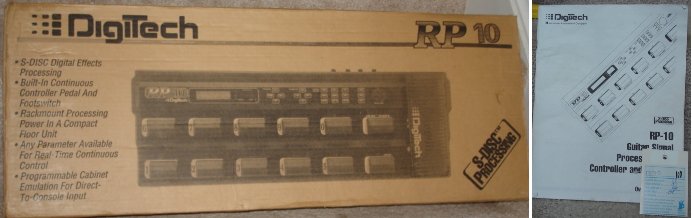
Digitech RP10 Multi-Effect Floorboard,
(back), (LCD/LED screens), (box/manual). Museum condition and a
great old unit from the 90's. Has all the usual vast array of effects like
distortion, delay, chorus, flange, phase, wah, comp., etc. in an easy-to-use
floor unit. Features both a back-lit LED for patch name and effects contained
in that patch, plus a large red LED for patch number. The technology, while a
little dated, sounds fine to my ears and I can't think of a bad thing to say
about this unit. Appears to have spent its life in the box and is as clean as a
new floor model. These sold for over $400 back in '96 but this used one works
perfectly, and is a powerful, good sounding unit for just $139. Includes
original manual and box.
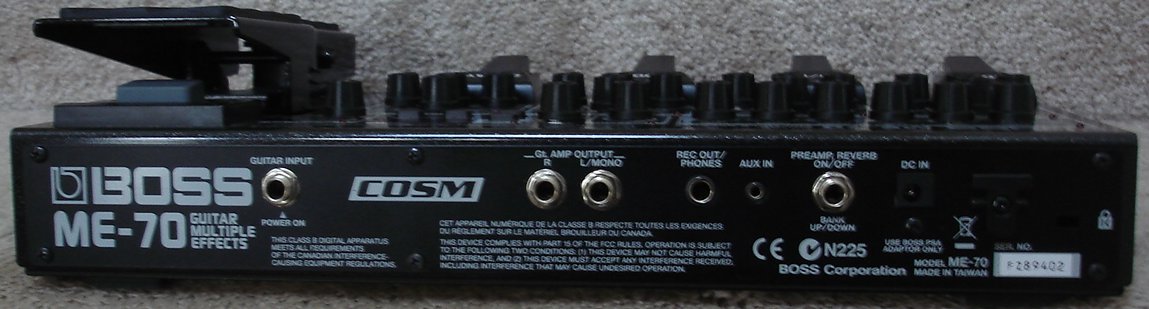
Boss ME-70 Multi-Effect Floorboard, (back). For the player who is more comfortable with
stompboxes than scrolling through menus. The ME-70 is a multi-effects unit that’s as easy as a stompbox. The friendly, knob-laden
design makes tone creation a snap, but with a powerful COSM AMP section derived
from the GT-10, the ME-70 takes Boss's “EZ effects� concept to new heights. It uses dedicated knobs
for each parameter for fast, friendly operation, with four footswitches and
Expression pedal for layout and operation much like a standard pedalboard. All
of your amp controls are arranged together, as well as a separate knob for
reverb, and expression pedal effect (wah, octave, modulation, etc.). It
features a phrase loop function in the delay section with 38 seconds of
recording time and features many classic Boss pedals such as Slow Gear, T-Wah,
OD-1, and many others. If you've heard it in a Boss pedal before, you can get
the tone out of this baby. For full specs and effects, go to Boss's site here
and download manual here.
These sold new for $299 and up but this one's in very clean shape, works
perfectly, and is a fantastic solution for the Boss pedal fan at just
$175(HOLD-Carlos U 6/5).
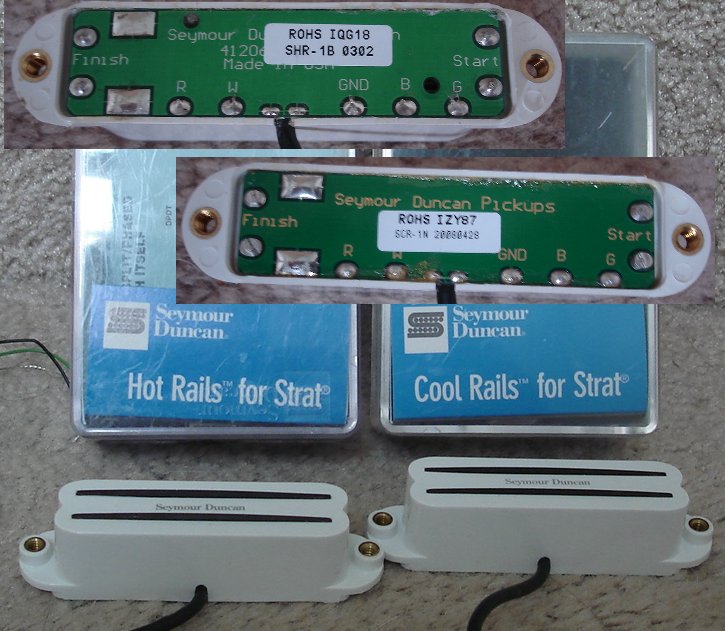
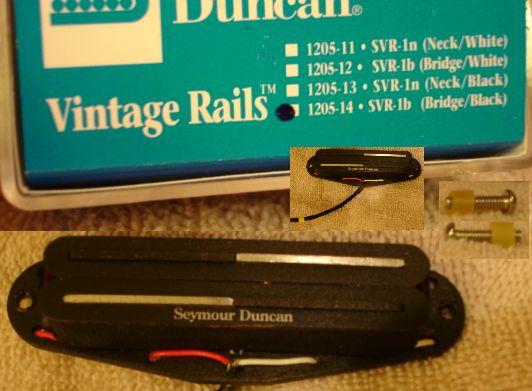
Seymour Duncan Hot Rails
& Cool Rails Pair, Get a fat humbucker tone out of your Strat or other
single coil routed guitar. These stacked humbuckers feature 4-conductor wiring
for single/humbucker wiring options and combinations, and install without
modifications. Hot SHR-1B (link)
bridge is a hot one, measuring 16.75K and matching SCR-1N (link)
which produces a clearer, brighter, and more dynamic sound. These sell for
$152/pair ($76/ea.) in the stores but get this clean used pair for just $109.
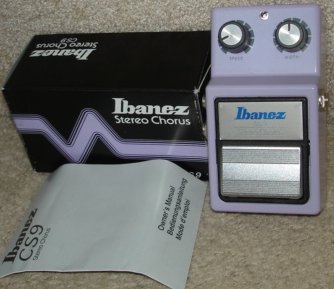
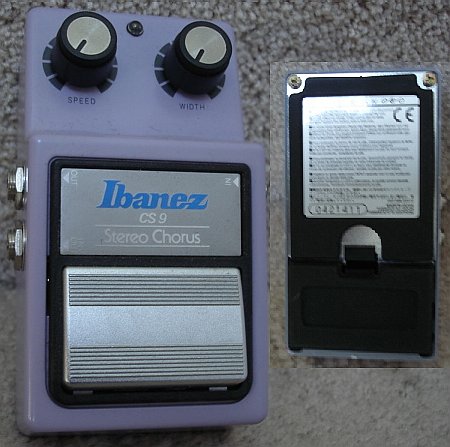
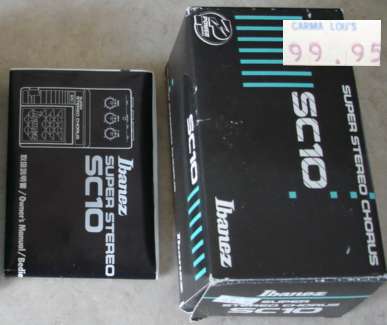
Ibanez CS9 Stereo Chorus Reissue, (pic2). Prompted by the demand of vintage
9-series pedals, and the escalating prices, Ibanez smartly reissued some of
their classic pedals, including the popular CS9 which uses the same circuitry,
for the same lush chorus, found on the original. Mint in the box with $79.
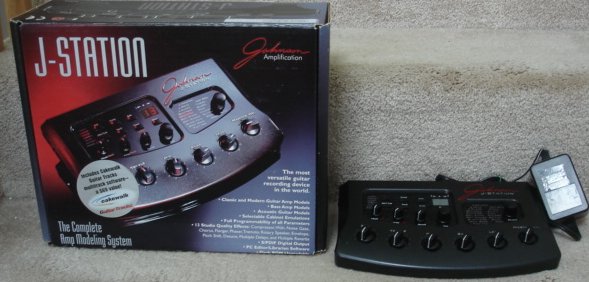
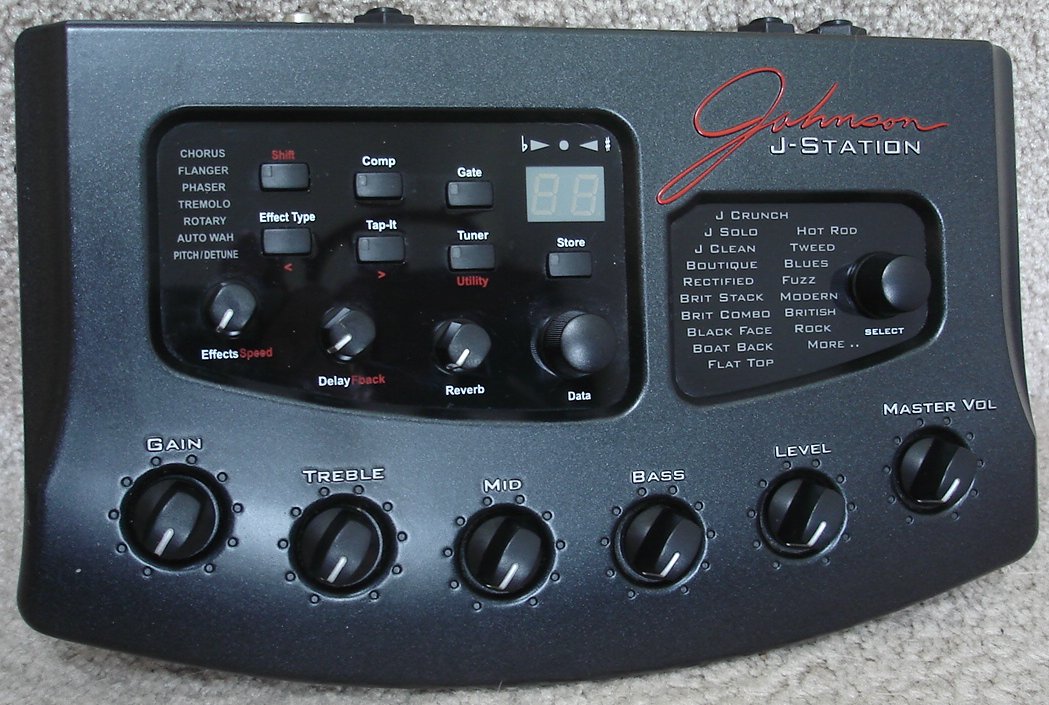
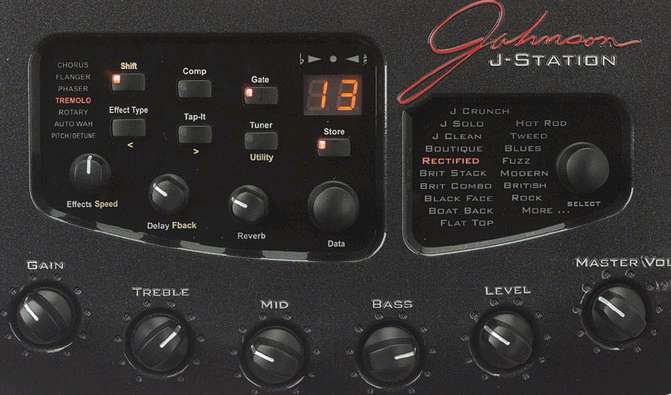
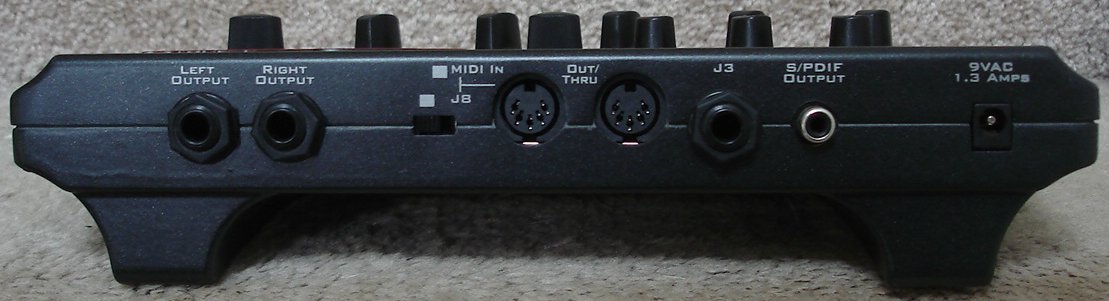
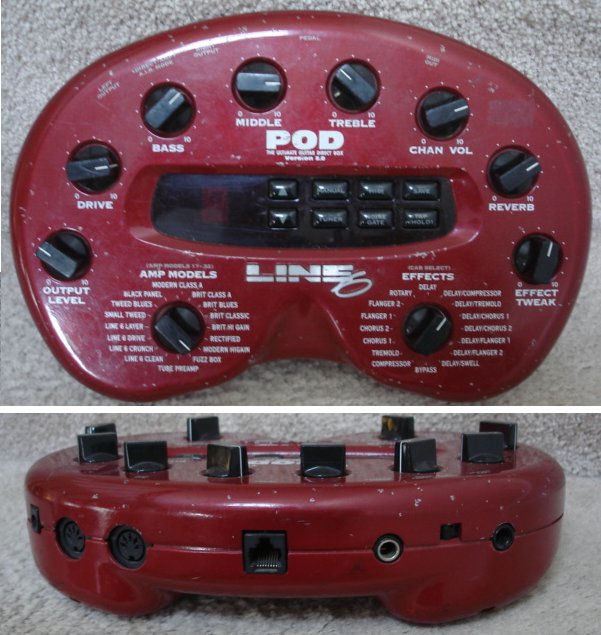
Johnson J-Station, (close-up), (detail), (back). Cleanest one of these I've had
in years. For you youngsters, once upon a time, Johnson and Line 6 (POD) were
battling it out - along the lines of VHS and Betamax
- each with it's own strong spots and weak spots. In
the end, Johnson lost, but I'll hold the J-Station up to a POD any day. Largely
the same selection of effects and amp modeling, but on the J-Station I much
prefer the built-in acoustic simulator and the 12-string simulator. All the
other effects are a toss-up in my opinion - they're both very good. Also, it's
so easy to use you really don't need a manual. Bottom line: This is very nice
unit that can do it all in the studio or it also is excellent for stage use -
and is very easy to get around on. For the price of a single stop box, you can
have 'em all. For full info and manual download, click here for Johnson's
site. Incredibly clean condition with original box and power supply, for $99.
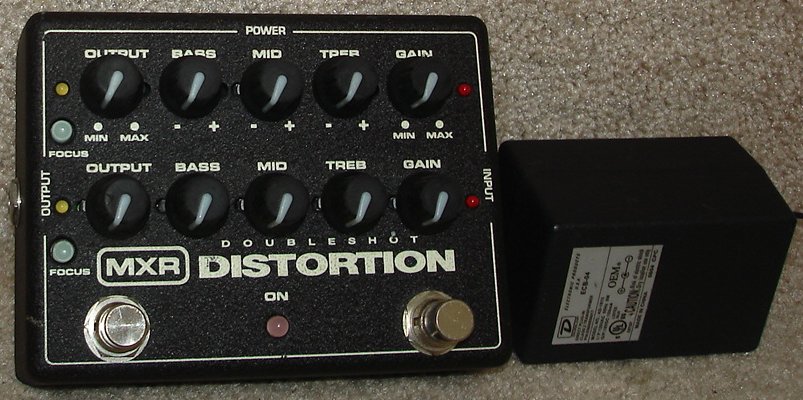
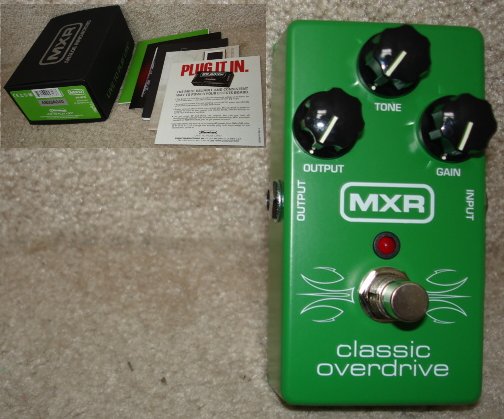
MXR Doubleshot Distortion. MXR
produced one of the classic Distortions of all time, the Distortion+. The M-151
Double-Shot Distortion is the evolution of MXR's original classic designs,
engineered with today's tones and much quieter than the vintage pedals. It
features two distinct channel that let you dial in blues-approved grind or
thick, old-school lead tones. With the touch of a button, you can select
another channel for fat bottom modern metal sounds or radically-EQ’ed fuzz ones. This pedal
features independent gain and EQ controls give you complete control over both
sides of this pedal’s split personality. You can
set up the Double-Shot to go from an in-the-pocket chord part to an
over-the-top lead line. Or toggle between two unique solo tones. Or switch
between two drastically different rhythm tones. Get all your gain from the
pedal or use its massive output to get screaming overdrive from your amp. And
no matter how dirty you run the Double-Shot, all the subtle details and
dynamics of your playing will come through. Activating the Focus control alters
the “Q� (bandwidth) of the bass filter, creating
a slightly emphasized low-end and a mild midrange cut. This subtle, yet
effective tonal shift lets you tailor the pedal for a variety of amp, guitar,
and speaker combinations. Other features include glow in the dark labels and
easy to read pointers for use on dark stages. Click
here for an in-depth review at GP magazine. List price when new was $189,
$119 street price, but this one's in perfect condition for just $75.
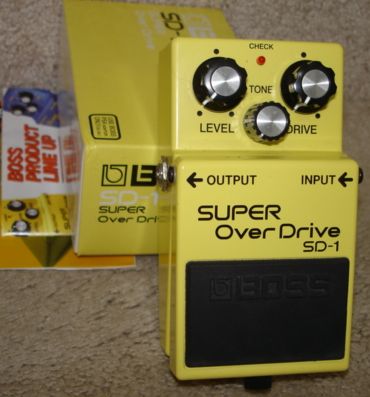
Keeley Boss SD-1 Super Overdrive.
Another fine modified pedal by Robert Keeley, king of the pedal mods. Take a
good old SD-1, a classic one-trick pony, modify the circuit, add a 2-way switch
for your choice of germanium or silicone diode, and you've got more tonal
choices and overall much fatter, cleaner, more defined, and with loads more
gain than a stock SD-1. Rather than adding a long description, click here for Keeley's site. Great sounding Keeley OD for $89.
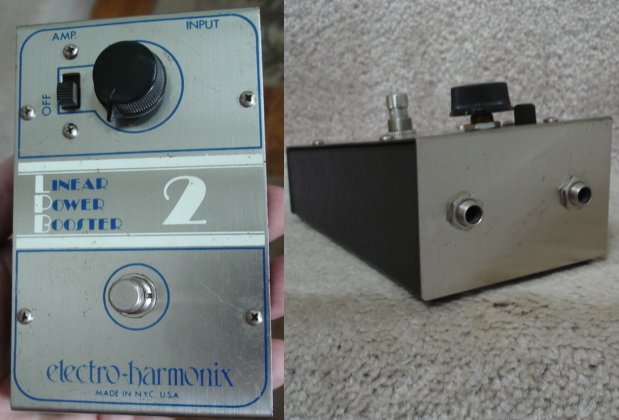
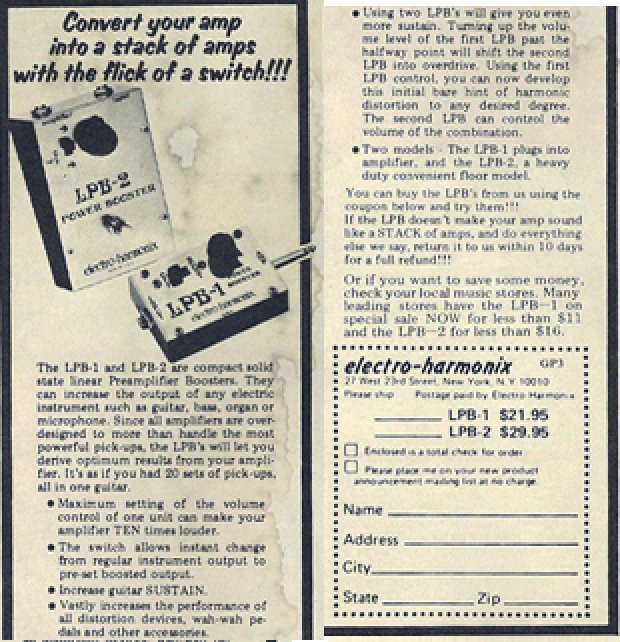
1979 Electroharmonix LPB-2, (circuit). Linear Power Booster. It's as if you had 20
sets of pick-ups all in one guitar...can make your amplifier TEN times
louder... These are the claims used in advertising on the LPB's back in the
70's (see ad here). While these might
be an exaggeration, the LPB-2 can be used effectively to overdrive the front
end of your amp, giving it thicker, hotter tone, or as a boost pedal for leads.
This is one of the cleaner examples of a 70's LPB I've had and a very useable
pedal, even for today's guitar rigs, for $79.
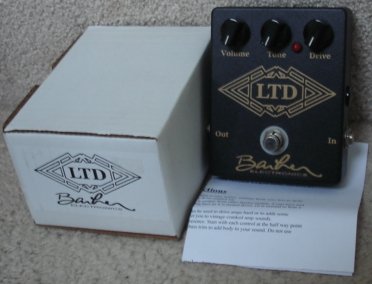
Barber LTD Low Gain Overdrive, (pic2). The LTD dishes out some of the sweetest
clearest overdrive you'll hear, with remarkable chord clarity with excellent
harmonic content. Hand made, one at a time, and
signed by the craftsman, the LTD features precision matched components-using
proprietary specifications to ensure symmetrical clipping and reduced intermodulation distortion. It features true bypass
switching with led indicator using an extremely high grade switch, in addendum
Solid 20 gauge copper hookup wire is used between the jacks and switching to
create the most transparent bypass yet. Extreme volume knob response circuitry
for an amazing variety of shades and textures just by adjusting your volume
knob. The cast aluminum enclosure is incredibly durable and will last decades.
Ready for 18 volt operation-The LTD operates from 9 volts to 18 volts, this
allows use of higher voltage converters and supplies, for players who want to
try higher voltage tweaks. Sells new for $139 but this one's mint in the box
with manual for $99.
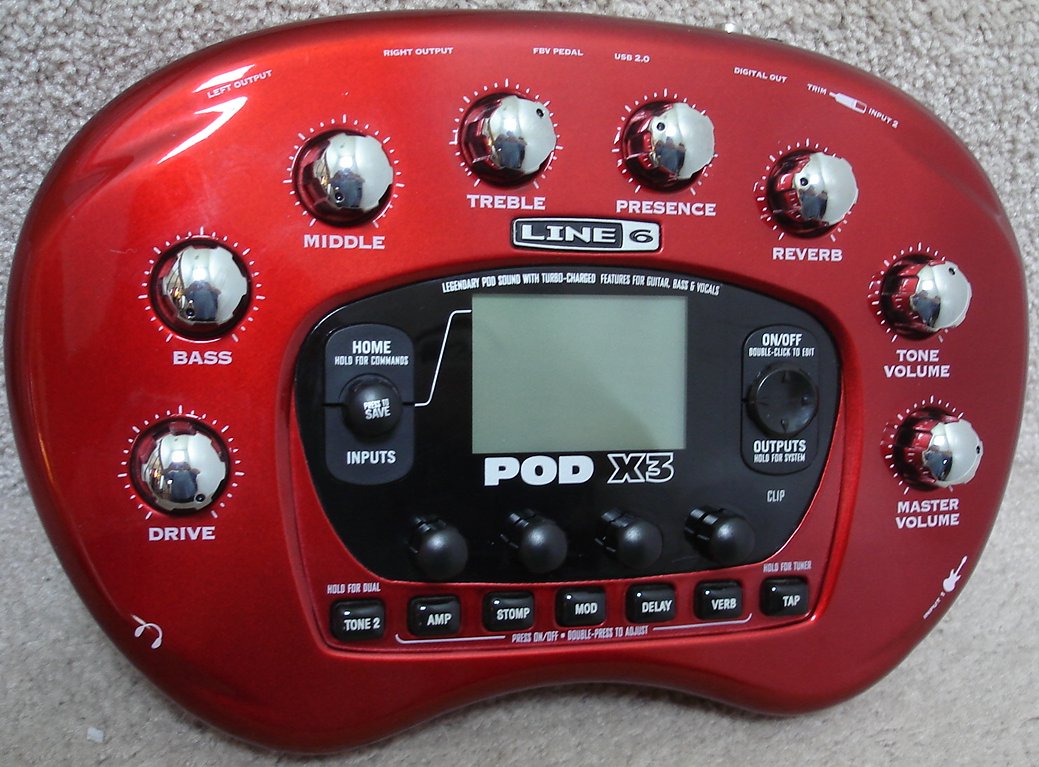
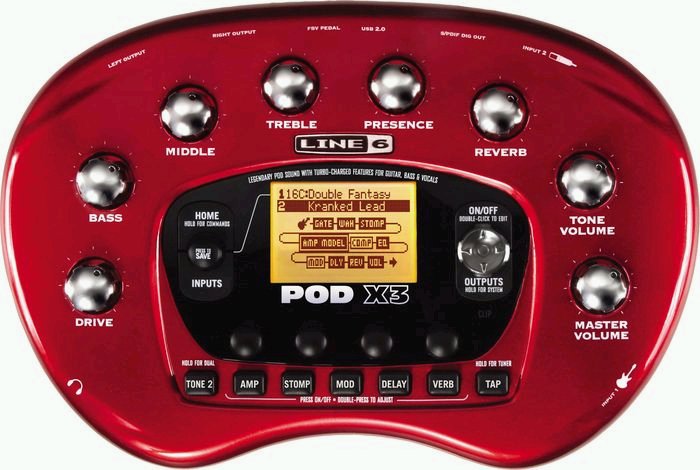
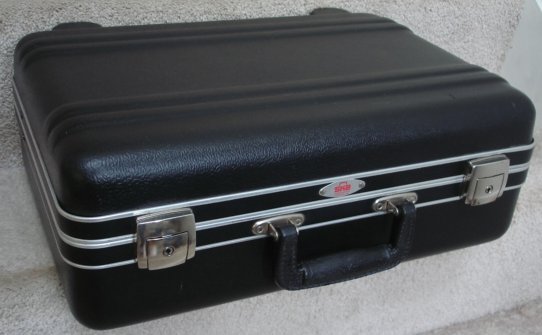
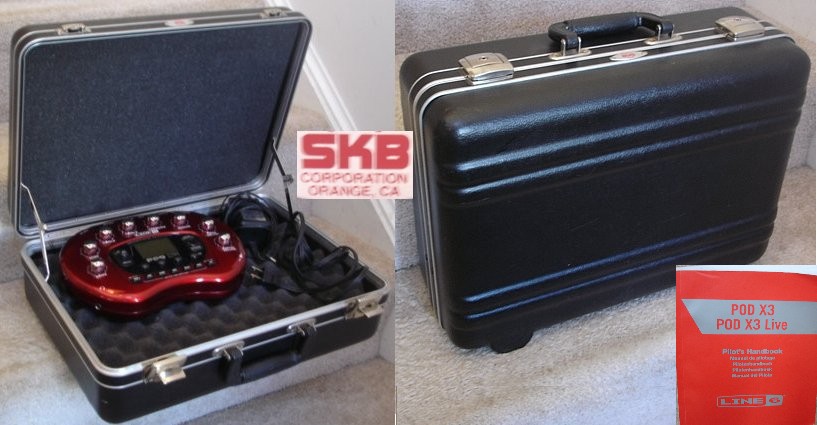
Line 6 POD X3 Guitar and Vocal Modeler,
(stock pic), (SKB case), (complete). The latest and greatest in the
iconic kidney bean POD's. Works great for guitars and vocals, whether in the
studio or live. The X3 has too many upgrades over the earlier versions,
including the ability to run two complete guitar rigs simultaneously. There are
too many features to list but here are a few: 78 guitar amp models, 24 guitar
cab models, 98 stompbox and studio effects, 28 bass amp models, 22 bass cab
models, 6 vocal preamp models, A.I.R.â„¢ II cab/mic
modeling with 4 mic options each, 1/4-inch Instrument Input, XLR Microphone
Input (w/ Trim Adjust), USB 2.0 for computer recording, S/PDIF Stereo Digital
Audio output, Stereo 1/4-inch TRS Balanced Line outputs, 1/4-inch Stereo
Headphones output, FBV Connector for optional pedal controller, Massive model
set for guitar, bass & vocals. Its larger backlit LCD screen contains
plenty of information, without being cluttered, and it's a fairly easy unit to
get around on. The sounds are the best ever on a POS unit and it contains
numerous songs that actually list the artist; names like "Sweet Child 'O
Mine", "Teen Spirit", "Purple Haze", "Strat Cat
Strut", "Sultans of Swing", EVH, The Edge, SRV, Rush, etc. This
unit was just discontinued but you can still find a few new ones online for
$399 ($559 list). This one also includes a top quality SKB case that uses the
same hardware as their guitar cases and sells new for $59. With the case it's a
$458 value...all for just $299! Includes POD, USB cable, power supply, manual,
and case.
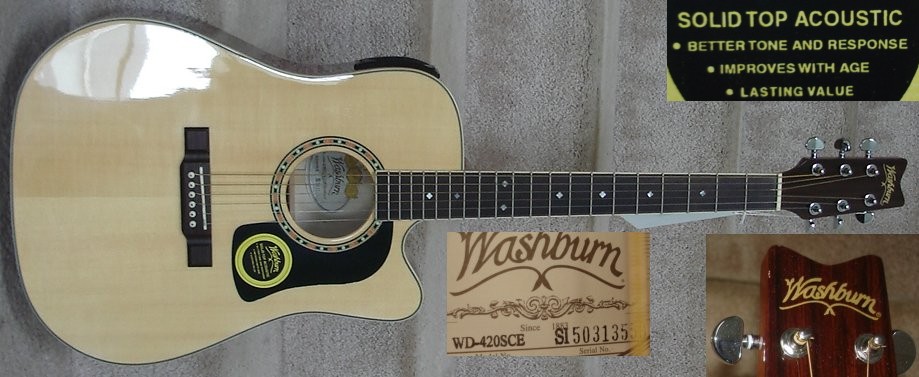
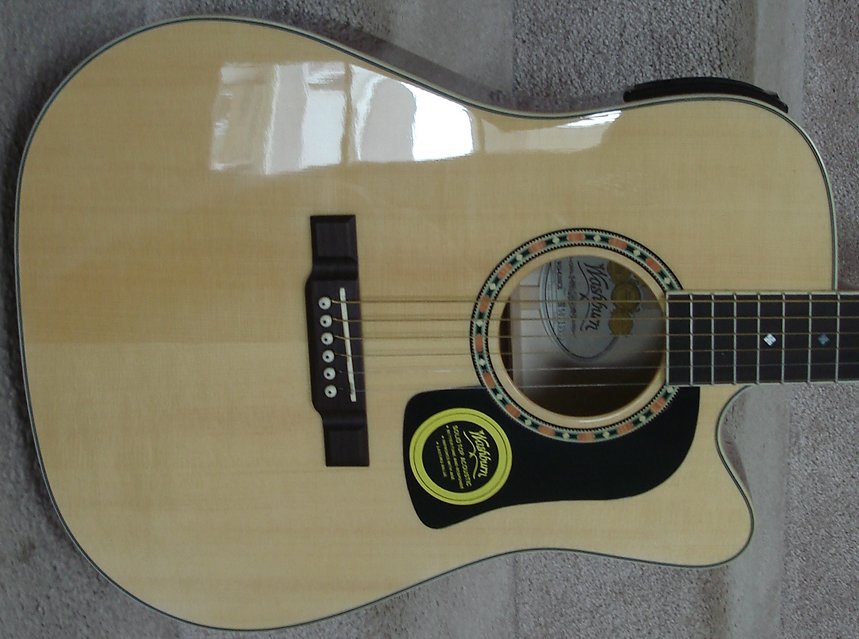
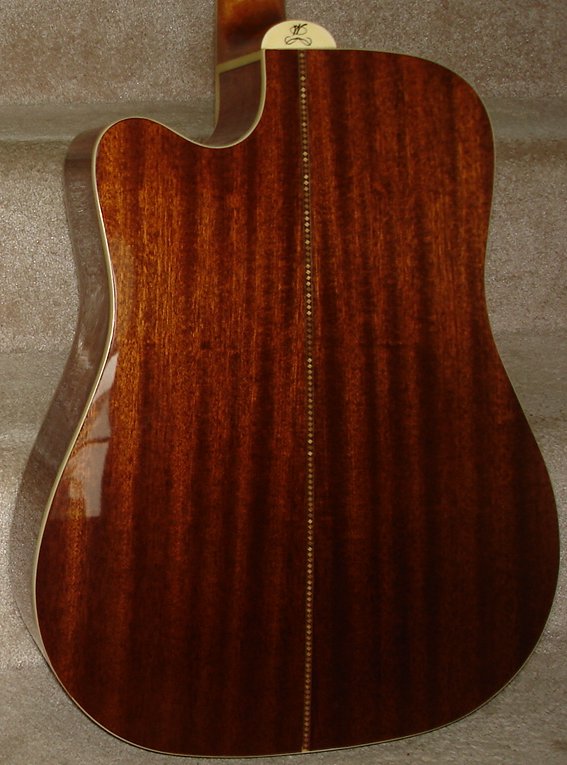
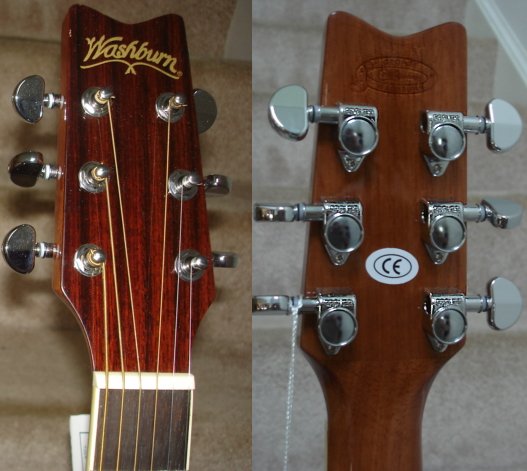
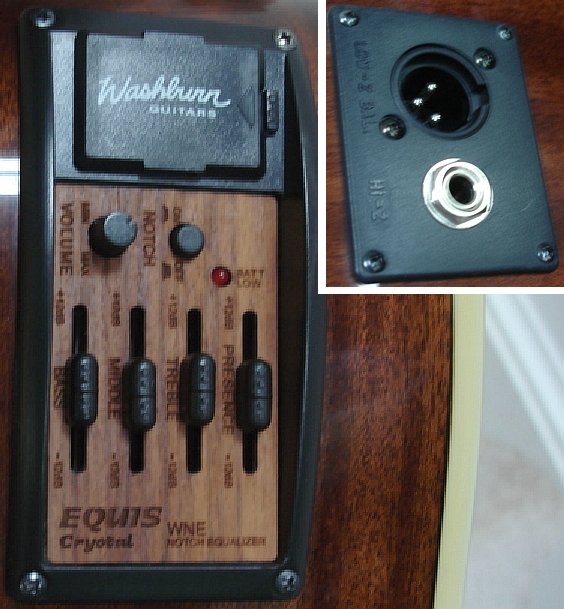
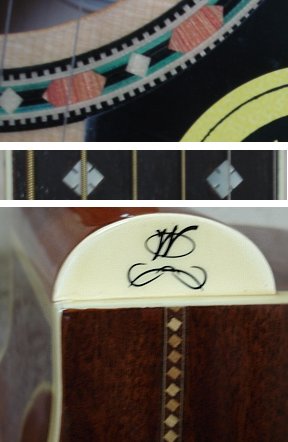
Washburn WD420SCE Acoustic Electric,
(front), (back), (headstock), (preamp/output jacks), (appointments). Brian continues to
find guitars that have never been on the web site. This one is actually a new,
old stock model from 2005. It is unplayed and immaculate. We'll, of course,
install a new set of strings and do a proper setup on it before shipping out
but other than that, it's straight out of the factory container. The WD420SCE
is a fancier version of Washburn's popular D10 series. It retains the same
solid spruce top and mahogany back and sides, but adds some dressed up
cosmetics as well as a cutaway and onboard preamp. It features the Equis Crystal preamp with a notch filter control, volume
knob, and 4-band eq (Bass, Mid, Treb, Pres) and battery low indicator, as well
as easy access door to change the 9V battery. The preamp is wired to both a
standard 1/4" jack plus a low-Z XLR jack for running straight into a
mixer, snake, or acoustic amp. The benefit of a low-z cable is you can use very
long cables without any loss in signal, whereas a standard guitar cable picks
up more noise and suffers signal loss over 20 ft. or so. The solid spruce top
yields a sound with much more clarity and sustain, plus the entire body
utilized Washburn's "Veil Process" finish that is applied very thin,
allowing the wood to breath and age quicker than a normal finish that leads to
a fuller, richer sound. Cosmetic appointments include bound body and neck,
intricate soundhole rosette, snowflake inlays, and diamond-pattern back stripe.
Set up is very comfortable which, along with the solid top and good electronics
system, makes this an excellent value on an acoustic/electric at just $299. Add
a nice hardshell case for $65.
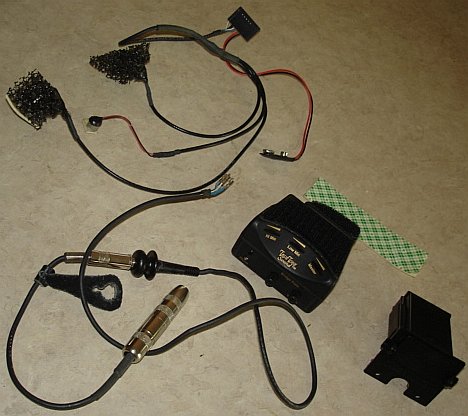
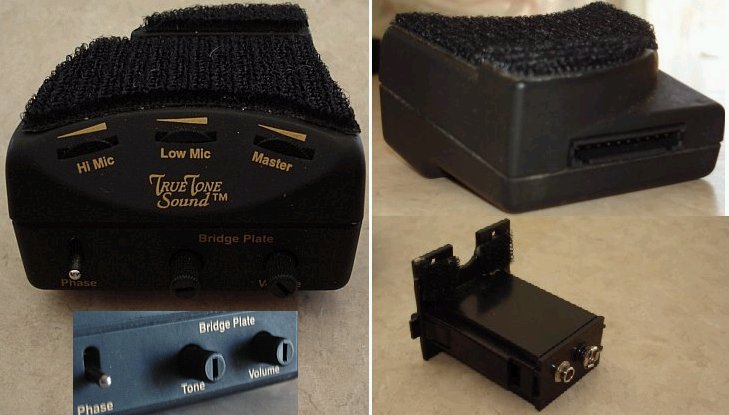
Truetone M7 Acoustic Pickup System,
(pic2). Looking for a quality pickup
system for your prized acoustic that won't require any permanent mods? The
Truetone M7, made in USA, is highly regarded by acoustic players, and can be
installed with non-invasive Velcro. Truetone is no longer in business but has
amassed a large following of fans who were fortunate
enough to acquire one of these before production was stopped. The M7 is a 3-way
system with a bridge Piezo 'pickup' which mounts on the bridge plate, plus
"Hi" and "Low" mics which you
place in the upper and lower bouts, respectively. They're all mixed at the preamp
which has dials for high mic, low mic, and master volume, as well as knobs for
bridge plate volume and bridge plate tone. It comes complete with everything
you need to install. Rather than a metal end-pin tube, it comes with a
standard-looking endpin that houses an 1/8" jack, which you can connect to
a short adapter cable that takes it to a standard 1/4" cable. Click here for reviews
on Harmony-Central. There are very few of these in circulation and users swear
by them. Sold for $400 new, but this one's complete and a quality unit for
$225.
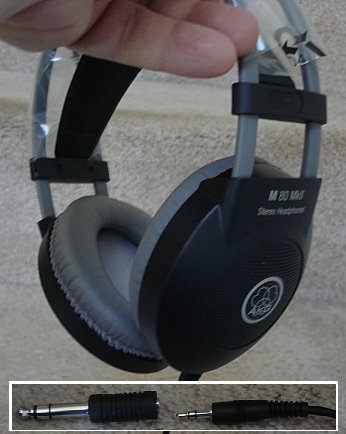
AKG M80 MK II Semi-Open Studio
Headphones, (stock pic). New in
the box. The AKG circumaural M 80 MkII
headphones are a semi-open circumaural design with a 1.57�
driver. Features an adjustable headband, leatherette ear pads, and single-sided
cable. 18Hz-20kHz frequency response offers deep bass and sparkling transients
- excellent choice for home studio on a budget. With a $179 list price, these
are a good buy at $49.99.
D-TAR Timber-Line 18V Acoustic
Pickup, (stock pic).
Timber-line is a piezo cable pickup coupled to an 18 volt, low-noise, high
input impedance preamp with twice the dynamic range of 9-volt preamps. The
increased dynamic range and adjustable bass trim pot gives musicians a more
natural and full sound. Timber-line is the perfect piezo pickup system for
musicians who want a more complex signature from their acoustic guitar. The
Timberline was DTAR's first design in the highly competitive under saddle
pickup race, and it was recognized as not being just another saddle
transducer/preamp. The coaxial element is of the same family as the Highlander
IP1, sensing not just the pressure of the saddle but also the vibration of the
whole bridge. This results in a truly complex tone. DTAR's 18-volt preamp first
saw wide acclaim with this model and it's used in some high end guitars such as
the Renaissance RS6. If you're looking for rich, dynamic tone, you should love
the Timber-line. For all the technical info that explains why this is a great
system, click here for
Duncan-Tuner's site. Easy installation with velcro-attached
9V batteries; set in the element, insert the end-pin/preamp, and you're up and
running. This is a fairly rare model and a excellent sounding unit for $79.
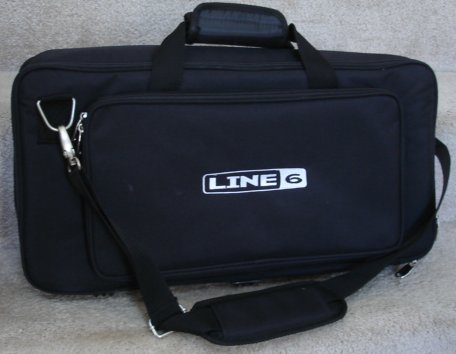
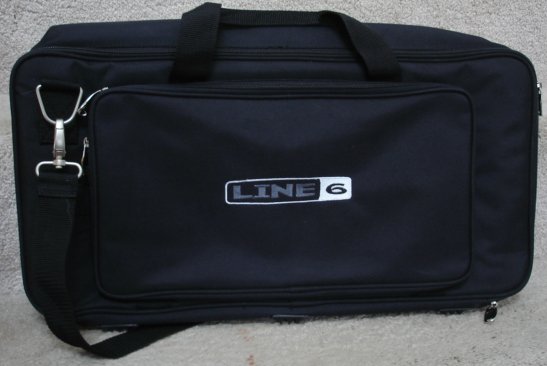
Line 6 POD XT Live Gigbag. Also
fits the X3 Live. Heavy duty bag that features a heavily padded compartment for
your POD and a front pocket with plenty of room for your power supply and
cables. Rip resistant, water resistant fabric has an embroidered Line 6 logo on
the front pocket, an easy-to-carry handle, and an adjustable, removable
shoulder strap. Can also be used to transport a rack preamp such as the T.C.
Electronics G-Major (in stock). It's basically new, purchased just prior to
trading in and offered in mint condition. New cost is $69 but this one is
"as new" and just $39.
RFX PEDALS:
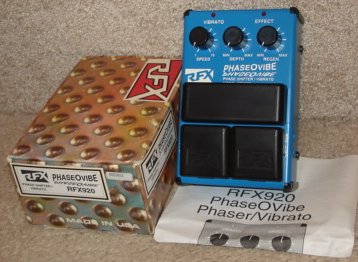
RFX Phase O'Vibe RFX920, (pic2). Another dual-purpose pedal, the
RFX920 features a six-stage regeneration circuit for a rich, full sounding
phaser effect, and with the touch of a switch, it becomes a smooth, classic
vibrato effect. RFX pedals are made in the USA. They all have a specially
designed output that will drive standard pair of headphones for personal
monitoring as well as FET Clickless switching, heavy
gauge steel chassis, dual operation, LED status indication, and easy access
battery compartment. .Mint in the box with manual for $55.
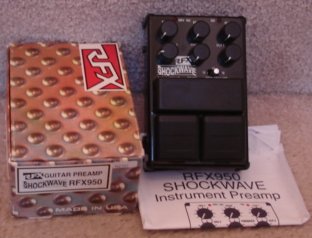
RFX Shockwave
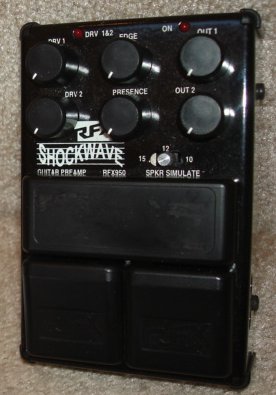
Guitar Preamp RFX950, ( pic2).
The RFX950 is a preamp that can be used directly to a recording device or
mixing board, or through any standard guitar amplifier. The Shockwave has dual
in-line gain stages, with the first channel cascading into the second. Each
channel has its own Drive and Output level, with shared Edge and Presence
controls. Build in speaker emulation switch lets you chose 10", 12", or
15" speaker emulation. RFX pedals are made in the USA. They all have a
specially designed output that will drive standard pair of headphones for
personal monitoring as well as FET Clickless
switching, heavy gauge steel chassis, dual operation, LED status indication,
and easy access battery compartment. Mint in the box with manual for $55.
E-Mu Orbit 9090 Dance Planet Rackmount, (LCD dispay). E-MU's classic 90's rackmount
dance module, strictly engineered for the techno artist. It has 8 MB of samples
of all the great vintage analog sounds plus many familiar and typical sounds
used in house, hip hop, trance, and techno. It includes an essential digital
VCF-like filter that is (on many presets) usually controlled from the
modulation wheel on your keyboard controller. It's great for filling tracks
with lush sweeping pads, or trancing along a 303 bassline pattern and filtering
away. It is a beautiful golden single-space rack unit with a big easy to read
LCD. Used by techno artists like Todd Terry, Roni Size, ATB, and Orbital. Click here for an audio demo of some of
its sounds. There are a number of YouTube demo's,here's one done entirely on the 9090. For
specs, other audio samples, and downloadable manual check out VintageSynth here. A replaced knob but nice shape and a
killer sounding dance unit for $199.
Catalinbread Perseus Sub-Octave Fuzz Same
company as the Catlinbread echo above. The Perseus isn't a one-trick pony like
most fuzz or octave fuzz pedals, with a wider variety of radical tones than
others on the market. The Perseus is named after the Perseus cluster, where the
lowest note in the universe emanates from a black hole. What’s happening out
there is that intergalactic gas has concentrated around a cluster of galaxies,
forming a cloud. A massive black hole is sending out jets of particles that
crash into the cloud, causing pressure waves to ripple outward. Some
astronomers interpret these as sound waves. Of course, even if you call it
sound, it’s too low for anyone to hear. They estimate the note to be a “B flat,�
about fifty-seven octaves lower than middle C. While the Perseus won’t give
you 57 octaves below, it is the coolest analog octave-down fuzz available. It
allows you to select either one or two octaves down mixed with a fuzz sound
that you can blend to any mix of the two you want, including just the fuzz or
just the sub-octave. The Perseus can track the sub-octave note accurately no
matter where on the neck you are playing! It's a cool unit for bass players
looking for a radical tone as well. Click here for full specs and a video demo
at their site, and there are others on YouTube (link). Sells new for $159; this one's mint
for $115.
Behringer FCB-1010 Midi Foot Controller.
For stage use, it's easy enough to go back to your amp and turn a dial on your
preamp but to get the most out of multi-effect in a live situation, you might
want something a little more powerful, with an expression pedal or two. This
unit works well with the GSP1101 or GT-8 listed below, or any other
midi-capable unit. For full specs and info click here for Behringer's site. Very
clean shape and just $99.
Digitech GSP1101 Guitar Multi-Effect, (front/back), (detail),
(back). Digitech's premier effect made for
the live player, with USB and software to translate it to your recording.
Contains 40 great amp models, 40 effects loops, with amp knobs on the front to
quickly tweak your tone, plus a very active online community with 100K hits a
month to quickly download a patch for countless signature guitar tones like
"Eruption", "Crazy Train", etc., which you can just drag
and drop into the unit and it's there until you overwrite the space. If you've
used other units like the RP500 with the DNA2 chip, this unit has TWO DNA2
chips, so you can imagine the power this baby has. A few of the features
include: over 120 amp, cabinet, preamp and effects models including vintage
stompboxes and pickup modeling; stereo effects loop; 40 Tone and 40 Effect
Chain Libraries - 1600 exclusive DigiTech combinations; Global EQ to allow
quick setup for a particular venue; balanced stereo XLR and 1/4" outputs;
chromatic tuner; USB with audio streaming Editor/Librarian software included;
MIDI In/Thru; internal power supply (no wall wart!); front panel guitar input
and headphone output; footswitch and expression inputs; and seamless preset
changes. Digitech makes a "Control2" foot controller for this unit
for $299 but the FCB-1010 above will do the job quite nicely at 1/3 the cost.
For a quick rundown on some of the factory presets, click here for the first 33. Sells new for
$499 but this one's mint in the box with everything and just $350.
Boss GT-8 Guitar Effects Processor, (close-up - click to enlarge). (Note: This
has been on hold for "Jim" for over a year...I guess he changed his
mind and forgot to tell me...). The latest and greatest from the #1 producer of
guitar effects. Just when you think Boss has produced the best multi-effect
possible, they come out with a new one, better than the last. There are too
many features to list here (click here for Boss) but as a brief
description: The GT-8 features a revolutionary dynamic sensitivity switching
mode that switches between two effects. You can play in one amp model/effects
patch when picking lightly and automatically switch into another configuration
when you pick hard. Dual modeling engines let you layer and pan different amp
models together. Seamless program change lets delays and 'verbs decay naturally
when you switch channels. Features 46 amp models each have a solo mode for
instant access to an optimized hi-gain soloing sound, 200 preset patches and
140 user patches with an intuitive layout to make it easy to get around on, 44
effects types include compressors, reverbs, choruses, EQs, wah models, noise
gates, synth waves, sitar, acoustic models, and much, much more. Fully
programmable routing lets you connect all 13 simultaneous effects in any order
you wish. Also features in incredible THIRTY Overdrive/Distortion models and
expansive I/O options include an external effects loop that enables you to add
in your effect that you can't quite nail on the GT-8. Click here for a good overview demo. There are
also dozens of tutorials so you'll never even to read the manual, such as this
one on expression pedal (link). This unit is flawless condition and
comes in original inner/outer boxes with manual and power supply. The GT-8,
recently replaced by the GT-10, listed for $695 and this "as new"
example is as good as getting an NOS model for just $319. It's an exceptional
sounding unit and could be the last guitar effect you'll ever need.
THANKS
to the 2 dozen people correcting me about Steve Jones - nice to know you're
reading closely! 1984 Bond Electraglide, (front), (headstock), (back),
("frets"), (LED window), (power
box), (tools), (case/acc.). Rare bird that made quite a
stir when it debuted at the '84 NAMM show. Despite the media hype and extensive
advertising, the Electraglide was finished in '86, less than 2 years in
production with shipping totals under 1000 guitars. The Bond
"Electraglide", was made in Scotland UK by Scottish luthier Andrew
Bond, and featured a ground-breaking combination of innovative features such as
carbon-fiber construction, high-tech electronics, a digital display and a
fingerboard that featured a height-adjustable nut and utilized saw-toothed
shaped steps instead of conventional frets. Pickups/tones were selected via five
pushbuttons; volume, treble and bass were incremented numerically via digital
rocker switches, confirmed by a three-color LED readout, angled upward to make
it visible to the player only (shown here). With 7 possible pickup
combinations plus phase in/out for each, there are 13 pickup combination in
total ( matrix here). Other features include 3
single coil pickups with "Bond" embossed pickup covers, Schaller bridge
and tailpiece, Schaller tuners, chrome hardware, metal height adjustable nut,
25.5" scale, 1-5/8" nut width, and weight of around 8 lbs. Everything
works properly on this guitar other than one segment of the middle LED is
intermittent and works, for instance, on a "0" but one segment might
be out on a "6" for instance. Although not wildly successful in their
day, the Electraglide has become very collectable due to their rarity and
innovation. There have been several famous users including Mick Jones,
guitarist for "The Clash", is known to have used one with his band
Big Audio Dynamite in the mid 1980s. The Edge used his extensively on The
Joshua Tree, including the solo on “One Tree Hill�, as well as on
“Exit,� and “Mothers of the Disappeared�. Will Sargeant from Echo and
The Bunnymen was also an Electraglide user. This is one of the most complete
packages I've seen and in addition to the original case with keys it includes
original manual, an extra fret nut, a Schaller "kit" screwdriver, original
power supply (many have an aftermarket), and Allen wrenches. It's probably the
nature of this guitar that they all play well but it plays great and I would
guess that the setup would last indefinitely, unless you wanted to change it to
higher action at the bridge or nut. The attack and sustain are pretty much the
same as a good sounding wooden guitar. The neck is a C-shape and a medium
depth. It's in excellent condition and highly recommended for collectors since
it does represent one of the more innovative guitars of the 80's. Really nice
example of a rare guitar for $1250.
Reverend Drivetrain II. The Drivetrain II
has followed in the steps of the "original" Drivetrain, and has
discontinued. Reverend describes this as "a vintage Tube Screamer* on
steroids". It's all-analog design by Bob Weil and Joe Naylor uses the
JRC4558 IC chip to deliver tube-sounding overdrive with more available clean
boost, more transparent midrange and perfectly voiced treble and bass controls.
Goes from a bluesy boost up to classic crunch and singing sustain without
masking the character of your guitar or amp. And I love this: controls,
switches and hand-wired jacks are mounted directly to a heavy steel chassis for
maximum durability and years of no-hassle road use. A few improvements over the
original Drivetrain include 1) Increased output volume - With the drive set all
the way off the pedal is still capable of substantial boosting by turning up
the volume control which allows a cleaner boost for fattening up the sound,
pushing a tube amp over the edge or for simply changing the EQ of your sound;
wider range treble control which allows more aggressive sounds and more tonal
control which is especially useful with dark sounding humbucker equipped
guitars; and 3) Neutral bypass - This buffered bypass does not alter tone when
the pedal is bypassed and does not pop loud like common true bypass switches,
and because it is buffered it prevents signal and treble loss when using long
cables or multiple pedals placed after the unit - superior to standard true
bypass switching. Here's one of many YouTube clips using mainly lower gain
settings (link). In receiving their Guitar One
Award, the magazine cited, "Playing through this pedal is like being
plugged into an expensive boutique amplifier - for pennies on the dollar."
An excellent sounding OD in excellent condition for $115(HOLD-Steve 3/29).
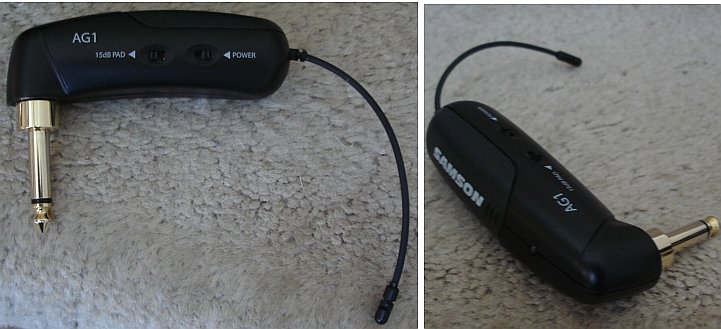
Samson Airline 77 UHF TD Wireless with AG1 Guitar
Transmitter, (front/back), (illuminated), (transmitter). Tired of your belt pack
transmitter with cumbersome cable running into your jack, plus a separate
antenna cable? Samson offers the Concert Airline 77 UHF system with several
transmitters but the best system is the AG1 transmitter which has the
transmitter built into the jack! The AG1 is around the size of your thumb and
features on/off switch and a 15dB pad for use with both passive and active
guitars. It also runs on a single AAA battery with battery life of 12 hours.
The CR77 is a true diversity half-rack receiver and features both 1/4"
unbalanced and XLR balanced outputs, volume and squelch knobs, and LED displays
including Antenna A/B (Green) - Power On (Red) - Peak (Yellow) and RF Level (5
pc ladder). Operates on Samson Channel N1 (642.375 MHz). This unit sounds very
natural without additional compression noted and no drop outs when I walked
upstairs, out the door, and onto the sidewalk. Sells new for $249 but this used
one's in clean shape and is an excellent system for just $165.
Solid Sound Electric Case, I don't know
anything about this case except that its well made and a cool idea. Half case -
half gigbag, it features a plush lining with heavy canvas sides, with a plastic
top and back, and heavy duty zipper closing. Fits a Strat or Tele and probably
many other models. Features a heavy duty plastic handle or has hooks to strap
it over your back. Especially recommended if you're looking for better
protection than a gigbag but want something light weight for traveling such as
players who take the subway to gigs. $39.
1962 Gibson GA-19RVT Falcon, (panel), (back), (chassis), (Jensen
C12R) On the heels of my beautiful '64 Gibson GA-25RVT 1X15 Combo, here's an
even cleaner combo. For the discriminating collector who only wants the
cleanest examples possible here's a stunning first year "Crestline"
model with the smooth brown covering. This has got to be the cleanest example
of this model on the planet - looks as clean as the pics. Panel is immaculate
with no pitting or rust; brown covering has no scratches and even the corners
are free from the nicks usually found on these brown amps; grill cloth is
un-faded and flawless; even the chassis has little to no oxidation. Imagine an
amp that was bought 46 years ago, played for a month, and then kept in a
climate controlled closet until yesterday. Such is the appearance of this amp.
Note the mid-90's Mojotone speaker is installed but original Jensen is in
similarly clean shape and works perfectly. Cosmetics aside, this is a fantastic
sounding amp with a nice clean tone, with just enough headroom to squeak by at
low volume, but crank it up and you get a wonderful breakup starting at around
4 and increasing with each minute turn of the dial. I believe it was rated at
19 watts, thus the "GA-19..." designation, with a pair of 6V6 for
power, 5Y3 rectifier, and three 6EU7's and a 6C4 in the preamp. For many
players, it's loud enough for club gigs, depending on the volume of your
drummer, but again keep in mind that you're getting some nice saturated tones
at higher volumes and if you need lots of clean volume, this isn't the best
choice. To my ears the amp sounds wonderful. Every bit as good as comparable
Fenders and the effects are even better than Fender, especially the reverb, which
is the most lush sounding I've heard in a combo, capable of a subtle background
to completely washing the tone. Likewise, the Vibrato is very pounced and the
speed allows it a proper range from very slow to very fast. Both effects can be
turned on/off via original footswitch that's included. The two inputs are voice
differently and you'll get an earlier breakup and more volume on #1, while #2
is a little bassier and breaks up at a higher volume but when turned up fully,
I think you're getting around the same apparent volume out of either input. The
third input is a line out. The tone control is very strong and takes you from a
very bassy tone - to a very bright tone, without being overly harsh. The tone
is especially useful with the volume turned up and it changes the character of
your overdriven tone much like a quality overdrive pedal. If you're looking for
a good amp, these are perhaps the best value on the vintage market and you can
frequently pick them up in decent condition for under $450. If you're the type
of player, or specifically collector, for whom condition is paramount, you'll
appreciate the fact that a '62 in this condition may come around but once every
few years and with this in mind it's worth the extra funds. Vintage aspect
aside, for a hand-wired club amp with reverb and tremolo in such stunning
condition, a nice find at $750(HOLD-Brad T 2/26), including original and Mojo
speakers. In over 20 reviews on Harmony-Central it scored an incredible 9.6
overall rating; 9.7 on tone.
Seymour Little '59 Middle/Neck
P.A.F.-voiced single-coil-sized humbucker that's great for all styles of music.
Specs here. Clean shape, full leads,
original box. $49.
Seymour Duncan Pearly Gates Bridge The
original custom Pearly Gates pickups were wound for Billy Gibbons '59 Les Paul
Standard for the raw sound of Texas blues rock. Essentially a variation on the
PAF sound, it's sweet, but slightly rude. Specs here. Clean shape, leads cut for
bridge position, original box. $59.
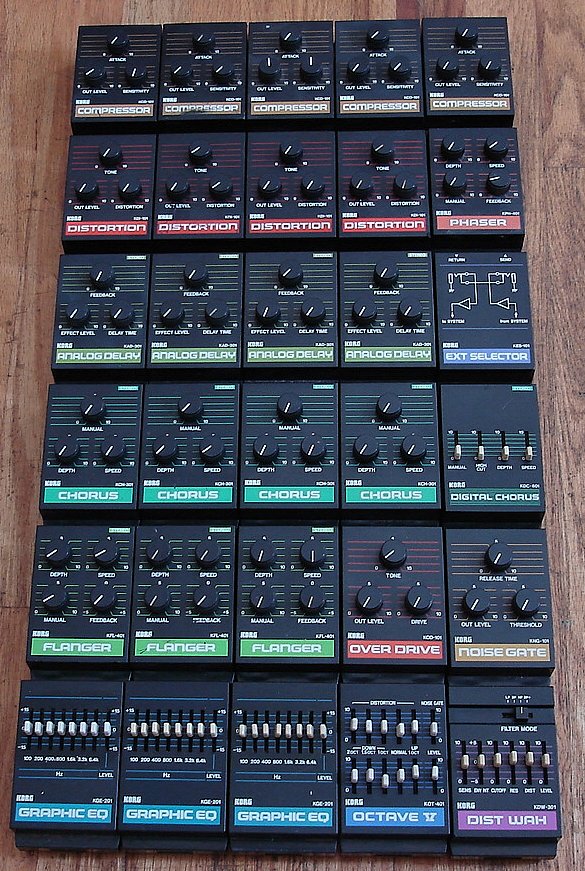
80's Korg PME-40X. I try to keep a lot of
the PME effects in stock (sample inventory). Every now and then I
get in an especially clean unit like this one, complete with Graphic EQ,
Phaser, Distortion, and Compressor. The PME40X (Professional Modular Effects)
was a cool idea from Korg which ran only from '84 to '85, serving as a
pedalboard with power supply, on/off switches for each effect, and master
bypass - with choice of mono or stereo outputs to accommodate those effects
which are stereo. It can be loaded with any of of the 14 effects from the
series, and allowed the user to load the unit with any 4 effects and put them
in the order that sounds best to you. At $229, which works out to around $45
per piece) nicely priced for a clean example of these unique effects.
Weber 10F150-T 10" Speaker. Weber
Ferromax, huge 40 oz. magent, 16 ohm 25 watt ceramic. I think these were clones
of the 60's ceramic Oxford ceramic 10 or Jensen C10Q and are considered by many
to be the best replacement speaker for blackface/silverface Fenders such as the
Princeton, Vibrolux, Super, etc, with a tight low end an lot of punch. You'll
notice that they're more efficient than many others so your amp will be louder.
Keep in mind though that this is a 16 ohm model, which won't hurt your amp but
won't be as loud on an amp that's rated at 8 ohms. Nice shape and just $59.
Museum Quality Case - Fender Mustang/Lead I/II/III,
(back). Ca. late '70s/early 80's tolex case
with black tolex, maroon interior, headstock retainer strap, silver logo. Made
for a student model, the quality is the same as a Strat/Tele case, but was
designed with no storage compartment. This fits a Lead or Mustang properly, but
you can also squeeze a Tele into it although its very tight on the side of the
body. I sold a nice one of these last week but this one is as clean as it
comes. If you have a Fender student model in museum condition, here is a
fitting home for it. $129.
Catalog
Day - these are all original/vintage pieces distributed to authorized dealers -
much more to come:
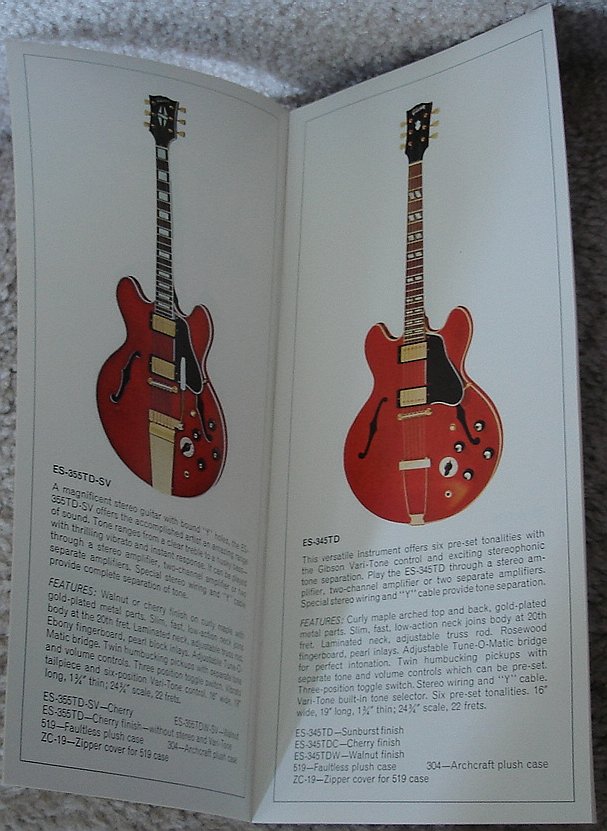
· 1970 Gibson Booklet Set, (example1), (example2). Set of 8 multi-page booklets
including flattops, electric acoustics, jumbo flattops, thinline electrics,
archtop electric and acoustic, 12-string flattops, mandolins, and classical.
$15/each or set of 8 for $80.
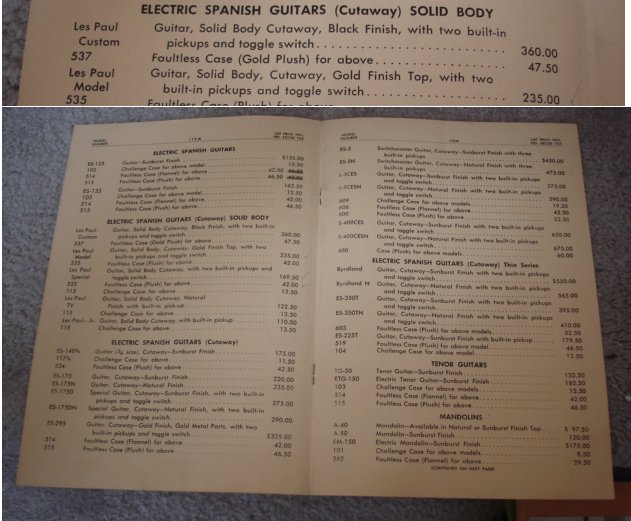
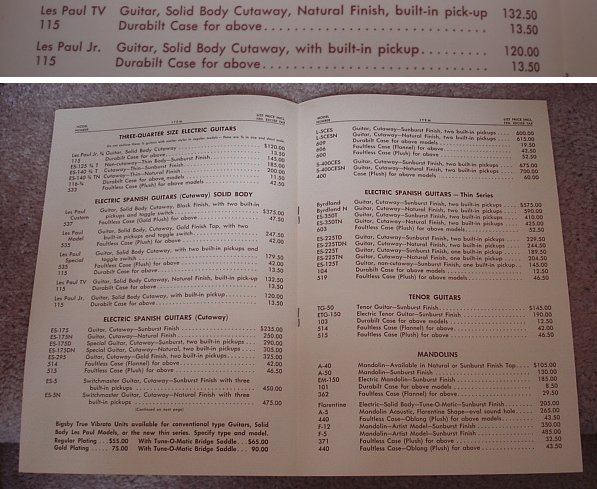
· 1956 Gibson Price List Booklet, (pic2). Guitars and amps. Les Paul Goldtop
for $235! Very near mint. 8 page. $39
· 1957 Gibson Price List Booklet, (pic2). Guitars and amps. Les Paul Junior
for $120! Truly mint condition. 8 page. $45.
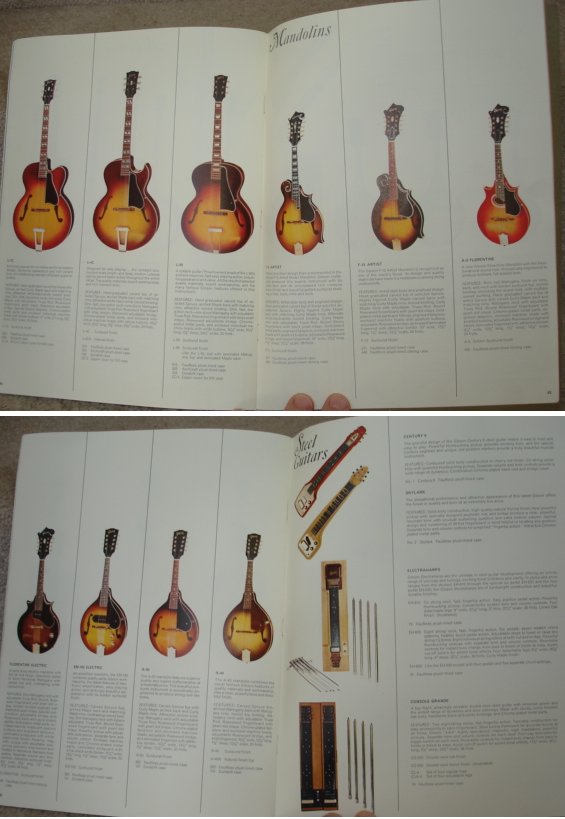
· 1966 Gibson Catalog, (pic2), (pic3), (pic4). 48 pages, extra nice condition.
Includes all types of guitars and basses plus amps, tenors, banjos, mando's,
steels, etc. Has some full page color pics suitable for framing. I have 5 of
these ranging from very good to near mint. $49-$69.
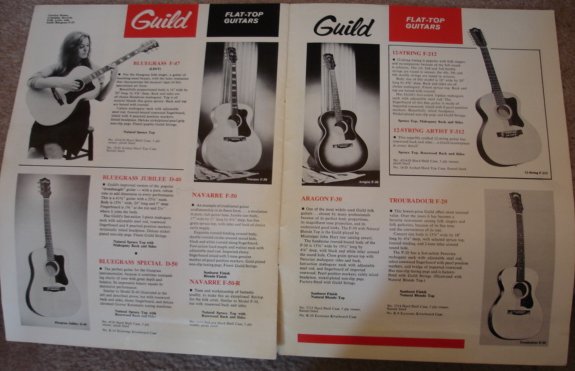
· 1966 Guild Catalog, (pic2), (pic3). 16 pages, full size. You can see
from the cover that Guilds are for jazzers, blues players, cowboys, and young
hipsters. Hard to find Guild literature. $45.
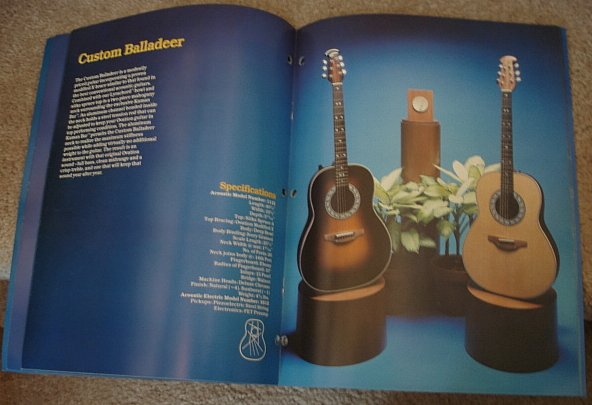
· 1980 Ovation Catalog, (pic2), (pic3). Guitars and parts. Very attractive
layout. 3-hole punched but very nice. Large 44 page. $50
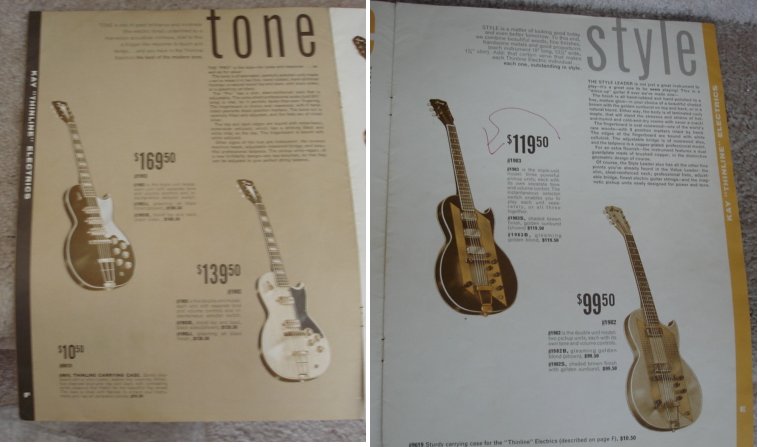
· 1960 Kay Catalog, (pic2), (pic3), (pic4). 16 pages including acoustic flattops,
acoustic archtops, electric guitars, mando's, banjos, amps, steel and lap
steel. Hard to find Kay literature. $55.
Crown 140MAx Pack Power Amp and JBL Monitors,
(back), (remote/antenna/cables), (speaker mounts), (box). Around a year ago I bought this for
our shop to run our Sirius satellite sound through it. I just went to install
it and after reading the manual I found out that it's compatible with XM only.
While it can still function as a small PA system (XLR input) and stereo mixer
(RCA inputs) (close-up), I'm going to order something
that's made specifically for Sirius. It has never been plugged in and was
removed from the box only to shot pics. It includes the Crown 140MAx
tuner/mixer/amp, a pair of JBL Control 1S 2-way speakers, 25' speaker cables,
XM antenna, remote control, and speaker mounts. Rated at 40 watts, this set up
is recommended for commercial use such as restaurants, retail shops, offices,
and of course home. For more info click here for Crown.com. These list at
$699 and sell just about everywhere for $399. Get this set, new in the box, for
$179, including UPS shipping to most places.
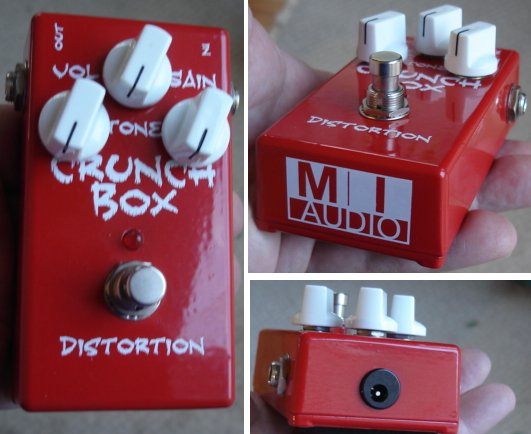
MI Audio Crunch Box Distortion. The Crunch
Box has become the best selling boutique distortion, due in part to a
reasonable price but mostly because it's an excellent sounding pedal. You can
get a variety of sounds out of it but it really nails the tone of a cranked
Marshall, with plenty of mids and it has excellent clarity with no muddiness in
the bass. I guess this one is a version 2 because it does have an internal trim
pot. The trim pot allows you to better match the pedal to a particular amp
adding/removing treble frequencies if needed. It's true bypass, built very well
with jacks mounted to the case and housed in a steel case. Immaculate condition
and just $99.
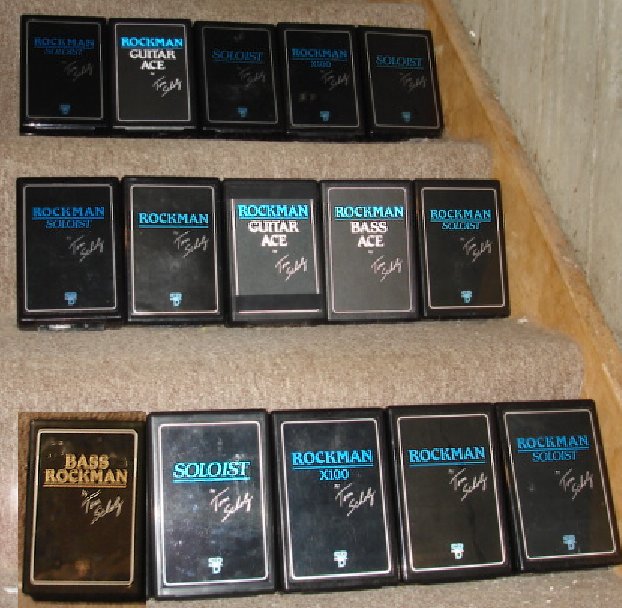
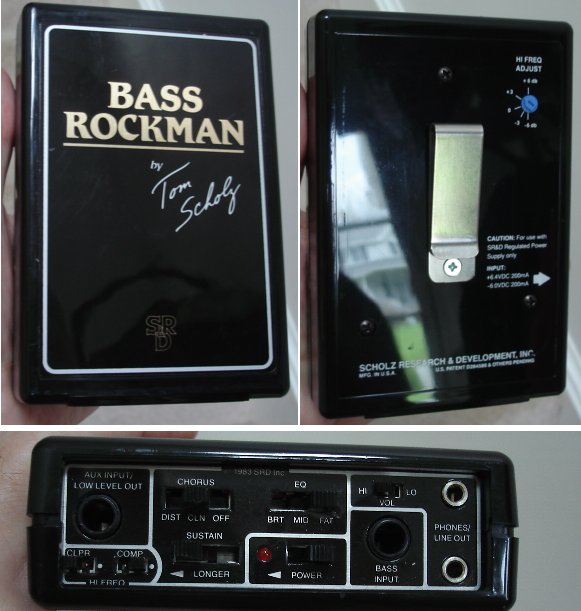
Scholz SR&D Rockman Products. I always
have a good selection of these in stock including the "Original
Rockman" - which was renamed Rockman X-100 (ranging from $139+), Rockman Soloist
($89+), Bass Rockman ($139+), as well as the recent Guitar Ace and Bass Ace
($45). I also have a limited number of Rockadapters and Rockman Wall-wart type
power supply's. Some are in original box, some with original headphones, some
in collector's condition with box, manual, and headphones. If you ever want to
get that "Boston" tone, think of me and I'll have what you need.
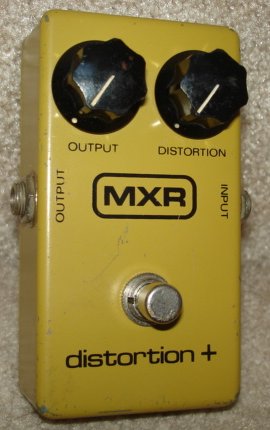
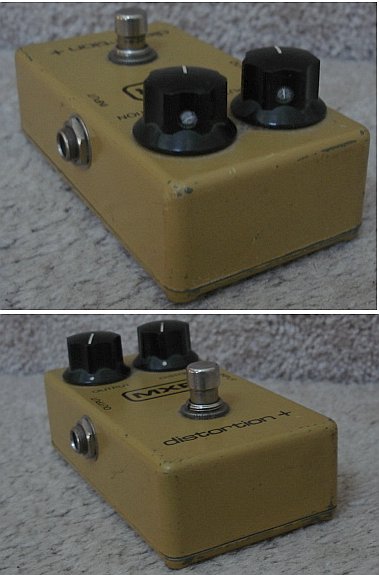
'80 MXR Distortion+. One of the most
popular distortions of the golden era of rock. This is the model used by Randy
Rhoads, an original early block logo unit, without LED or 9V adapter jack
(which began in mid '81). Nice shape as these go for a 30+ year-old pedal and
perfect performance. The Distortion Plus was much more than a
"distortion" pedal. The tone is more like an overdrive-type of sound
ranging from low-volume mild distortion, to a warmer tube-like overdrive, to a
very crunchy fuzztone when you peg both knobs, with loads of sustain. For a
2-knob pedal, it's capable of capturing many different tones which allows it to
be used in a variety of music styles. Pots dated very early '80 and all
original except for battery clip appears to be replacement. Nice MXR for $110.
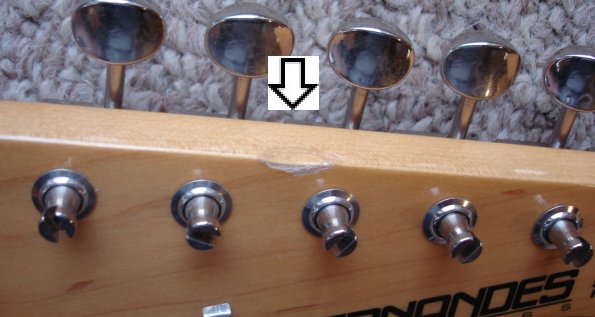
Fernandes Japan Tele Neck, (frets). Removed from a brand new TE-1
Tele, thus zero wear. Perfectly straight with a perfect set-up on the guitar it
came off of. It is in mint condition other than one small in-shop ding (shown here). For a quality MIJ neck,
nicely priced at $169 or $139 without tuners.
Fishman Aura Sixteen, (pic2). Expand the sound palette of your
acoustic/electric guitar, especially guitars with a simple soundhole or
under-saddle transducer. The Aura 16 is a compact yet powerful stompbox
featuring award-winning Aura Acoustic Imaging technology that restores a
studio-mic'd sound to your under saddle or soundhole pickup. Super easy to set
up and use - just plug it in and turn the dial - the Aura Sixteen eliminates
intrusive stage noise and expensive, complicated microphone setups while
providing the most realistic acoustic sound available for stage or studio. You
can also connect via USB, additional images from Fishman's library. The images
were recorded using primarily rosewood back and sides (#11 is mahogany, #14 is
composite), using a variety of quality mics such as the Neumann U87, AKG C414,
and Neumann KM84. Please note that this unit is made for dreadnought guitars
specifically. Click here to read/download manual. This
is a very powerful tool that can transform your mediocre tone into a quality
tone for much cheaper than modifying your guitar. Sells new for $219 but this
clean used one is just $139(HOLD-Eddie).
TC-Helicon Voicetone Create Vocal Effects Processor,
(close-up), (side). Put your vocal effects on the
floor...what a great idea! TC Electronics Voicetone gives the singer complete
control over their mix, no more relying on the soundman or walking over to the
mixer to tweak or change effects. The Voicetone features XLR In/Out jacks in
mono or stereo, has 99 effects patches, loads of Reverb algorithms (plate,
spring, ambient, etc.), loads of Delay types (tap-tempo, ping-pong, slaps,
taps, etc.), Transducer effects (distortion, telephone, megaphone, filters,
etc.), 5 "favorite" performances, each with A/B switching via
footswitch, studio quality mic preamp with phantom power, and much more. From
an audiophile perspective, it exceeds the specs of many high end studio units as
far as noise floor, harmonic distortion, and frequency response. To read the
manual click here. Click here for a quick demo on YouTube. TC
has come out with an updated XT version but the sounds and ease of use are the
same on both units but do you want to pay $249 for the XT when you can get one
that sounds the same for just $139.
Hush Two-Channel Pedal, (pic2). Get the superb noise reduction of a
Hush unit in a dual-channel pedal. It has independent threshold controls to
control the level at which the noise reduction kicks in. One switch changes
from channel A to B, while another switch turns off the unit. Runs off a 9V
batter or external power supply. You see some regular Hush pedals around but
you'll probably never see another one of these. As new, flawless condition,
$85.
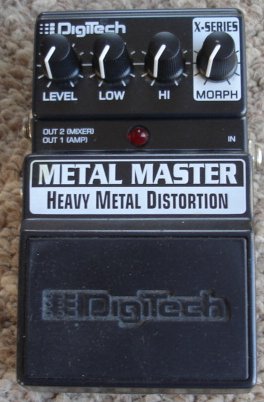
Digitech Metal Master X-Series, (pic2). Get 3 quality distortions built
into one stomp box. With the Morph knob you can morph between a smooth high
gain tone, to a scooped midrange sound, all the way to a punchy mid range heavy
metal sound that will cut through any mix. Super heavy metal chassis will
sustain years of road use. Sells new for $89 but this clean used one's just
$55.
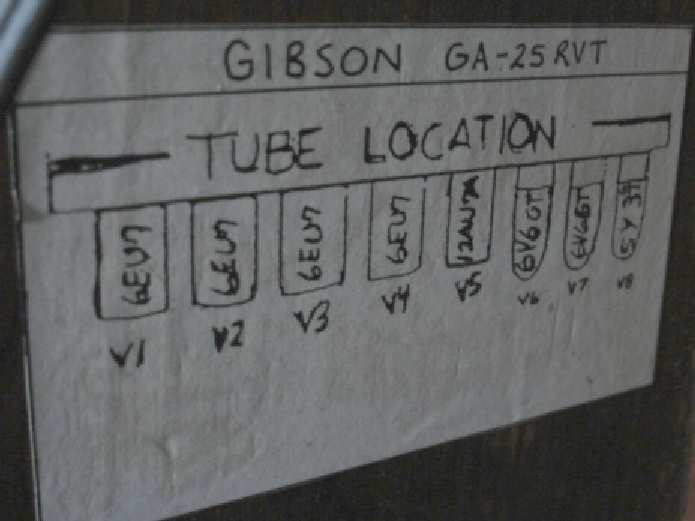
1964 Gibson GA-25RVT Hawk 1X15 Combo, (panel), (top), (back), (speaker/footswitch (tube location). A little known secret in
the world of vintage amps. These brown-era, aka "Crestline", are some
of the best sounding amps from that era, sounding as good or better than
comparable Fenders. The 1X15 Hawk is one of those amps. Even at low volume,
it's a thick sounding amp, and you don't have to crank it to enjoy the tone.
When you hit the sweet spot, at around 6-7, it really sings with a sweet
sustain and rich harmonic content, which increases the more you crank it. There
have been few 15" guitar amps so that alone makes it a rare item. It's
Jensen C15R is from the 16th week of '64 and sounds perfect, although I would
recommend setting it aside for fear of blowing an expensive vintage speaker.
It's a point-to-point circuit of course, and all tube with four 6EU7 and a
12AU7 in the preamp, a pair of 6V6GT's for power, and a 5Y3 rectifier. The
tubes, speaker, and everything about this amp sounds perfect. It is as loud as
it's supposed to be, quiet at idle with no extraneous noise, and no floppy sound
from the speaker. It is a perfectly tuned amp that's ready for a gig right now.
The effects, reverb and tremolo, sound great. There is one peculiarity, and I
think it's then nature of the beast, in that there is bleed over from the
effects channel to the regular channel but from a practical standpoint that
just means you can have effects from either channel. With 4 inputs you'll find
some of the sweetest tones are found by jumping the two channels with a short
cable and then using the individual volume controls to blend the tone to your
liking. It works equally well with single coils and humbuckers, which
frequently isn't the case with Fender amps. This model features a single tone
control, later models featured a separate bass and treble, as well as a 2X10
speaker configuration, but that model is a different circuit and isn't nearly
as highly regarded, i.e. it's "just another Gibson amp". This amp,
however, is regarded by many to be one of the greats from the early 60's and,
best of al, less than 1/2 the cost of a comparable Fender. As you can see in
the pics, this amp is beautifully preserved for an amp that's nearly 50 years
old and would be right at home in a collection or museum, but it sounds so good
I hope it goes to an owner that will enjoy the tone regularly. In my opinion,
it's a super buy at $750(HOLD-Phil H 2/10).
Z-Vox Box of Rock, (pic2). Z.Vex Effect's first
"distortion" pedal, highly specialized to simulate the
"everything on 10" sound of a classic Marshall JTM45
non-master-volume amplifier. You may use the Box of Rock effectively with many
any amplifiers, but it's especially great on a Marshal. It's both a boost and
distortion pedal with separate on/off switches, which gives you 4 tone
selections (bypassed, boost only, distortion only, distortion with boost). One
of the best pedals made for using your guitar's volume control to adjust for
the exact amount of distortion you need, all the way down to very clean and
clear with most drive settings. Z.Vex is noted for some of the coolest pedals
on the market and this distortion is way cool indeed. Click here for YouTube demo and a few
comparisons to other boutique pedals and here for Zvex's demo. Don't pay $199 for a
new one when you can have this nice used one for $129(Tent Hold - Steve S
1/27).
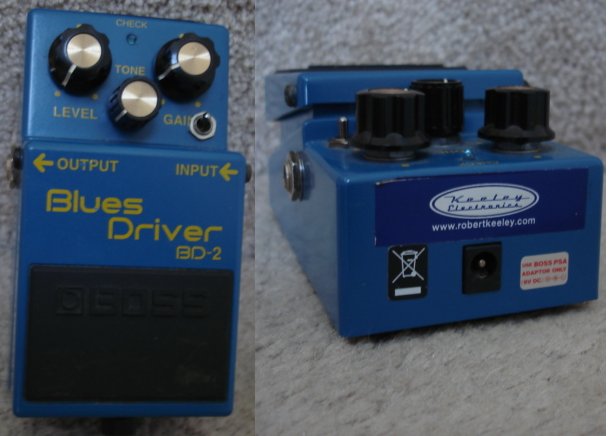
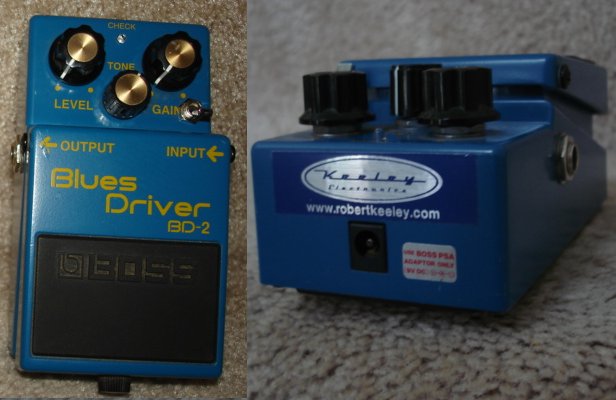
Keeley Boss BD-2 Blues Driver Phat Mod.
Used by players in groups from Steely Dan to Brad Paisley and even "The
Edge" uses one. The BD-2 Phat Mod is a Transparent Overdrive with Full
Range sound, which lets your guitar tone shine through regardless of how you
set it. It's not simply a distortion pedal but rather a tone tool that adds to
your guitar tone, supplying really nice lows, crystal clear high frequency,
great picking response and detail. It differs from, say, a TS9, by its
full-range sound, which is much more transparent and, when cranked, it offers a
grittier/more-edgy tone. It's extremely dynamic and works wonders using your
guitar's volume control to dial in the amount of drive you want. It is perfect
for Hendrix to Country. It's also noted for having that cranked Fender Super
amplifier sound. The "Phat switch" to allows even more of your
natural low end through for those times when you need a little more beef. It's
also noted for having tremendous volume output and can be used as a clean
boost, driving your amp into natural sounding overdrive. New these are $199 from
Keeley. This one's in clean shape and just $125(HOLD-Donald 1/26). (Note: for
box fans, I have one mint in the box for $139).
Gibson Burstbucker Pro (Nickel) Set.
Rhythm Pro and Lead Pro set in nice shape. Excellent choice for modern rock tones
while retaining much of the vintage sound. These are running $196/each in
stores but here's a clean set for $175/pair.
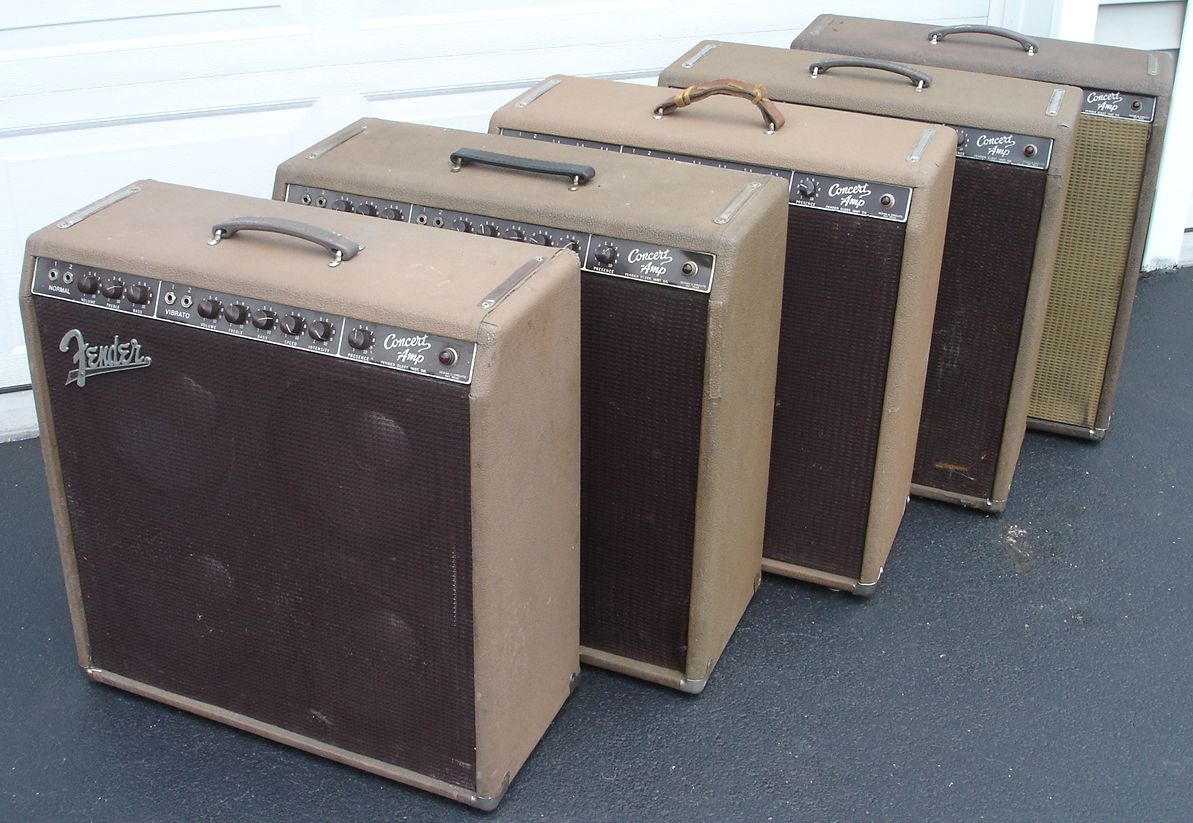
ca. '60-'62 Fender Concert Brownface - LOT!!!.
(Selling as a lot of 5 only). Four years ago I bought these from a collector in
Maryland. Yet another year has passed and I've never had the spare time to go
through each one and sort out the specifics as far as replaced components and
performance. I tested each one when I bought them and all of them do work. A
few sounded great, while others sounded like they needed filter caps or other
minor tune-ups. You can expect a range of originality and condition, for
example, one of them is missing the back panel, replaced with a piece of
uncovered plywood. Another one has two added switches for speaker select (all 4
speakers, 2 speakers, or one speaker). Some have replaced speakers. I am NOT
looking to sell any of these individually as it could be another 4 years before
I dedicate a half a day to go through them. I AM looking for a collector or
dealer who wants a cool brownface Concert collection. Maybe ask a few buddies
if they want to team up for a group purchase. If I were to list these
individually they would be $1300 to $2300, I'm guessing with very little bench
time required to get them all up to spec. Here's the deal: $1300/each X 5 =
$6500 takes 'em all. Price takes into account the range of condition and
performance so I'm not open to dropping the price. Since 5 large amps are
involved, it should be worth the time for you to make the drive which is
desirable since I'm not looking to ship them. In closing I'd like to say that
I'm not selling them individually. Also, I am looking for a local pickup by the
buyers or a freight company who can safely transport them. Did I mention that
I'm only selling them as a lot.
Frenzel HBX - WC30 "Hot Box Wild Cat 30" Head,
(panel), \ (top), (back). Same deal as the FM-5E3 above,
hand-wired, point-to-point, American made, and this one is one of Frenzels
higher-end models. This design was *inspired* by the classic Matchless Hot Box
and the Hot Cat 30. The preamps have three stages of high gain and are modeled
after the classic Hot Box preamp. Frenzel added separate HI - LO inputs, gain
controls, tone stacks, and master level controls to give you maximum tone
control. This allows you to set each channel for the exact tones and overdrive
you want, and then to select or blend both channels with an AB/Y footswitch.
The output stage uses a pair of cathode biased Class A EL34's that will give
you 30 watts of pure sound reproduction. And to finish things off they added a
custom Presence control with an Edge pull switch to contour the sound. This amp
is truly a "wild cat" and will drive you crazy with all the tonal
variations possible, some which you have never heard before! It features a
5U4EH heavy duty rectifier for optimum pick attack and sag selection - or you
can use a 5AR4, or SS plug-in for different amounts of sag. It uses 4 12AX7's
in the preamp and a pair of EL34's in the power section. For a full run down of
features check out Frenzel's site here. Frenzel offers a few options
and this one has two: the steel cage ($100) and effects loop ($50). Even with
these options, this amp sells direct for just $845. Better yet, this one has
seen very little home use and is just $629. (Note: I have a variety of cabs,
including some Avatar 1X12's below).
Gibson Deluxe Tuners. From the '08
Standard Plus above, nickel with aged Keystone buttons. Work properly and a
nice upgrade for your Epiphone or other 3+3 headstock. Includes screws.
$35.(note: these are sold but I have other Gibson Deluxe sets in stock).
PEDAL
DAY!
· Ibanez SD9 Sonic Distortion. Early 80's
Japan; preferred by many over the more poplar TS9. It doesn't have the
mid-range hump of the TS9 with more bottom and upper ends, sort of the
"smile" shape on your graphic EQ which makes it an excellent choice
for metal players. Click here for a bunch of Harmony Central
reviews where it scored very high; 9.2 out of 10 on sound quality and overall
rating. Extremely nice vintage condition, all original, and works perfectly.
The reissue costs $157 and will be worth $110 next week. Why not get the real
thing, that only goes up in value for the same price. $155.
· Ibanez CD10 Delay Champ. Quality analog
delay from the 80's Master Series that sounds every bit as good as the earlier
AD9. Has all the warmth you'd expect from an analog with delay times ranging
from slapback to doubling, to medium repeat, up to 300ms delay time, plus a
great sounding bucket brigade. Considering what AD9's and Boss DM's are going
for, these are a real sleeper on the analog market. This one works perfectly
but has replaced knobs and some Velcro on the bottom. Great sounding delay for
$99.
· Keeley Boss MT-2 with Twilight Zone Switch,
(pic2) Mint in the Box. Complete
Hi-fidelity upgrade! Nothing like a heavy distortion channel that is produced
well! Keeley designed this mod to have an Aural exciter built in for increased
fidelity leads to better bass response and less harsh upper high-frequency. He
eliminated every harsh sounding cap and replaced it with audiophile grade parts
that let the midrange sparkle and breathe, with an increase in presence to take
your tone over the edge. Integral to this mod is the 3-Way Toggle Switch to
give you a sweet volume boost and a fatter tube like circuit designed into it.
The toggle switch gives you three different distortion types. He created two
different tube amp characteristics (switch to the right and to the center) has
tube amp characteristics: huge power, increased harmonics, and better
transparency. Lastly, the LED is changed to a cool blue color. Keeley describes
the stock MT-2 as sounding like "putting a blanket over your speaker
cabinet", i.e. a dull, lifeless tone. Click here for a YouTube demo where the
difference is clear. New these are $199 from Keeley. I have a few in stock but
only one that's mint in the box and this one's $139(HOLD-Jeff M 2/12)
· Keeley Boss BD-2 Blues Driver Phat Mod, (pic2). Used by players in groups from
Steely Dan to Brad Paisley and even "The Edge" uses one. The BD-2
Phat Mod is a Transparent Overdrive with Full Range sound, which lets your
guitar tone shine through regardless of how you set it. It's not simply a
distortion pedal but rather a tone tool that adds to your guitar tone,
supplying really nice lows, crystal clear high frequency, great picking
response and detail. It differs from, say, a TS9, by its full-range sound,
which is much more transparent and, when cranked, it offers a
grittier/more-edgy tone. It's extremely dynamic and works wonders using your
guitar's volume control to dial in the amount of drive you want. It is perfect
for Hendrix to Country. It's also noted for having that cranked Fender Super
amplifier sound. The "Phat switch" to allows even more of your
natural low end through for those times when you need a little more beef. It's
also noted for having tremendous volume output and can be used as a clean
boost, driving your amp into natural sounding overdrive. New these are $199
from Keeley. I have a few in stock but only one that's mint in the box and this
one's $139.
· Tech 21 American Woman Overdrive, (pic2). Although it may not be the most
famous, certainly one of the most recognizable tones in rock history was Randy
Bachman's solo on BTO's "American Woman." Initially they had a tone
on the Sans Amp that was dedicated to this signature tone but later Bachman
worked closely with Tech 21 to design a single pedal he could use with any amp.
After having captured the sound of an entire chain of Bachman's '59 Les Paul
going through amps, mikes, compressors and tape compression in one preset of
the SansAmp PSA-1, the electronics were reconfigured into a single overdrive
pedal. With just the right balance of odd and even harmonics, the American
Woman re-creates the cascading effect of 2 different amplifiers, including pre-amp
and power amp stages. This effect is typically only achieved by running 2
guitar amplifiers into each other. For versatility, the American Woman pedal
can also be cleaned up for semi-dirty and warm blues sounds. It has a built-in
gate to reduce hiss and noise when you're not playing. The Tone shifts the high
cut from 10kHz to 1kHz, allowing you to remove the high end without losing mids
or getting muddy. With an extremely high output of up to 10dB, this will drive
any lame amp into overdrive and give it the gain it's not capable of producing
on its own. New these are $109 but this clean used one has barely been used and
is just $75.
· MXR M-134 Stereo Chorus Pedal, (pic2) One of the great chorus units of all
time, the MXR M-134, is recreated with the same lush analog tone, plus more
tone shaping than the 3- knob original pedals. In addition to the usual
Intensity (depth) and Rate (speed of sweep), plus a Width control to set the
limit of the sweep. It also adds Bass and Treble EQ knobs which help make the
effected sound stand out. If the EQ setting is identical on the effected tone
as the straight signal, much of the effect gets lost in the mix. The one also
includes a Bass Filter button that applies effect to the high frequency effect
only, i.e. doesn't mess with your low end so your guitar retains its fat sound.
You can run it mono, or if you really want to be blown away, use the stereo
outputs for an absolutely huge tone.
· 70's Thomas Organ Crybaby Mod. 95-910511,
(pic2). The original Sepulveda Calif.
model. Original TDK 5103 inductor is noted for having a human voice like
quality. It's a good sounding wah and very much the whacka-whacka sound heard
in scores of 70's R&B and rock songs. Nice shape for its age, no
scratchiness in the pot and a nice price for a vintage Thomas Organ at $115.
· Morley Little Alligator Volume Pedal. A
better volume pedal, built to Steve Vai's specs, and he's a master at volume
swells and playing in general. If you're tired of moving electronic parts
wearing out, relax, this has Morley's electro-optical circuitry to ensure
noise-free, super-dependable operation. The consistently smooth audio taper is
steady and predictable plus a "minimum volume" knob is provided for setting
a smooth transition between rhythm and lead volumes. Also features easy-access
battery compartment and 'gator green LED indicator. Sells new for $85; this one
works perfectly for $50.
· Line 6 POD 2.0. The most influential
multi-effect on stage and in the studio of all time. I've written so much about
these over the years that you'd have to be a cave dweller to not be familiar
with them. This one isn't for the collectors but it works perfectly and just
$99 with power supply.
· Novation NSP-1 Momentary On/Off Switch. I have
a few of these, new in the box. It has rubber pads on the bottom and top to
keep it from sliding when you stomp on it, plus a polarity switch which enables
it to work with any 1/4" jack. These are great for keyboard damper pedals
- buy three if your keyboard is set up like a real grand piano. It's also
perfect for recording punch in/out, doing overdubs. You can also use it as an
amp/effect footswitch if you don't want the effect to stay on, since it will
engage only as long as your foot is pressing down.
Upgrade before we ship - Earvana Nuts.
Instantly improves the intonation of any guitar and we're getting more and more
requests to install them on guitars before we ship out. Martin is very big on
these so that says a lot to me. If you want one installed before we ship your
guitar, let us know. The part alone will run you $34.95 from Earvana but we're
offering the upgrade for just $49/total, parts and labor, for most guitars. For
details, click here.
Pearl AD33 Analog Delay, (back/side), (bottom), (box/man.). For the discriminating
collector - museum condition, and a very rare model from a rare brand. I come
across many pedals and I've never seen another one of these. Nothing has the
warmth and natural tone of analog, especially analog delay pedals, which is why
prices on vintage Boss DM-2/3, Ibanez AD9, and other 80's digital delays continue
to climb. The AD33, from the "Sound Spice" series, is from the same
era, with one very distinct difference - the AD33 is like having to AD's, with
two separate program channels, with independent delay time and feedback (number
of repeats) controls. It also has a footswitch jack that can control on/of and
program I or II, which I guess is useful if you want to locate the pedal in a
rack. Other features include delay range from 20 to 350ms, noise reduction
circuit and variable filter circuit for crystal clear sounds and wide dynamic
range, regulator IC's for stable power at a constant voltage, optional 18V
power supply jack, electronic switch and gates with C-MOS IC's to prevent
"clicking" when switches are engaged, battery life warning circuit,
heavy duty housing made of die-cast aluminum, LED's for on/off and selected
channel (I or II), and peak indicator LED to warn when incoming signal is too
hot. Pearl had a regular single delay from this same series, the AD-08, which
easily competes with Boss and Ibanez from the same era and is similarly priced.
Frequency response on 80's analog delays was usually 3KHz and under; some, like
the DOD FX90 only went up to 1.3KHz. The AD33 goes up to 4KHz (20KHz when
disengaged). The higher range is especially noticeable on the short delay
settings. This unit sounds as good as it looks. A single unit Pearl AD08 in
fairly clean shape is getting $225 and I'd imagine one in collector's condition
would be $300+. If you're looking for the cleanest of the clean, or simply want
a great sounding analog with two delay settings, here's a once in a decade
chance to pick up one in 9.9+ condition. $375 includes original manual and box
which is still in very crisp condition.
Halogen Stage Light Bulbs. I found a bunch
of new bulbs, some going back to the Mars Music sellout. All are new in the
box. Ushio jcd-120v-600w 600 watts for Par-56/Par-64 cans; Chauvet fcr-12v 100w
100 watts for misc. stage lighting; Chauvet 64535 120v600w 600 watts for Par
cans; Chauvet J79-mm-120v 100w 100 watts for misc stage gear. Most of these
list at $18-$30. Take your pic for $8/each.
Tuners
and Pick Ups!
· Kahler Pro Saddle Set. Fits the Kahler Pro
above, and possibly others. USA made. $18/each from Wammiworld.com, the best source for all
your Kahler needs, but here's a full set for 1/2 that price, $54/set.
· Tonepros Tuneomatic Bridge and Posts.
Includes TP6-C Nashville bridge as well as posts kit with wrenches. Direct
retrofit for Gibson but will work on nearly any ABR/Nashville equipped guitar.
This set was installed briefly but appears un-used, mint condition. These are
currently $106 for the pair from Allparts. Get this set for just $65.
· Fender American Standard Tuners. Fits all
USA Fenders, '86 thru now. Installed briefly but perfect condition. $35
· Hamer USA Tuners. Removed from a 90's
Studio. Clean shape. $45.
· 60's Kluson Deluxe - Nickel. 60's double
line with metal oval buttons for your vintage Rickenbacker, Gibson, and others.
Pat. D-169400. Includes ferrules and screws. $225.
· Fender SCN Strat Sets. The latest
evolution of Fender's search for the perfect vintage tone...without vintage
noise. They're quiet and sound like a Strat should. The bridge pickup is hotter
at 11.6K while the middle and neck are 6.5K. New in the box and just $125/set
· 1974 Fender Jazz Bass Set. Nice set of
vintage gray bottoms, bridge and neck. Rewound by Kent Armstrong for another
35+ years of sweet Jazz tone. $225/pair(HOLD-Jyrki 11/22/19).
· Gretsch PAF Filter 'Tron Set. The real deal
PAF's for your ca. '57 to '60 Gretsch. Both are proper low output, around 4K,
and sound perfect. Very clean vintage condition. $700 (be glad you're not
looking for Gibson PAF's...).
· Fender '05 Standard Strat Pickup Assembly.
Good year for Standard Strats - USA CTS pots and switch, pickups that I believe
are essentially American Standard - they look identical other than wire colors.
Includes knobs and switch tip (not shown). Just mount on your pickguard, hook
wire to output jack and attach ground wire and you're done. Excellent condition
and a cheap upgrade to any Asian import - just $45 - or we can mount on one of
these MOTS pickguards (pic here) for $25 more. They're 11-screw and fit a USA
or Mex body exactly.
Kent DM-13 Dynamic Mic, (cable) I need to have my tech repair the
cable before I can give a tone report, but all of these mics were working
perfectly when put in storage in the early 70's. Comes with swivel mic stand
adapter (screws onto a standard mic stand) that also houses the on-off switch.
50K impedance, made in Japan. Cool looks with a long sculpted chrome shaft.
Assuming it works perfectly, which we'll guarantee prior to shipping, $59.
Kramer Wireless Guitar Transmitter by Samson,
(installed pic). Very rare part for an
extremely rare Kramer. During the late 80's Kramer offered as an option, a
wireless Samson transmitter, fitted into an extra cavity on the back of the
guitar. According to Vintage Kramer (link), the best Kramer site in the
world,"These models are extremely rare, and was probably more of a gimmick
that never took hold. Nevertheless, these models are superb...". If you
need one of these, I've had this one for over 10 years and as it appears as
though I'll never need it, so it's time to find a new home. $150.
Gemeinhardt M2 Flute, (pic2), (pic3). If I'm reading the chart right,
this is an M2 (currently 2SP) from 1973. These were USA-made student models, but
silver-plated and I'm sure better quality than the current proliferation of
Chinese brands. Pads may be perfectly functional but the only thing I know
about used flutes is that they frequently need new pads. At $60, there's enough
savings that if it needs pads, you can get the job done and still not have too
much invested.
Crate FS-60 2-button Footswitch. Labeled
Reverb and Channel Select. For most any Crate amp but should work with most
amps using a stereo 1/4" jack. $20
Tech 21 Trademark 60 3-button Footswitch.
If you've ever needed one of these you know that they're proprietary, they're
not mechanical, and nothing else will work. $94 from Tech 21, the only
suppliers. This one's perfect and just $64.
ElectroHarmonix Little Big Muff Pi. Based
on the original 70's big bog model, with the great sustain and killer
distortion, in a pedalboard friendly small box, in a die cast housing that's
more roadworthy than the cheese cutter original big box. Here's a demo from EH. Good value in a
quality USA EH pedal at $47.
Ernie Ball Volume Pedal. The one the pro's
use. Built for years of road use, crystal clear with an even taper - great for
humbuckers or single coil. Nice shape and nearly 1/2 of new cost at $69.
Keeley Boss SD-1 Super Overdrive. Another
fine modified pedal by Robert Keeley, king of the pedal mods. Take a good old
SD-1, a classic one-trick pony, modify the circuit, add a 2-way switch for your
choice of germanium or silicone diode, and you've got more tonal choices and
overall much fatter, cleaner, more defined, and with loads more gain than a
stock SD-1. Rather than adding a long description, click here for Keeley's site. Not
collector approved but it works perfectly and a killer OD for $89.
Ibanez MS10 Metal Charger. Previously
known as the SM9 Super Metal during the 9-series a few years earlier, when
Ibanez came out with the "Power Series", aka "10-series",
it was renamed the MS10. It has the highest gain and highest distortion level
of any Ibanez pedal of the era. Despite the 3 controls, labeled
"Attack", "Punch" and "Edge", it will always
sound like a metal pedal, so if you want versatility, you should only buy this
if you're using another OD/Dist in your setup. "Punch" cuts/boosts
bass - center is flat; "Edge", centered around 1.5K, controls treble
with the center flat; and "Attack" accentuates or minimizes the sound
of your pick attack. Inside you'll find FOUR of the famed JRC4558 chips to give
you unprecedented control over your metalness. Overall very nice shape other
than previous owner sanded down some of the green to make it two-tone finish. Click here to view the catalog page. For
you 10-series fans, MS10's don't come along that often. This one's $79.
Baja Tech Bone Bender Original 2-knob
version! Germanium-based Sola Sound/Vox Tone Bender clone that gets those early
Tone Bender tones (Beatles, Mick Ronson of Ziggy Stardust fame, Yardbirds,
etc). Built with top-notch components and has true bypass to preserve your
signal. For details, and sound sample click here and here's a good YouTube demo of the later
3-knobber. $145 new but this perfect used one is just $99(HOLD-3/9).
Lovepedal Kanji 9 Overdrive The Kanji 9,
so named due to its 9 tone settings (two switches, 3-way each switch), is a
very versatile and extremely well made OD pedal. It features true bypss,
premium electronic components, knobs for Volume, Tone (Treble Boost), and Gain;
blue LED indicator, and two 3-way switches for changing diode clipping stages.
It produces enough gain to rock you harder than any box you've used, but cleans
up very well by rolling back your guitar's volume control, or choosing a softer
clipping setting. Click here for a YouTube demo. I don't
believe they make this black model 9 any longer. This is an excellent sounding
unit that's mint in the box with manual, priced at $165(HOLD-Bill S 4/10).
B.K. Butler Tube Driver Reissue. Butler
had one of the first tube overdrive pedal, using a 12AX7 to warm up the tone.
Due to incredible demand for the originals, Butler has started building a
limited run of his classic 4-knob Tube Driver, at a rate of around 6 per week,
with a 6 to 8 week waiting list. He hasn't set a limit on total numbers but
when they're gone, they're gone. The design and sound is the same as the
original (as supplied to Eric Johnson, David Gilmour, etc.) but with improved
parts such as Switchcraft all metal jacks, click pots, etc. Each unit is hand
built to his specs and Butler personally checks out each unit to ensure it's
working perfectly and sounds great. He then engraves his signature on the
bottom of the case to ensures authenticity now and in the future. These are
$299 plus shipping new but this one's in perfect condition, available now, and
$225. Here's a cool video to let you hear some of that sweet Eric Johnson tone
(link).
OFF-HOLD:B.K. Butler Real Tube Overdrive. Butler
was responsible for the plethora of tube overdrives that are around today.
Beginning with his original Tube Driver, advertised in Guitar Player mag in
1979, his pedals later gained favor with the likes of Eric Johnson, David
Gilmour and Billy Gibbons. Here's a great interview with the man (link), where he talks about this black
version stating, "I then designed the black Real Tube pedal in 1986 which
I still think is a superior pedal in some ways to the Tube Driver (ZZ Top’s
Billy Gibbons agrees)". You'll note in the interview that he has no
association with Chandler and that there never was a "Chandler Tube
Driver", stating, "It's all Butler." This is an excellent
sounding, unit, built to last a long time, with quality click pots, jacks
mounted directly to the case, and a very heavy steel casing. We cleaned all the
pots, installed an ARS Tesla/JJ tube, and replaced the pop rivets on the
transformer (tranny was starting to get a bit floppy), so it's ready to go for
another decade. This is a genuine Butler pedal and a good deal at $115.
A
bunch of pedals by MXR:
· 1981 MXR Dyna Comp See description above -
this is basically the same pedal except with LED indicator and 9V adapter jack.
Very clean shape. $65.
· 1982 MXR Dyna Comps See description above
- this is basically the same pedal except with LED indicator and 9V adapter
jack. Very clean shape. $65/each.
· MXR Dyna Comp. Recent Dunlop reissue. Very
clean shape. $45
· MXR Classic Overdrive. Very good sounding
unit that emulates the sound of an overdriven tube amp, in the way of a TS9.
The circuit is supposed to be near identical to the Zakk Wylde Overdrive. I
don't have one to compare right now but from memory, it's pretty close. Works
very well with humbuckers, or with Strats, where it does a good job of
fattening up the tone while retaining the character of the Strat. True bypass,
heavy construction, and a nice pedal for $45, as new in the box with
everything.
· '79 MXR Distortion+, (circuit/pot date). Another '79, just like
the one I posted two weeks ago. This is the model used by Randy Rhoads, an
original early block logo unit, without LED or 9V adapter jack (which began in
mid '81). This was perhaps the most popular distortion effect of its era, and
this is a nice example, cosmetically in nice shape for 30+ years and perfect
performance. The Distortion Plus was much more than a "distortion"
pedal. The tone is more like an overdrive-type of sound ranging from low-volume
mild distortion, to a warmer tube-like overdrive, to a very crunchy fuzztone
when you peg both knobs, with loads of sustain. For a 2-knob pedal, it's
capable of capturing many different tones which allows it to be used in a
variety of music styles. Very nice pedal for $125.
***DiMarzio
Day, 2011*** Free shipping on orders of 2 pickups or more.
· DiMarzio DP114 VT-1. New, very old stock.
Built for a Vintage Tele (VT) tone and is a direct retrofit for any Tele routed
guitars. Never installed, new in the box with instructions and screws. $65.
· DiMarzio Super Distortion DP100. New in
Box. The choice for some of the top players such as DiMeola, Gambale, Vinnie
Moore, and Ace Frehley. High output with a pronounced mid, regular spacing, 4
conductor for variety of wiring applications. New in the box for $55.
· DiMarzio Tone Zone Strat Humbucker DP189.
New in Box. Sounds just like the full size humbucker Tone Zone, except in a
single coil size. Dual rail design ensures consistency during bends. Noted for
extra bass and mids for a very fat tone. Has been out of the box but never
installed and comes with instructions and screws. $59.
· DiMarzio Virtual Vintage Blues Strat Set DP402.
The DP402 is almost identical to the original pre-'63 Strat, with the
original's attack, tone, and feel, and its single-coil look. The difference
though, is that DiMarzio has eliminated the noise. 3 of these will run $195
new, or you can get this clean trio for just $135(HOLD-Nelson V 4/20).
· DiMarzio Super Distortion. 70's vintage,
2-conductor. Medium output and an excellent choice for the EVH tone. Works well
on SuperStrats or LP's. $75.
· Dimarzio Al Di Meola Set The original
signature model, now available only as a special order from the custom shop.
Note the slotted screws on the bottom, whereas recent custom shop have
Phillips. They're regular spaced with black bobbins, gold hex poles, gold base
plate, and signature edged on bottom. I have never seen another set of these on
the market so I'm guessing they're rare. Excellent condition, with rings, for
$299.
· DiMarzio Strap Lock Set. Used, Includes
strap and all parts. Probably the safest locking method on the market. I have a
number of these in stock, some straps marked "DiMarzio" and some
plain. Just $15, including shipping - or 2 for $25, 3 for $35.
Alesis Quadraverb GT Chip Kit. If you have
a Quadraverb with a chip that's on the fritz, make it work again. Version 1.03.
Includes hard-card with list of patches, and tweezers for removal and
installation. $35.
EVH D-Tuna. Installs in a few minutes.
Ingenious innovation for players who occasionally want to drop the low-E to a
D; and back to E again. Used in original packing. $35.
BMF Fat Bastard One-Off. Donated for an
Ebay charity auction by BMF Effects, this is a
one-off Fat Bastard with a nice landscape paint job, labeled simply
"BMF". The Fat Bastard is a clean boost that adds a little weight to
your sound without destroying your tone. With a fair amount of gain available,
it is perfect for getting your leads just above the mix, boosting overdrive or
fuzz pedals or pushing a tube amp into a nice, warm break up. The preamp
section on some amps tends to get thin or raspy when cranked up but you can
keep the preamp gain down on your amp, and get a fatter, warmer tone getting
your boost from the Fat Bastard. It works equally well with bass guitars. Click here for some sound clips (1/2 down
page) and here for a brief video. Better yet,
check out these reviews on Harmony-Central. $139 for
this one of a kind, mint in the box.
Electroharmonix LPB-2 Linear Power Booster.
It's as if you had 20 sets of pick-ups all in one guitar...can make your
amplifier TEN times louder. These are the claims used in advertising on the
LPB's back in the 70's (see ad here). While these might be an
exaggeration, the LPB-2 can be used effectively to overdrive the front end of
your amp, giving it thicker, hotter tone, or as a boost pedal for leads. This
is one of the cleaner examples of a ca. '76 LPB I've had and a very useable
pedal, even for today's guitar rigs, for $99.
Digitech Brian May Red Special Signature Pedal,
(bag/pick/power supply), (box) I just found two more of these: One
of the newer pedals in Digitech's Signature line, the Brian May Red Special,
with 7 of his signature models with 14 distinctive tones. Tones include Red
Special Guitar, Treble Booster, Deacy Amp, Vox AC30, Foxx Foot Phaser, Pickup
Configurations, Delay, Reverb, Flanger, Acoustic, Tele, etc. If you want to
nail the tone of, say, Bohemian Rhapsody or We Will Rock You, this is the
ticket. Rather than writing a book, Click here for a good review by Guitar
World magazine. This thing really sounds authentic and click here for proof - a YouTube demo done by an
amateur beginner through a 15W Crate amp. This pedal listed for $299 and used
ones are going around $140, but I have these new in the box, for just $139.I
have a stack of Digitech's signature pedal line posters - remind me, and I'll
also include a full size poster with Brian and the full pedal line on reverse (pic).
Teese Real McCoy Custom RMC5 Wizard Wah, (pic2). (Note: I sold the RMC3 and RMC
Picture Wah in the past 2 days so I moved this from the semi-just in page). The
RMC WW is designed to be an entry level RMC wah along the lines of the RMC1,
but with a tuning that works well with a variety of pickup designs, especially
for higher output pickups like humbuckers. Especially good for high-gain tone,
so you rock/metal players will especially like the RMC5. Tonally, it's a cross
between the RMC1 and Picture Wah, with a rich, yet tight low end, haunting
mids, and a smooth top end to an extended sweep range. It features true-bypass
switching, 9V DC adapter jack, and rocker tension that's easily adjustable via
included Allen wrench. There's a YouTube demo of the RMC5 here. Mint in the box with manual for
$175(Tent. Hold - Roger M 10/31).
Dunlop 535Q Crybaby, (pic2) One of the most versatile Wah's on
the market; gives you unprecedented control over your wah tone. Easily adjust
where the frequency will be centered, then decide how wide you want the
frequency range sweep to be. There's also an adjustable and switchable boost
function onboard with 16dB of boost. You also get six new guitar wah ranges, in
a sturdy housing plus hardwired on/off switch. Sells new for $129 but this
one's in excellent condition in the box for $85.
Monster Cable Z2R ML-10/10 Speaker Cables.
The ultimate audiophile cable, Z-series cables will provide a noticeable
improvement in your studio reference monitors, home theater system, or any
other application that uses a 10 ft. banana plug cable. Z2 Reference incorporates
Monster's famous MultiTwist construction, an ultra-tight winding of connectors
resulting in enhanced sonic performance with superior noise rejection
throughout the audio bandwidth. Combined with specially formulated PEX
dielectric, Z2 Reference offers incredibly low dynamic noise and startling
realism in sound and film. You'll hear details you never heard before - from
nuances in vocals and dialog to high frequency detail like the rustling of
leaves, to the low-end rumbling of the loudest explosion. These have recently
been discontinued but you can still find them on the web, selling discounted for $149.
You can still get 250' spools of the cable from Monstercable.com (Link) for $5/foot. For less than the price
of the raw cable alone you can get this set, new in the box. Just $89.
Boss MD-2 Mega Distortion One of Boss' newer
compacts, the MD-2 has been around since 2001 and cranks out more gain than any
other Boss pedal. With the MD-2 Boss focused on massive bottom end which makes
this pedal especially useful for 7-string or drop tuning players. With this in
mind it features the usual Tone control, plus a separate Bottom control. It
also features separate Gain and Distortion knobs and Level, to match the
engaged signal to the disengaged. Mint in the box, $45.
Electroharmonix USA Big Muff Pi. Refin'd
Candy Apple Red and modded. I don't know what the switch does specifically, but
it sounds different - and cool. A classic 60's fuzz/sustainer. $55.
Dunlop Crybaby GCB-95, (pic2). Works great. A classic American wah
tone for $45.
60's Gibson Pickup Ring. Very hard to find
M8 ring for your late 60's/early 70's Gibson neck pickup. Shown in pics top
side and bottom side, with proper numbers, M8 788 and 70 595. With late 60's
Les Pauls now above $10K, if you have a cracked or replacement ring, this is a
small price to pay to make it right. $50.
1967 Clarostat 1M Pot 13th week of '67.
Nice shape. $25
ca.'83 Scholz SR&D Bass Rockman, (close-up). Shortly after release of the
popular Rockman X-100, came the Bass Rockman, especially designed to meet the
needs of bassists. I used one of these in the mid-80's, both on stage and in
the studio, and I'm quite a fan of their tone. Played through headphones,
you'll hear a tone you've never heard before. It won't sound like your usual
jamming...it will sound like you're listening to a CD and you're playing the
notes. This unit features a quality analog chorus, 2 clean settings, a
distortion setting, Fat-Bright-Mid EQ settings, High Frequency Clip and Comp
switches, Sustain level switch, Hi/Lo volume setting as well as a Gain dial on
back, 1/8" stereo headphone/line out pair, and an Aux Input/Low Level Out
1/4" jack. You can hook these up to your guitarist's Rockman and get some
great tones on a "silent" jam. Quiet enough for the studio and on
stage adds fatness and a pretty good vintage bass distortion for your Cream
songs. We sold these new in the mid-80's for $199 which is like $403 in 2011
dollars. This is one of the cleaner ones I've had and comes in the original
box. I see beaters regularly going up to $125 but this one's clean and works
flawlessly? $139 for this one.
2-Button Footswitch Behringer FS112 for
their GMX series amps, but with its 1/4" stereo jack, should work on most
amps using 1/4" dual function output, whether it's channel/boost,
channel/tremolo, reverb/tremolo, or whatever. LED indicators, heavy metal
casing, 15' cord to reach the front of the stage. Solid built unit for $15.
Fender 2-button footswitch. Another
1/4", housed in Fender's chrome oval metal case. Labeled R/C for
"reverb/channel" but its stereo jack should work on same variety of
functions as Behringer above. $20.
dbx DB12 Active Direct Box, (pic2). When it comes to DI's, don't buy
the cheapest one you can find; there IS a difference. The DB12 employs custom
dbx mu-metal-shielded audio transformers, Gold-plated Neutrik XLR Connector
connectors, and low-noise circuitry to provide a transparent, strong signal to
your amp or mixing/recording deck. A 20/40dB pad switch accommodates
instrument, line, and even speaker level signals. It also has a polarity invert
switch to set the phase relationship between the direct and mic'd sound, LED
power light, flat/high cut filter switch, 48V phantom power direct from your
mixer, and unique design to allow stacking units on top of each other. Don't
confuse this with the DB10, which is dbx's passive DI, the DB12 lists for $179
and sells online for $99. I have a few new in the box for $75, including
shipping.
Menatone Pleasure Trem 5000. More than
just a vintage tremolo, the Pleasure Trem can emulate the effect of a vintage
synth as well, with a Wave knob to change the pulse from ultra smooth triangle
to stuttering square. A Speed goes as slow as you could possibly want, but
crank it up and it's aster than anything out there, sounding almost like a ring
modulator. Use the Depth control for subtle 3D effects to full on and off chop.
Regardless of settings, the Pleasure Trem is designed not to not alter the tone
of your instrument and does not boost the signal - it's as transparent as they
come. The yellow LED flashes in time with the sweep, allowing you to easily
sync it with the song tempo. Features include all Analog Circuitry; Ultra
Bright LED; Easy Access Battery on the Side; True Bypass Switching; External
Power Supply Jack; Silver Plated, Teflon Coated Wire; Shielded Wire from Input
and Output Jacks to Switch; Carbon Resistors and Film Capacitors Used in Signal
Path. This model sells new for $179, which is reasonable for a pedal with these
components. For around the price of a Boss TR-2, you can have this immaculate
used one - just $119.
Line 6 ToneCore Roto Machine (Leslie Simulator),
(panel). The classic lush, swirling sounds
of a rotating speaker in a unit that's 1/3 the size of other units. The Roto
Machine features 3 classic filters, the 145, L16, and 122, each with its
distinct tonal characteristics, a blend knob which fine-tunes drum to horn mix,
separate Fast and Slow speed controls, Drive control to add some classic grit
to your sound when needed, 2-in-1 footswitch to allow switching between
Fast/Slow modes, ramp time is user-selectable between fast, medium, and slow. Here's a demo by Line 6 and some audio
samples: (Medium Ramp) (Slow) (L16 Fast) (Fast). Sells new for $120 but this one's
perfect, in the box, and just $79. Add a Line 6 DC-1 power supply (pic) for $10.
Vox AC-15 Tube Set. Matched pair of
Chinese EL84's and three 12AX7's. Removed from a new AC-15 so they're fresh and
good to go. $25/set.
Mid/Bass Studio Monitor Speakers. Super
heavy duty French-made 6.5" drivers for low end in a 2-way or mids in a
3-way system. Weighs over 5 lbs. each with massive magnets, approx 65 oz. Work
perfectly and just $45/pair.
Mid/Bass Studio Monitor Speakers. 8"
drivers for low end in a 2-way or mids in a 3-way system. Magnets are approx 30
oz. Work perfectly and just $29/pair.
Eminence 10" Guitar Speaker. Good
replacement speaker for the plethora of 5-watt tube combo's on the market that
run a 16 ohm load. Doesn't appear to have been used. $25.
K&M Mini Booms. Top quality German-made
short booms. Mounts to any standard mic stand. Ideal for drums or guitar cabs.
These aren't cheap Chinese made disposable units and will last longer than the
life of your band. $18/each or $30 for the pair.
WEM Footswitch. Impossible to find
footswitch for the Watkins/WEM Copicat echo device. This is the
"click" on/off type. Nice shape, original cable/jack, works
perfectly. If you have an original WEM and are missing the footswitch, here it
is! $65.
Marshall 50/25 Silver Jubilee Footswitch.
Boost switch for the 80's Silver Jubilee 100W or 50W combo or head. Metal
casing, long cable, LED indicator. Original, clean, $59.
ELI SL-5050 Digital Echo. Not a lot of
info on the web about these but it's a good sounding unit, from the late 90's.
It appears as though these were made by Linear Tech, according to once source.
It's a table top unit, around a foot wide, with dual inputs, each with volume
control, with controls for level (mix between straight and delayed signal),
repeat (number of echoes), and delay (delay time from zero to around 800ms),
with a large master volume knob (output level). All controls and jacks are
front-mounted, including aux out and footswitch to engage/bypass. You can get
some cool spacey sounds by turning up the repeat and messing with the delay
time - great for tone tweakers. It's a good sounding unit that works perfectly
and just $65.
Boss FBM-1 '59 Fender Bassman, (panel) Designed to produce the sound and
feel of one of the all time classic amps, the '59 tweed Bassman 4X10 combo.
Although designed as a bass amp, guitarists eventually determined that it's fat
tone with chunky rhythm and smooth overdrive, made it a great guitar amp as
well. This pedal can be used to give any amp the signature Bassman sound. It
even has a separate Bright input, just like the original, for a brighter tone.
The control layout has the bright chrome panel, just like the amp, with similar
controls including Presence and Mid (using a stacked pot), Treble, and Bass EQ
controls. It has one other stacked pot, the Level (volume) and Gain controls
which, unlike the original amp, allow you to get the sweet compressed overdrive
at low volume, without overdriving the input stage of your amp. If you want the
classic Fender tone, without buying a separate amp, this pedal does a good job
and costs a lot less than an amp.Here's a demo on YouTube, and a good
performance demo here. Sells new for $119 but this one's
mint in the box for $85. Manual is downloadable here.
Korg AX1000G Floor Multi-Effect, (close-up), (lit-up),
(effects/models), (back).
A good choice for players who want a multi-effect with a layout similar to a
row of stompboxes. If you want to change, for instance, from a Hall Reverb to
Ping Pong Delay, just reach down and turn a knob. The AX1000G has 56 types of
modeling effects cover numerous vintage compressor, overdrive, distortion,
echo, reverb, and wah units that are expensive and difficult to obtain.
Numerous simulations are provided, including the fat sound of tube amps, the
nasty fuzz sound of the '70s, and the metallic distortion of the '90s. In the
drive-amp section, "REMS" supports the hybrid gain structure
developed by KORG. You even get unique lo-fi effects such as a tape echo that
simulates the unique distortion produced by magnetic tape and the unstable
pitch caused by irregularities in rotation speed. The Cabinet effect gives you
a wide range of simulations that cover both vintage amps and modern designs,
down to every detail of cabinet shape and speaker characteristic. The
expression pedal lets you control eleven types of pedal effect in real-time-not
only volume and wah, but also unique sounds like pitch bend and traveler
(filter). With the Power-Paced Practice with the Phase Trainer, you can record
up to 16 seconds from a CD/MD player or cassette, and then slow down the
playback to as little as 25% of the original speed without affecting the pitch,
an ideal way to learn rapid solos or difficult phrases by ear. The recorded
phrase can also be looped for playback, allowing you to listen repeatedly,
plus, you can even hold a specific note. Scored 4 of 5 stars on Harmony-Central reviews, cited for its
ease of use, which is a big thing for me, a non-manual-reader. To view or
download manual, click here for Korg's site. This pedal is
very solidly built, especially the rocker pedal, and should take years of road
use. With an original retail price of $350, this is a bargain at $99, less than
you'll pay for a most single effects. Includes power supply; include a new
heavy gigbag for $22.
Seymour Duncan Humbucker Pair. Includes a
Pro Shop "Full Shred Trembucker" and a Production Floor Custom
"Trembucker". A Production Floor Custom is a regular production
pickup that's a one-off ordered with a slight change in specs such as wiring or
cosmetic differences. These are both rather high-end Duncans, very low hours,
in perfect condition. $125/pair.
T.C. Electronic Sustain + Parametric Equalizer.
A true classic from Denmark's T.C. Electronics and like all the old TC's, it's
sound is awesome and it's built for decades of constant use. Delivers studio
quality compression in a pedal; crank it to the extreme and it’ll give your
sound that percussive “thud� brilliant for funk or country, and with its
parametric EQ you’re in full control of which frequencies to target. If you
have your pedalboard set up with all your favorite effects and it's still
missing "something", this could be the answer. It really enhances
your tone - from subtle compression to extreme sustaining effects - this
sustainer will prolong life of even your weakest tone otherwise destined for
premature death and since Sustainers inherently add some noise, there's also a
very effective adjustable noise suppressor as well as a simple but effective
Distortion switch which provides a subtle but distinct fattening of your sound.
They have reissued a different version of this pedal in their "Classic'
series but this early model appears to be more solidly built than the recent
models. It also has a different layout than the new style pedal plus "Distortion"
on/off and a bandwidth selector switch. One thing about TCE pedals, they were
used, and used generally by professionals. Unlike other 80's pedals that are
mint in the box, I've never had a vintage TCE pedal in that condition. Click here for an in-depth review. This is
a true classic model that's been used in countless stage and studio rigs for 25
years. Works perfectly and a true classic for $175.
Cables!
· Monster Cable 10' Speaker banana to
1/4", $30/pair or $20 with purchase of power amp.
· Planet Waves 5' Speaker 1/4" to
1/4" or banana to banana, $29/pair or $20 with purchase of power amp.
· Mainline 10' or 20' Speaker Speakon to
banana, $39/pair or $25 with purchase of power amp.
Blues Pearl Blue Screamer, (pic2) Blue Screamer is not a distortion
pedal, it's an overdrive pedal. The Blue Screamer has an asymmetrical notched
clipping design with a bit more kick and versatility then other guitar effects
pedals in its class. The idea is to provide some kick to make your
amplifierscream for you with even order harmonics when you need it. There is
enough clean gain and level to use this guitar pedal as just a boost or full
overdrive pedal. This is a recent model with a 9V jack and LED indicator, plus
quality components, sturdy construction, and true bypass. Here's a brief
YouTube demo (link). I don't know if anyone is stocking
these any longer, or perhaps Blues Pearl is only selling direct nowdays but
they're available from Blues Pearl for $229 (info/pricing) but this nice used one is
just $99.
USB to 2 X MIDI Cable. USB to MIDI adapter
cable, with USB to 2 DIN-5 MIDI-IN and MIDI-OUT Connectors. Use to connect a
keyboard, controller or other MIDI device to desktop or notebook computer. $15.
Ibanez Edge Tremolo. Original 80's model,
thought by many to be the best tremolo Ibanez has ever made. Stamped
"Ibanez Edge Japan", with the "HS" stamp on the reverse,
which generally means it was used by H&S, which were guitars that were
assembled in USA (Bensalem PA) of Japan parts. $99 includes trem springs.
Belcat BC850 Chromatic Tuner. This is the
best tuner I've found in this price range. Many budget tuners dance around and
take a second to zero in on the note. This one gets a solid read instantly. The
advantage of a chromatic tuner is that it automatically displays the note
you're playing and lets you know if you're sharp or flat. This is a quantum
improvement over non-chromatic tuners which require you to select
"E", for instance, and it doesn't respond until you get within a 1/2
step of an E. If your string is tuned to a "D", you really don't know
if you have to go up or down, since it won't meter until you get within range
of an E. For specs, check Belcat's site here. I'm not selling these separately,
but if you buy another item, you can add one for $7.50.
Pickguards: All of these are
excellent/mint, most with plastic film still on the guard:
1. Standard
Tele, 3-ply white, $15
2. Telecaster
Thinline, '69 style with single coils, 3-ply white, $25
3. '57
style 8-hole, single ply beveled edge, $15
4. Nashville
Tele, Tele neck pickup with Strat middle pickup, 3-ply white, $18
5. Telecaster
Bass, ca. '68 style with small Tele pickup, single-ply, holes may not align
with genuine Fender, $25
6. Melody
Maker 2-pickup, new, $35
7. Standard
Tele, 3-ply black, copper shielding tape, $18
Box of Guitar Stands. Fret Rest by Proline
model HT-1010. Breaks down into 3 small pieces and sets up in 15 seconds. Sells
new everywhere (link) for $19.99, but get this box of 6
new ones for the price of 3. $57.97 takes all 6.
Epiphone Valve Junior Head This is the one
that started the budget all-tube amp shootout. After Epi's success, came the
Fender Champion 600, Vox AC4, and others, generally 5-watters with single EL84
power. At 5 watts single-ended Class A you can get a full power tube distortion
at very reasonable home levels but you'll likely be surprised at how loud 5
*tube* watts can be. Controls are as follows: Volume. That's it...volume. Tubes
are a 12AX7 preamp and an EL84 power. It has a nice clean sound at low volume
but gets a good saturated tone starting around 4 and attaining increased
breakup at virtually every number above 5, and it's also engineered to work
very well with your guitar's volume control. Back it off for clean, turn it up
and send the amp into overdrive. There are a number of mods available for this
amp, including a very popular one by Mercury Magnets which guarantee boutique
tone at around 1/2 the cost of a boutique amp. There's even a site devoted to
this cool lil' amp, http://www.valvejunior.com/. While these
mods are nice, they can be expensive and the good deal goes out the window. It
actually sounds good in stock condition. Beautiful condition, works perfectly,
and just $115(Tent. Hold - Jeff 2/13).
Truss
Rod Covers and a Speaker!
· Genz-Benz/Eminence 12" Speaker.
GBE1240-75 used in the George Lynch cab. 8 ohms, removed when new so perfect
shape. $39.
· Ibanez Jem Truss Rod Cover. Black,
aluminum truss rod cover for your Jem series. Clean shape. $25.
· Gibson Truss Rod Covers (sample pic). The
"good" ones - 3-ply with beveled edge. I usually have new or used
Standard, Deluxe, Les Paul Custom, Classic (gold writing), and blank. $10-$20
depending on vintage and model. Inquire.
60's Dearmond Weeper Wah, (pic2). Sounds great. Does a nice 60's
whocka-whocka-whocka. All original and decent vintage condition. $99.
Holmes H-X3 Super Flanger, (pic2), (pic3). A surprisingly excellent sounding
Flanger. Japan made with stereo outputs and noiseless FET switching. LED
flashes in time with the sweep to make it easy to synch with the beat. Missing
battery cover, but electrical tape works fine or not even needed if mounted on
a pedalboard. Dollar for dollar, one of the best flangers I've heard, $50.
Jam Pedals Chill Tremolo, (close-up), (circuit). Jam builds hand-made pedals in small number
from their factory in Greece. The Chill is their classic vintage, sine-wave,
analog tremolo, made with carbon comp resistors. It can also be used as a clean
boost. Simply set the Depth control to zero, and adjust the Level to your
preference. Runs on 9V battery or Boss type adapter, and has a cool looking
sunset orange LED when engaged. For full specs and samples, click here for Jam's site, with a
Tonequest report here. YouTube demo here. Sells new for $220 but this one's
mint in the box for $155(On Hold).
1960's Favilla F-6 Orchestra Model, (front), (back), (headstock), (side),
(label). Many of you have probably never
heard of Favilla guitars, but they have a proud history of stringed instrument
building in the USA going back to 1890 at various locations in NYC (Long Island
late in production), peaking at around 3,500 instruments a year in the mid-60's
but due to the proliferation of the electric guitar market, the company closed
its factory in 1973, although they built a few custom orders until 1986 from
their retail store. Toward the end of production another line,
"Aquila", were imported from Japan. In all my years in business, I've
only had one Japan model, and this is my first NYC model. Considering the
1000's of these made over the years, it's a mystery why so few are in
circulation. You can read the Favilla story here. This F-6 is comparable to a Martin
000/OM size, measuring 14 5/8" across the lower bout (3/8 less than a
000), identical 11 1/4" at the upper bout, and 9 3/4" across the
waist. It features a sold red cedar top, with mahogany back, sides, and neck,
with a Brazilian rosewood fretboard. Other features include Fire Stripe
pickguard, pearl dot inlays (5th, 7th, 9th, 12th, 15th frets with double dots
at the 7th and 12th), scalloped bracing, 1 11/16" nut width, rounded neck
with medium thickness, and thin semi-gloss finish. Cosmetically there are some
rubs and dings, as well as finish checking (shown here), but no cracks or repairs.
This is by no means a fancy guitar but the tone is excellent, with excellent
projection and a very "open" sound. It is well balanced, with perhaps
a slight peak in the mid-range, but not at all boxy sounding. It plays very
well, with comfortable action, and that's on the original neck set. You can get
cheap USA Kay, Silvertone, Harmony, etc. but this guitar is clearly in another
league. It's the best value on a quality vintage USA flattop you can imagine at
$499(HOLD-Mark S). I got it without a case but I can offer this great, Martin's
best, Geib case (as shown here), for $135 if desired. Try
it...you'll like it!
Boss DS-2 Turbo Distortion. The choice of
John Frusciante, Billie Joe Armstrong, and Kurt Cobain, among others. Unlike
most Boss OD/Dist pedals, the DS-2 gives you two modes of distortion. In mode I
the DS-2 sounds a bit like the DS-1 or the OS-2, with a circuit designed to
remove any shrill frequencies. In Mode II you get a tone more like the HM-2 or
MT-2 with the ability to really overload the signal for some cool grunge tone.
Great shape, in the box, for $49.
Electroharmonix USA Big Muff Pi Distortion/Sustainer,
(pic2). Recreation of the classic 70's
model, still made in the USA, and a dead-on copy of the original. The Muff
delivers some of the finest harmonic distortion/sustain you'll ever hear, and
is one of the few pedals from the 70's that still holds its own today. Sustain
knob optimizes the long sustain with just the right amount of harmonic
distortion while the Tone control provides a range of sounds, from warm bass to
crisp treble. These go for $79 new but by this one's in really clean shape in
box with manual for $49.
Walco Sustainer, (circuit),
(schematic). One of those wild and wacky
70's effects from one of the lesser known companies. Around 5 years ago a bunch
of Walco effects, all new-old-stock from 1973 and this is one of those.
Although missing original shrink wrap packing, it is in dead mint condition and
works perfect. Very simple to use - just an on/off switch. It provides a lot of
compression at a fixed rate and sounds almost like a Swell pedal with soft
output upon attack, that quickly blooms and holds the note or chord for a long
time. Like most compressors, it does induce a fair amount of noise which is most
noticeable on higher gain settings. This can tamed somewhat with a replacement
FET's; the MPF102 is readily available a Radio Shack and supposedly works well.
This is definitely one for the collection and at $59, a very small investment.
Boss DD-6 Digital Delay, (pic2). Not just another update in the
DD-series, the DD-6 is the first BOSS delay pedal to offer true stereo delay
and panning effects. Features include built-in tap tempo capability and a
delay/hold time of over 5 seconds (5,200ms). A new Reverse mode makes it easy
to get trippy ‘60s and ‘70s-style effects, while a newly designed Warp mode
creates radical delay effects on the fly.Click here for a brief demo. Not mint but
good shape for a used pedal and includes box and manual. Sold new for $159 but
this used one works perfectly and is just $99. Read full specs here.
Boss DD-6 Digital Delay. As above with one
replaced knob, no box or manual but it's downloadable here.1/2 price of a new one at just $79.
Boss DC-3 Digital Space-D, (sides/back). Extremely rare pedal, at
least here in the USA. Made only from '88 to '93, the DC-3 was made in Japan,
for the Japan market only, other than a brief period in 1988 when it was offer
to markets outside of Japan. This pedal replaced the DC-2 Digital Dimension
(you know, the one with 4 push buttons presets instead of knobs) and, in fact,
the '88 version was called the DC-3 Digital Dimension before the name was
changed to Digital Space-D (first version shown on left in this pic). The two DC-3 versions had
identical circuits, only the name was changed. Controls are straight ahead:
Effects Level, EQ, Rate and Depth. The chorus produced is a bit different from other
chorus units in that most chorus effects adds vibrato as the depth of the
effect is increased. The DC-3 adds significantly less vibrato than the others
with the resulting sound described as dimensional and spacial - especially when
using the stereo outputs - and natural sounding. There are more range of sounds
than you'll find on most chorus pedals from this era and, overall, and
excellent sounding unit and being a Boss pedal, will likely be in use for
decades to come. There are very few of these on the market, understandable
since every one was introduced into the country by a consumer. Considering its
rarity, tone quality, and very nice condition for its age, a nice pedal for
$165.
Voodoo Labs Proctavia. Mint condition.
Classic fuzz/octave tones, true bypass switching, made in the USA. The
Proctavia is an exact replica of Tycobrahe Sound Company's Octavia pedal with
the same types of transistors, germanium diodes, and transformer-coupled output
stage in its circuitry, creating a note an octave higher than the original. The
sound of the Octavia effect is easily identified by the "Purple Haze"
tone and can also be heard on numerous tracks by Jeff Beck, John Mayer, and
Michael Landau. Sells new for $129 - could be your perfect germanium tone for
just $79.
Crate V8 Palomino Combo - Blonde, (top), (panel), (back), (manual). Going back to the
"student" amps of the 50's, most notably Fender's tweed Champ,
players have long recognized the potential of a low wattage combo with minimal
EQ and a small speaker. When you turn them up into the sweet zone, with the
volume cranked into the overdrive range, nothing has a purer sound, with sweet,
singing sustain. These type amps have long been a studio secret weapon where
they can be mixed to sound huge - and then double as a great sounding
backstage/practice amp. With a single EL84 and a 12AX7 in the preamp, this amp
puts out a very loud 5 watts (4 ohm load), that can probably handle your stage
volume on a small club gig, as long as you mic'd the house mix. In addition to
a very versatile Tone knob, the V8 features both a Gain and Volume knob, which
allows you to control the amount of distortion. It does have a fair amount of
clean headroom with the gain turned down low and begins to break-up at around
1/3 output, getting more saturated at ever number past 3. The Tone knob adds a
lot of versatility and completely changes the character of the amp. With the
tone set to 5, it is the brightest with a slight mid-boost as well. As you turn
the knob toward 1, it acts like a normal tone control, primarily rolling off
the highs; as you turn towards 10, it becomes a mid-scooped tone with
pronounced bass and treble. Combining these 3 simple controls, you can coax a
lot of tones from this combo. One cool feature I like is the Line Out jack on
top panel which not only serves as a line out, but also an Insert jack, which
you can use as an effects loop using a stereo cable (stereo to Y cord or Y
adapter and 2 cables), which you can hook up to run your favorite outboard
effects. The Line Out is post-gain and post-EQ. I must point out that this
model is prone to squealing if you crank the gain way up. Looking around the
web, it appears to be inherent in the design and there are some suggested
alterations. For many players though, who will rely on the power amp volume for
their distortion, it's not an issue. You'll get your sweetest overdrive with
the gain set to around 1/2, and your master turned up. Great tone aside, this
is a cute little booger with blonde tolex, accented with gold panel and
hardware, and tan handle. Very clean shape and a cool sounding combo for $159.
Ibanez JS-100 Pickups, Model AH-1 and AH-2
from an Ibanez Joe Satriani JS-100. Clean shape, designed for split coil
option. These are very good sounding pickups, close to DiMarzio quality, for
1/2 the cost. $45 for the pair.
Hipshot BT4 Fender Bass Detuner Made
especially for American Standard P and J basses; 2 mounting pins just like your
stock tuner so no modification is required. Just remove your old tuner, put
this one on, and tighten down the screw on the headstock, and you're up and
running. A cheaper alternative to buying a 5-string if all you need is to have
a low E-flat or low D on a few songs. Sells new for $95 from Hipshot, this one
is perfect shape, although I don't have the original packing, for $59.
Electroharmonix USA Q-Tron Envelop Filter
Reissue, super funky envelope filter/auto-wah that does the Mu-Tron tone plus a
whole lot more. Does the Bootsy Collins Parliament/Funkadelics thing to a tee.
Analog circuit and layout is easy to dial in loads of cool tones and works
equally well on guitar, bass, or keys. EH has a new "mod" looking
model out now but this earlier reissue is just like the classic 70's model and
sounds great. Nice shape and a lot of fun for just $99 Includes power supply.
Heavy Electronics Radio Havana, For those
looking for a cool Lo-Fi tone, the Radio Havana has a tone reminiscent of a
small transistor radio - tinny with washed frequencies, and very responsive to
pickup choices and string manipulation. The center "disorder" knob
can be used to dial in any amount of clipping decay desired, exposing a
characteristic static appeal. This discrete engineered pedal finds the odd
frequencies and pushes them to the forefront (especially at higher gain).
Perfect for breakdowns and artistic expressions of decay with exciting
applications for less traditional instruments and perfect for that
scratchy-throated bass tone. For full specs or manual download check out Heavy Electronics; a YouTube video is
available here. Hand-made in Minneapolis MN, it
features a lifetime warranty and upgrades, Repairs and Mods Available for Life.
It's voiced Openly for Guitar, Bass or any Instrument. These are available in
different colors, this one is copper. Priced new at $149, this used one is
perfect in the original box for $105.
DOD 201 Phasor. The simple single knob
layout and tone beg comparison to the MXR Phase 90 and the 201 does compare
favorably with a similar sounding sweep and sweep rate adjustable via the
single knob. The block logo Phase 90 and the 201 were both initially introduced
in the 80's with similar tone, built in identical boxes with very solid
construction. Excellent sounding phase shifter for $49(Tent. Hold - Robert
6/10), in super clean condition, other than two strips of velcro on the bottom.
MXR Classic Distortion, (pic2). Good value on a basic distortion
pedal. A/B'd with my Boss DS-1 Distortion, the MXR sounds at least as good with
an overall smoother tones but still cuts through...in the right way. No
ear-spike highs, and sufficient bass to level out the mix. All in all, hard to
beat for $35, mint in the box with manual.
Strat Pickguard - Birdseye Maple. Cool
maple look to give your Strat that natural appearance. $29.
Fender DH-1 Atomic Humbucker. Excellent
sounding pickup taken from a '95 American Deluxe Strat. 4-conductor wiring for
single/double coil wiring. Frame is designed to accommodate standard 1 screw
per side, 2/1 screws, or 2/2 screws. Not many of these on the used market.
They're a reliable sale on Ebay for $90 - this one's just $69.
PRS McCarty Treble Humbucker. From a 2005
McCarty. Paul used a unique manufacturing process taught to him by Ted McCarty,
combined with a vintage Alnico magnet and special nickel silver cover, give the
McCarty its silvery vintage tone. Bridge with a hot 15.25K output has a few
more turns on the coils than the normal neck position. Well worn relic look to
the cover but will probably clean up if desired. $69.
Tuners - Waverly/Grover Sta-tite by Gotoh - Gold.
Perfect for restoring a vintage guitar that used the old Sta-tite tuners. Gold
plated individual open gear guitar tuners with butterbean buttons, 15:1 ratio,
3/side headstock. Nice shape, $49.
Martin Sealed Back Tuners. Good quality
3+3 tuners, $39.
Gibson Deluxe Tuners. Removed from a
recent Les Paul Standard, clean shape, $45.
PRS Gold Tuners. Good quality, clean
shape, from one of the higher end SE models, $35.
Washburn A-SC7 Stereo Chorus. Excellent
sounding analog chorus and a cheaper alternative to a Boss CE-2. Sounds warm
and lush, with a wide range of sweep rates and plenty of depth when needed. Click here for a bunch of great reviews on
Harmony Central. Washburn logo is missing but, otherwise, it's all there and works
perfectly. $59.
Voodoo Labs Proctavia. Classic fuzz/octave
tones, true bypass switching, made in the USA. The Proctavia is an exact
replica of Tycobrahe Sound Company's Octavia pedal with the same types of
transistors, germanium diodes, and transformer-coupled output stage in its
circuitry, creating a note an octave higher than the original. The sound of the
Octavia effect is easily identified by the "Purple Haze" tone and can
also be heard on numerous tracks by Jeff Beck, John Mayer, and Michael Landau.
This is an early model, pre-LED, in perfect condition, and could be the perfect
germanium tone for just $85.
Boss RV-5 Digital Reverb, Thought by many
to be the best digital reverb made, at least in stomp box form. Sounds as 90%
as good as the finest rackmount units at 1/10th the price. Following the RV-2
and RV-3, the RV-5 is the newest and most powerful of Boss' popular RV series
with six of Boss’ best reverbs in an all-new stereo effects pedal. New
reverbs include convincing spring reverb emulation and a high-quality gate
reverb, plus an all-new Modulate mode for spacious detuned reverb sounds. One
of the cool things about this reverb is the "Time" control, which
lets you adjust the reverb decay. You can use a thick wash of spring reverb,
for instance, but unlike most amps, which turn into a big mush, you can set it
to 1 second or so. There are a bunch of YouTube demo's; New these are $149 but
this one's mint and just $99.
MXR Wylde Overdrive Zakk's turned to MXR
to create his own signature overdrive. It will turn your clean amp into a
heavy, chunky crunch machine, or use it like Zakk does and kick it in front of
a dirty amp for a screaming, sustaining lead tone. The three simple
controls—Output, Tone and Gain—make it simple to use, but offer all the
control you'll need. Sells new for $99 but this one's in perfect shape for just
$65.
Tech 21 MidiMouse, (pic2). Need a simple Midi switcher; here
you go. The Tech 21 MIDI Mouse is a compact, portable, and exceptionally
user-friendly 3-button MIDI foot controller that transmits up to 128 patches on
16 selectable MIDI channels. It can be powered by a standard 9V adaptor, 9V
battery, or phantom power via Midi cable. New cost is $109 but this ones mint
in the box for $75.
EVH D-Tuna, original model, 10 years old, new
and factory sealed, picture of Ed and his Wolfgang on the back, a must have for
your Floyd if you’re doing drop-D tuning, 2 in stock at $45/each.
Tele
Bridge Bonanza:
· Fender USA Vintage '52 Tele Bridge the
real McCoy with serial number, 3 brass saddles, $59.
· Fender USA 6-saddle Tele Bridge Conversion Kit,
70's style optional bridge included with USA Vintage '52 Teles, 6 saddles,
includes instructions, never installed, $29.
· Fender USA 6-saddle Tele Bridge Conversion with Ash Tray,
same model as above with original Fender bridge cover, might have multiples in
stock for $45.
· Fender USA Highway 1 Tele Bridge, late
60's style with 3 chrome grooved barrels, $22.
· Fender American Standard Tele Bridge w/Graphite Saddles,
used condition. Upgraded with $50 GraphTech Stringsavers, $49.
· Tele Bridge - Gold - Top Loader 90's
American Standard style without lip. Made for top-loading only (no strings thru
body). Nice shape, $15.
LocoBox DS-01 Distortion (Aria), (IC) Fairly rare pedal, at least outside of
Japan, LocoBox were a series of eight or so pedals produced by Aria in Japan, with
identical looking pedals made under various labels such as Aria, Guyatone,
PowerVoice, Studio Series, and Sound City. It is solidly made, with metal
housing, the DS-01 is a straight forward distortion pedal. With the distortion
knob pegged, it's a great buzz box, much like an MXR Distortion+, that will
take the top of your head off. Personally I like it with the tone knob all the
way down which produces a thick, mellow tone, much closer to the Tube Screamers
of the era. It uses the Japanese Texas Instruments TL4558P chip, the most rare
of the good sounding IC's, which is the same one used on some original TS808's
Tubescreamers, early Boss OD-1 Overdrives, and an option on Analogman's TS808
mods. Click here for a good Japan link for
pedals. Built in the early 80's, it's in great shape for nearly 30 years, works
perfectly, and worth a try at just $59.
Fernandes Molded Case. Fits Strat/Tele
styles; Fernandes Revolver, Retrorocket and Dragonfly (Pro/X). Nice used
condition. $65.
Tom Anderson Pickguard with Circuit Board.
Desirable and hard to find part for vintage Anderson fans. Tortoise guard has
some warping but still quite usable. 4 mini toggles on top; Anderson circuit
board on back with multiple taps for near infinite number of tone combinations,
plus 3 switches mounted to the board. I'm not an Anderson expert so, please, no
technical questions. I you think you know what to do with this, here you go.
$75.
Anderson Stacked Humbucker. From an older
boutique guitar from LA. It came mounted, although not soldered, on pickguard
above. Hot 13.92K output. Leads cut for bridge or middle position. $59.
Tom Anderson H2+ Humbucker. This is new,
old stock, from a lot I bought at Mars Music 10 years ago. The H2+ is Andersons
most popular humbucker, with exceptional smoothness and more mids and bottom
than the H2. All of Tom's humbuckers have an exceptionally smooth overdrive
tone and upper end clarity without a harsh fuzz quality. By using a larger pole
piece and redesigned string spacing, they have eliminated high and low string
dropouts with a uniform magnetic field plus 4-conductor shielded cable to
allows the maximum in wiring versatility. $89
Tom Anderson H2+ Humbucker, (back) Used pickup with same specs as H2+
above. Leads are cut with plenty of room to mount in bridge position. 10.64K
output in full humbucker mode. $65
Bass Pickups - Large MIJ. Don't know what
these are from but I'm fairly certain they're 60's Japan. Big chrome covers
with Philips adjustment screws and slits with blue pearloid plastic underneath.
Might be a cool set for your project bass or restoring your original MIJ model.
$65 for the pair.
60's Fender Strat Pickup. Not pretty but
not $500 from a vintage parts dealer either. Hot 6.39K output, black bottom.
Lead clipped to an inch but we can solder longer wire if desired. $150.
New Tubes. I recently came across a small
lot (40 or so) of tubes from the final sale of "The Only Guitar
Shop", which closed back in '06. All are brand new in the box. Shipping
cost is $5 for Priority Mail with tracking, regardless of amount ordered.
DigiTech HardWire Series CM-2 Tube Overdrive,(pic2) Digitech has come out with a great
new series. Following the X-Series which I personally thought were excellent
pedals for the money, comes the HardWire Series. These have the heavy duty
construction of the X-Series, with more focus on tone and less on features. The
CM-2 covers a lot of ground for an OD - a little gain in front of your clean
combo, some boost into your distorted tube head, or full out tube saturated overdrive.
Its Classic/Modified option switches between classic overdrive circuitry for a
smooth overdriven tube sound to a fatter, hot-rodded tone with extra gain
without overwhelming your guitar's natural tonal nuance. With true bypass, it
won't color your signal chain when disengaged. These contain a protective cover
for your knobs, if desired, and a pre-cut piece of Velcro for mounting to your
pedalboard. Click here for some brief reviews. Sells
new for $99 but this one's mint in the box with everything for $65. Add
optional Digitech PS200R power supply for $8.
Strat Pickguard - Loaded with Duncan Hot Rails.
Mounted to Warmoth tortoise guard with black knobs and tip. USA pots and 5-way
switch for single coil and humbucker tones. $225 with of pickups - get the
whole guard, drop in ready, for the same price. $225 with tortoise or we'll
switch to another color for $18, parts and labor.
Pickguard
Bonanza: We have around 100 new and used guards in stock. Here are a few
interesting ones:
· PRS EG II Pickguard and Back Plate.
Original 3-ply black set from a '91 EG II which was a PAF humbucker in bridge
and Fralin Domino pickups in middle in neck, although you could go with PAF's in
all 3 slots if desired. Very hard part to find. Restore your vintage EG II, or
convert another EG model to II specs. $75(HOLD-Rich F 2/15).
· Fender Strat Pickguard and Back Plate - Tortoise
Direct fit for USA Fender; looks like a genuine Fender product judging from the
matte finish on back and foil pattern, probably from a 90's Roadhouse Strat.
$29 for the pair.
· Suhr S-Style Pickguard and Back Plate The
real deal from a Suhr Classic. $35 for the pair.
· Ernie Ball Musicman Stingray 5 Pickguard.
Genuine Stingray guard from a Stingray 5. Pickup spacing might be the same with
a 4-string but I don't know. $29.
· Thunderbird Pickguard. Single-ply black.
Was an extra in the case from a recent T'Bird. Don't know what it's from but
was identical to the original white guard. Single ply black. Has a pearloid
star on top which is glued on. $20.
· Fender Strat Ultra Pickguard - White. Hard
to find guard for the fairly rare early 90's Strat Ultra model. Factory cut for
dual Lace Sensors in the bridge plus has the extra control hole for the bridge
pickup splitter switch. $49(HOLD-Pulkit 2/11).
· Stratocaster MOTS pickguards, new, may
have slight warps but with 11-screws, no problem. Choice of
green-purple-bronze, $22.
Warwick Rockstand 3-Guitar Folding Stand.
Has foam protection for the base and headstock; with just one hinge, folds down
flat for easy transport. Excellent condition just $29.
Boss SD-1 w/Mods, (
mod list) Great sounding SD-1 with a Full-Drive 2 mod ( google link for Indyguitarist). Web lore
(take it for that) says that Fulltone's famed FD2 had a circuit based on the
SD-1. By changing 8 components and adding a mid switch (and a cool white
light!), this thing sounds warmer, thicker, and indeed much closer to a FD2
than an SD-1. You can do this mod yourself rather cheaply, but if you're not
good at intricate solder jobs, here's one that's done right, sounds great, and
a good value in a great sounding OD for $75. It's as clean as it looks in the
pics.
Dunlop DC-Brick Power Supply, (close-up) Excellent quality power supply
and power conditioner. FCLC (Foldback Current Limiting Circuit) provides
ultimate protection against power shorts and overloads. Even at full load,
you'll enjoy the quiet and cool operation of a fully regulated power supply.
With battery powered effects rarely exceeding 30 milliamps each, the Brick's
1000 milliamps capacity is enough to do the job. Has seven 9V outputs and three
18V and includes and assortment of 12 connector cables. Includes Dunlop AC power
adapter that can run on 100 to 240 volts, at 47 to 63 Hz. New cost is $119.99;
this one works perfectly and ships in box with manual, power supply, cables,
etc., and is just $79.99.
Line 6 POD X3 Live/XT/etc. Gigbag. Very
heavily padded - excellent protection for your X3/XT Live floor effect. With
handle, shoulder strap, and storage compartment. Sells new for $49.95 but this
one's like new and just $29.95.
Tremol-No. Ingenious device that installs
quickly with no modification to your guitar, and functions in 3 modes: Standard
(performs as a normal tremolo); Hardtail (performs as a hardtail with the
bridge fixed in place); and Drop-Only (allows only downward de-tuning with no
up-pull). The advantage in the Standard mode is your other strings don't go out
of tune when doing pedal-steel licks and double stops. In the Drop-only mode,
it functions like a vintage tremolo with downward pressure only but up-pull is
locked out. The advantage in this is you can drop, for instance, your low
string to a "D", and the rest of your strings will stay in tune,
which is a major time saver, especially for Floyd-Rose type tremolo's.
Installation is easy, just detune your strings, remove the original tremolo
"claw", and use your same wood screws to install the Tremol-No; then
just run the shaft up to your tremolo block, usually in the 2nd or 4th trem
block hole; tune your guitar back to pitch and you're ready to jam. For specs click here. This is the "Clamp
type" which works on most guitars but click here to verify it's the one you
need. Unit is in perfect condition and we'll include Allen wrenches if needed
at no cost. $49 includes Priority Mail shipping.
BBE Sonic Stomp - New Cosmetics or BBE Sonic Stomp - Previous Cosmetics.
These are identical pedals, only the look has changed. Other than removable
Velcro on the bottom, both are in mint condition with box, manual, and power
supply. The Sonic Stomp is a stompbox version of BBE's rackmount 482i Sonic
Maximizer. These are excellent units for live or studio sound, equally useful
for guitar or bass, in fact you can run a whole band mix through a Sonic
Maximizer and it will add more space to the mix, giving it an open, airy sound,
where it might have sounded like a jumbled mix before. When used on an
individual instrument, guitar for example, it adds clarity and punch to your
notes and separates it from the mix so that even subtle changes in attack and
fast runs will stand out. Features including low contour and process knobs,
sturdy metal housing and knobs, runs on 9V battery or supplied power supply,
true bypass, and non-slip rubber bottom. For full info including video demo's,
click here for BBE; or click here for a YouTube demo. Sells new
for $99.95 but this are both perfect and just $65 for the new cosmetics, $55
for the older cosmetics.
Bigsby B3 with fixed "Coathanger" arm,
(arm). For thinline hollowbody guitars - I
"think" this is the B3, however I can't find this identical unit
anywhere so that's just an educated guess. The coathanger is $70 as an
accessory from a Bigsby dealer I found online and from what I've read, is the
type used by Chet Atkins. Mint condition, don't think it was ever installed,
and $120. Includes spring and plastic washer.
PRS McCarty Pickup Set Vintage Alnico
magnets and Ted McCarty's own manufacturing process yields a pickup that sounds
very much like the 50's PAF's you know and love. We get requests to install
these in PRS Customs and Standards, for players who want more of a vintage
tone, and when paired with a push/pull tone pot, you get 6 great tones. Also an
excellent upgrade for an import SE model or any other guitar in need of quality
vintage-sounding humbuckers. New cost is $220 a pair but this set is immaculate
and just $150/pair.
Lace Sensor Jazz Bass Set. Stock equipment
on older "Plus" series and some limited edition models. Has the
vintage tone with zero magnetic string pull. Features quick disconnect ends or
clip it off for standard wiring. If you have an upscale 80's/90's Fender, or
just want better tone out of your bass, these are excellent sounding and just
$100/pair.
Electroharmonix USA Micro Synth, (power supply). (For the guy who inquired a
month ago, I finally found this unit and bought a new power supply for it.) One
of the coolest funk boxes ever made to give your guitar (or bass) fat, analog
synth tones. This pedal emulates the tones of the early Moog keyboard synths
with similar waveform sliders. Has individual sliders for Trigger, Sub Octave,
Guitar, Octave, Square Wave, Attack Delay, Resonance, Start Frequency, Stop
Frequency, and Rate. The layout isn't sophisticated and there's nothing digital
going on here - just tweak the sliders until you get the right amount of warp,
flutter, bounce, etc., and that's it. The new ones have different cosmetics but
the controls are the same as is the tone. They also make a separate unit made
specifically for bass now but this unit works very well for either instrument.
New ones are running $279 but this clean used one is just $185 including new EH
power supply.
Boss MD-2 Mega Distortion. Highest gain of
any Boss pedal for some of the heaviest tones you'll hear. The MD-2 is a
dual-stage distortion circuit with an added Gain Boost. With the focus on the
huge bottom end, this is an excellent choice for 7-string players or players
who use a dropped tuning. One of the cool features is a stacked knob set which
lets you control the overall tone - plus a separate tone for bottom end. As
with any high gain device, be it an amp or pedal, it induces a fair share of
noise when the gain is pegged so you might want to run a noise gate on the back
end, or stand by your volume knob or kill switch before and after the song.
Here's a good demo (link) done on a 6-string guitar. If you're
strictly into modern metal or very hard rock, this is an excellent choice.
Sells new for $73 - this one is mint in the box with manual and paperwork for
$49.
Seymour Duncan Loaded Strat Pickguard, (pic2) Pro-assembled and a killer set up
for the rock musician with a JB Jr. (bridge) in the bridge, Cool Rails (bridge)
in the middle, and Cool Rails (neck) in the neck, wired to USA pots and switch.
Drop in ready - just solder your output jack and ground wire. Clean shape, with
all pickups all have perfect lettering. Pickguard is 4-ply, with a tortoise
color, but with swirly lines of red, black, and white and all 11 screws align
perfectly for your genuine Fender body. Pickups alone are $228 new, plus pots,
switch, cap and pickguard and you're at $280 plus labor. A smoking deal and
easy upgrade for just $199.
Rockman Guitar Ace Headphone Amp. With its
roots in the 80's Rockman the Guitar Ace offers the same convenience and
versatility at around 1/3 the price. Great for personal practicing - or equally
at home routing it directly to a mixer for recording or straight into your amp.
Features built-in compression, volume control, auxiliary stereo input/output,
and choice of pristine clean, semi-clean, and heavy distortion. Sells new for
$79.99 but this nice used one's just $45.Note: I also have the Rockman Bass Ace Headphone Amp in stock if
you want both.
Tokai TXC-1 Exciter. Adds clarity, punch,
and sparkle to your guitar, very effective at the end of the signal chain to
bring back the shimmer that may have gotten sucked out along the way. Balance
regulates the direct sound and effect sound - turning it to the right increases
the effect sound. Frequency regulates the frequency of the peak of an overtone
- turned to the right the high tone is emphasized. Bright knob adds more range
to the sound of the frequency - turned to the right this effect becomes
stronger. If you mess with the controls, you can radically change the character
of your tone, such as making a humbucker sound like a single coil. Tokai
effects are made in Japan, well made, and fairly rare. This one's $65.
Korg CA-30 Chromatic Tuner Extremely
accurate, compact, plug in or use built-in mic for acoustic guitars. Back of the
unit includes a unique arc-shaped "tilt slit" that lets you insert a
plastic card for use as a handy stand. Auto power off to preserve battery life.
Lists for $69.99; nice used one here for $29.
Shure Mic Cable C5-3. For your old-school
high impedance Shure mics that take an XLR to 1/4" mono cable. I don't
think it's ever been used so it's very clean and comes in original box. $25.
Protone Springfield Fuzz. One knob, one
switch, all you need to get the classic creamy 60's fuzz tones of Clapton, Zep,
and Jimi. Excellent quality, hand-built with point-to-point construction, tough
aluminum housing with enamel finish, true bypass. Works on 9V or optional Boss
style adapter. Very clean shape but the racing stripes with lettering have been
removed. Great sounding fuzz for $65.
BYOC Analog-Digital Delay, this is an
early Pre-Built (not from kit) model, originally assembled and painted at the
factory (as shown here). This early 3-knob model is
a Digital Delay with Analog Filter for repeats, built in a Hammond-sized box,
offering around 600ms of delay time with true bypass. When I sold this a year
ago it was finished in the original green hammered finish but has been
repainted "fireburst", with orange on the inside, feathered into a
red that's similar to a Boss DM-2. It's a very good sounding pedal and for
factory built quality, nicely priced at $79.
Line 6 Pod 2.0. The original "Kidney
Bean" model that virtually revolutionized guitar recording starting in the
late 90's. With a vast choice of amp, cabinet, mic, and effects models, most
studio's can do every guitar track with just one unit. Sure, you'll still see a
wall full of vintage amps but to the guys who aren't purists about such things,
the POD sounds as good and is much easier to work with than moving amps around
and patching in different effects in a pedalboard. For all the info click here for Line 6. If you're one of
the few who have never tried these out I highly recommend it. Just $99 which
includes original manual and power supply.
DiMarzio Tone Zone S (DP-189) Get the tone
of DiMarzio's popular Tone Zone full-size humbucker from your Strat. DiMarzio
built in the tremendous mid-range and bass response of the original Tone Zone,
and the same patented dual-resonance design, to produce great harmonics. Works
easily with a push-pull pot, mini-switch, or super switch with its
four-conductor wiring for parallel humbucking and split-coil modes. Recommended
for Bridge position in solid body guitars and neck position when a very warm
jazz guitar sound is desired. Perfect condition - $50 includes Priority Mail
shipping.
Boss LS-2 Line Selector/Power Supply The
LS-2 is all about connections - its two connection loops and 6 modes can be
used to connect and route the input and output signal in many different ways,
plus with an external power supply, it can also be used with a daisy chain to
distribute power to several other pedals. Looping modes include: A<->B:
Alternate between the two effect loops; A<->Bypass: Effect loop A or
bypass; B<->Bypass: Effect loop B or bypass; A->B->Bypass: Switch between
loop A, loop B or bypass; A+B Mix->Bypass: Switch between both loops in
series or bypass; Output Select: Input is alternately connected to Send A, Send
B or Output. The advantage to a guitarist: As an A/B box you get individual
volume controls and effortless switching. As a loop selector it offers a few
various modes that can clean up your tone by eliminate noisy effects from your
chain until its time to use them. These modes keep you from tap-dancing when
executing multiple pedal combinations between verses, choruses, or bridges in
your songs. By throwing all these pedal combinations into various loops you can
make these swift easy changes with the tap of a single pedal. Lastly, as a
Splitter, it allows you to toggle between three amplifiers. Nice shape and a
very useful pedal for $55.
Dixon Amp Stand, (
folded flat). Gets your amp off the floor and directs the
sound up at you, making it easier to hear. Folds completely flat, less than
1", and sets up in 2 seconds. New in the box for $15.
Baja Tech Bone Bender now stripped, used
to look like this (before). Germanium-based Sola Sound/Vox
Tone Bender clone that gets those early Tone Bender tones (Beatles, Mick Ronson
of Ziggy Stardust fame, Yardbirds, etc). Built with top-notch components and
has true bypass to preserve your signal. For details, and sound sample click here. $145 new but if you don't mind
the generic look of this one, save big at just $89(HOLD-Gino 11/11).
Igniter II Humbucker. Somebody called me a
few months ago to purchase this, stating that it was a prototype EMG pickup and
less than 100 were ever made. I don't know anything about it other than I've
had it for 10+ years and I don't know what this came out of. I couldn't find it
at the time but it has since turned up, located in a mis-labeled box. $45.
Gibson Melody Maker Pickup. Good sounding
single coil taken out of a Melody Maker reissue. I have at least a pair of
these, priced at $29/each.
Dunlop Crybaby GCB95. The classic wah,
built like a tank and the basic design is unchanged since the Crybaby's of the
60's. In addition to the usual wacka-wacka wah sounds, the coolest trick on
this is find a sweet spot and leave it there during a lead or rhythm break. I
have a bunch of these in stock. This one's in clean shape and $45.
Akai U40 Riff-O-Matic Phrase Recorder, (close-up) Digital phrase sampler that
records up to 27 seconds, plays back at full, 2/3 or 1/2 speed without changing
pitch, transposes and loops, input and output volume controls, line in, line
out and headphone jacks. With the push of a button you can change speed as well
as the EQ, accentuating the lows for bass notes - the highs for guitars and
drums - or just like the original sample. You can also change the pitch in
tones or semi-tones so you don't have to keep re-tuning your guitar. Here's a
demo to show how easy it is to get around (link) and a good review at
LoopersDelight.com ( link). Includes manual, but you'll barely
need it, and power supply. Sold new for $149 - this one's in excellent
condition for $75.
Boss TR-2 Tremolo I don't get many of
these in, excellent sounding trem. For full details click here for Boss. These are $89 new but
this nice used one is just $59.
HEY
MAN, IT'S THE FUZZ!...
Dunlop Fuzz Face Reissue, (close-up) Built to the specifications of
the Original Dallas-Arbiter Fuzz Face, ruggedly constructed to the original
germanium PNP transistor design and vintage specs. This is the tone that Jimi
Hendrix and countless other rockers of the 60's and 70's made famous. Sells new
for $124 but this one's mint in the box for $85.
Strat Pickguard - Birdseye Maple finish.
11-screw for '62 Strat, American Standard, etc. Would look really cool on a
natural finish. Clean shape, $25 including shipping.
Fender Jazz Bass Pickguard WBW. Fender
American Standard. Clean shape, $22 includes shipping.
Fender '52 Tele Pickguard. Single-ply
black, 5-hole. New. $35 includes shipping.
Tele pickguard - Confederate Flag 8-hole.
Clean shape, $21 includes shipping.
Faber TPWC Compensated Wraparound Tailpiece
Lightweight, strong, tone-enhancing substitute for your old Junior or Special.
Includes Studs. Very clean shape, $65.
80's Washburn A-SC7 Stereo Chorus. This
has got to be one of the best values in an analog chorus. Solidly built with
metal casing. To my ears it sounds almost as good as the Boss CE-2, one of my
best sellers, although at 3X the price, plus this model is stereo. It is lush
and warm, with none of the tone clipping at the end of the sweep, which is what
I love about the CE-2. Works perfectly except for LED thus $35 as is - or $49
with new LED installed.
Gibson ABR-1 Bridge. Clean shape; missing
retainer wire that's not required to function properly. Replace your rusty old
ABR with multiple string slots with this clean nickel one. $35.
Strat pickguard & tremolo cover, 3-ply
brown MOTS, excellent condition, $25.
Gibson Humbucker Pair, 496R and 500T from
a 2003 Les Paul Classic; 14.5.K bridge; 8.5K neck. $115 for the pair.
DiMarzio DP155 Tone Zone and DP193 Air Norton, With the F-spaced Tone
Zone in the bridge and the Air Norton in the neck you've got a killer rock
setup and one of the pairs recommended by DiMarzio. These have the screw holes
enlarged slightly for mounting directly to the body and are in nice shape with
full length leads. Want to make your import Wolfgang come alive? Try a pair of
these. $47 for the Tone Zone; Air Norton was sold .
Roland GK3, (pic2).
Unlike previous models that required modification to your guitar body, the GK3
installs via a clamp, with rubber inserts to protect your finish. The pickup
mounts with 2-sided tape (included). Most accurate performance ever to your
Roland GR unit. With this pickup and a GR unit, you'll have more power than you
can imagine. Perfect for small groups where guitar may need to double on string
fills or voice pads, etc. This unit also will work on carved top guitars with a
special bracket that's not included. For more info go to RolandUS. Sells for $185 new but this used
one works perfectly and is just $119.
Gibson Explorer Wiring Harness, factory
soldered, complete with Vol-Vol-Tone (46th week of '08) and output jack.
Gibson Burstbucker 2, Great bridge
position humbucker which Gibson describes as "the most accurate
reproduction vintage-PAF-style humbuckers Gibson has ever offered—yield
everything from warm, fluid vocal tones to fat, sweet growl". It was
removed from an '09 Gibson Les Paul Custom Axcess and is in perfect condition.
Sells for $109 new - or you can get this nice used one for $69.
DiMarzio Super Distortion DP-100, hot
& thick tone with tight bottom end. Clean shape with full leads, $45.
Greasy Groove Neckplate and Trem Cover,
"Pin Up Bridesmaid" neckplate ($17.99) etched chrome with incredible
detail - plus "Pin Up Girl 6" antique white ($19.99). These are both
new/mint and a cool way to dress up your Strat for a 50's vibe. $25 takes the pair.
Check out more at Greasy Groove.
Ibanez ADL Analog Delay, Excellent
sounding analog with the warmth and depth of the higher priced preceding AD9 or
Boss DM-2. The "L" or "Master" series was made just after
the "9" series, only for around a year before the "10"
series. Quality built with metal casing and failure on these pedals is very
rare. If you're looking for a classic analog for around 50% less than an AD or
DM, this one's in nice shape and can't be beat for $135.
Ibanez NB10 Noise Buster, (box) NOS condition in original box. VERY
rare and this is only the 2nd one I've had in the past 10 years and this one is
in museum condition without a single flaw, one knob to control your noise - run
this last in your signal chain for a quieter signal going to your amp. Not
cheap but a perfect example of a rare 10-series, $99.
Ibanez No. 57 Wau Wau Standard, (pic2). Made from ca. '73 to '79 and
similar to the Mod. 58 I had recently, but this is straight wah pedal, without
the fuzz. Does a good wacka-wacka tone and fatter sounding than the Crybaby's
which were more prolific in the 70's. These pedals seem to run forever so
you'll likely have many years of use without problems. Nice vintage condition.
$129.
Ibanez TS9 Tubescreamer Reissue, A true
classic and one of the most authentic tube sounds ever made in a pedal. Very
clean shape, $75.
Parker Gigbag, original 90's model that's
supposedly in great demand. Nice used condition $125.
Parker Tremolo "Spring", 9 ga.
spring for anyone who wants to change string gauge but only has the 10 ga.
model, $35.
Mica Wau Wau Wailer, (pic2). Very rare 60's Japan effect that's
sort of a Fender Blender with built-in fuzz and wah-wah effects, with a rocker
pedal to control the amount effect with the pump of the foot. Controls include
separate Fuzz and Wah on/off switches, and knobs for Fuzz Depth and Balance,
which blends the Wah with the Fuzz. To quote the Guitar Player vintage pedal
shootout, "This pedal's "wow wow" voice sounds pretty decent,
but the Wailer easily wins the "Most Disgusting Fuzz" medal, though
there were plenty of runners-up. We've yet to hear thinner, stinkier, or more
irritating buzz. Well done." This fuzz isn't for everyone but it will go
places that no other fuzz can go. Overall nice shape for a pedal of its age and
considering its rarity, a cool effect for $150.
Fender Fuzz Wah, ( pic2),(pic3). Vintage 70's, built like a tank and
sounds awesome. The idea is the same as the Mica effect above, but the
distortion is a little more tame, although with the dial pegged it does get as
shrill as you'll ever want to hear, passing pretty much only high frequencies.
By blending the fuzz and wah you get some very thick fuzzy tones, some fat bass
tones with just a little overdrive, or some piercing tones. With the rocker
pedal in the middle and the fuzz engaged, it sounds like two guitars, one with
a clean notch filter tone and the other one fuzzed out. Very rare effect, only
the second one I've had and the first in the "square off" shape,
rather than the rounded corners as found on the reissues. With the reissues
running $199, here's one that's around 35 years old, 100% functional and decent
shape, for less. $175.
Gig-FX Chopper, (pic2),(stock pic). Early model with blue trim. Five
effects in one pedal - all of them quality tones and if you really want to blow
your mind, try this baby in stereo. I hooked it up to a pair of Crate 5W tube
amps and it was unbelievable. Effects include: Tremolo, with modulation rate
controlled on the fly by the pedal; Rotating Speaker: stereo rotating speaker
effect again, with pedal-adjustable rate; Copper - Entrancing rhythmic fully
adjustable short or long pulses in stereo or mono, with pedal-adjustable
frequency; Delay Emulator has all the texture of multiple echoes but without
the encumbrance of a repeated note; Panning Machine - makes your solos soar
across the sound stage with a STEREO auto-panner. Control panning rate with the
pedal. For a basic demo, here's a YouTube demo or better yet, just click here for Gig-FX's site and some
killer sound files will start automatically. Any one of these effects would be
worth $100 alone but with all 5 built into one pedal, this thing's a bargain at
just $145.
Epiphone Humbuckers, from a '96 Ltd Ed Les Paul Standard, good choice
for your mid-line project guitar, chrome covers are in clean shape and just
$35/pair.
TonePros Locking Tuneomatic Bridge AVR-II,
clean shape, exact replacement for vintage Gibson ABR-1 but with many upgrades
including more intonation range, and saddles that are "engineered in"
solid, preventing "lift" against the retainer wire, has extra tight
construction that eliminates rattles and improves sustain. If your ABR has that
"sag" from years of use, this will not only replace it, but will
sound better than a new ABR-1. $40.
Fender Tweed Deluxe Bass Gigbag.Thick
padding and cool tweed look for your prized bass. $29.
Frantone "The Sweet" Germanium Fuzz.
If you're looking for an extremely versatile germanium fuzz, and one that's
actually controllable when you want it to be, The Sweet is for you. Hand-built
by Frantone in the USA with the finest components and, of course, true bypass.
Frantone describes this pedal as over the top in every way using the classic
tone of germanium transistors and the longest sustaining and smoothest sounding
all-transistor fuzztone you will ever own. Frantone designed many fuzztones,
including the 2000 New York City Big Muff for Electro-Harmonix, and Frantone
says this is the most extreme one he's ever made. The full bottom and crisp
highs will astound you, and the endless sustain will make you cry like a
baby.Hearing is believing, so Click here for a good YouTube demo and here for Harmony-Central reviews. Full
specs are at Frantone's site here. Sells for $345 direct from Frantone
but this one's mint in the box for $239, including shipping. I've had many
germanium fuzz units, including every vintage one made. This is by far the best
of the lot.
Alesis MidiVerb II, (back). One of the classic 80's reverbs
loaded with some great sounding preset patches. Highly recommended for users
who don't want to mess with menus and editing. Just select any one of 99
presets and you're good to go. LED display lets you know what patch you're on,
which was an improvement from the rotary dial or push-button units that
preceded it. Alesis revolutionized the affordable digital reverb market with
the original 1/3 rack Midiverb and improved with the full-rack II version. Wide
dynamic range, quick setup and use, and 15kHz bandwidth allows sounds from
delicate to thunderous with no loss of warmth or subtle harmonics. The high
impedance stereo inputs handle signals from low level electric instruments to
+4 professional mixing consoles. Also, you can assign any of the 99 programs to
32 MIDI Patch locations for integrating MidiVerb II into your awn MIDI system.
Also features stereo inputs, stereo outputs, and bypass switch input. Manual is
downloadable here. On the club and bar circuits, I
still see a lot of these in the PA rack, 20+ years after it was introduced. A
nice unit for Pro-sound or guitar rack system for just $69.
B.C. Rich Warlock Guitar Case, top quality
Canadian TKL case with plush lining, tolex covering with leather ends and white
stitching. Extremely clean shape, $79.
Fishman Rare Earth Humbucking Active Soundhole Pickup,(close-up), (stock pic). The ultimate in ease of
installation, just slide the pickup into the soundhole and screw down on each
side. Cork shims keep it firmly in place without damaging your top. Miniature
batteries mount to the bottom of the pickup (battery life 300 hours). Included
cable can be run to the endpin jack (included), or simply hang out of the sound
hole for temporary installation. No modification to your guitar is required.
New these are $139 but this nice one's just $95 in the box.
Gibson Deluxe Vintage Tuners with Kidney Bean
or Gibson Deluxe Vintage Tuners with Keystones.
Nickel cased - hand-relic'd by a friend who doesn't like any shiny hardware but
they've seen little to no use and work perfectly. If you're looking for a set
or a well-used guitar, you need these - not a shiny new set. Pre-aged for just
$49 per set. Take your pick.
Seymour Duncan Phat Cat PH90-1N,
Originally designed for Hamer guitars and now available as a replacement pickup
to the public. Cool thing about these is that it's actually a P90 that drops
right in to your humbucker route. P90's are fat like humbuckers, but being
single coils they have the expressiveness and articulation of a single coil.
The Phat Cat uses two Alnico 2 magnets for more sustain and softer attack,
while the metal covers provides more shielding and noise reduction than
standard soapbar covers. This gold one has never been installed and new in the
box. Store priced at $99, available here for $69.
Seymour Duncan Duckbucker Strat Bridge,
Vintage output single-coil-sized humbucker. Excellent for country, pop, surf,
rockabilly, blues, ska and classic rock. Based on the Vintage Rails, the
Duckbucker uses six fully adjustable pole pieces together with a unique, split
blade design. $49.
Seymour Duncan Twang Banger, True
single-coil pickup that makes a Strat sound like a Tele. Recommended for
country, pop, rockabilly, blues, jam, classic rock and heavy rock. Get the
twangy, muscular punch of a gutsy Tele in your Strat with the secret
ingredients being the copper-coated steel bottom plate with aggressive coil
windings, Alnico 2 magnets wrapped in plain enamel wire for a high-output Tele
tone. $49.
Seymour Duncan Vintage Rails Strat,
Vintage output single-coil-sized "rails" humbucker with the sound of
a vintage Strat®. Perfect for country, pop, surf, rockabilly, blues, ska and
classic rock. Uses a unique split rail, twin coil design and special (parallel)
wiring to achieve true, vintage, single-coil tone without hum. Clean, clear and
bright, with all of the "quack" you love in the notch positions.
Tonally similar to Duckbuckers, the rails design eliminates any potential
dropout in string bending. $49.
Seymour Duncan Dimebucker, The Dimebucker
uses a powerful ceramic magnet coupled with stainless steel blades. It's secret
to the hard-hitting crunch is the small amount of metal mass in the core of the
pickup which allows the SH-13 to have both high DC resistance and a high
resonant peak, resulting in a high-output, aggressive humbucker with lots of
treble bite and clarity, as well as punchy bass response and exceptional
dynamics. The Dimebucker is perfect for heavy rock and metal; and it rocks
equally hard with tube and solid-state amps. Used but very clean, and the
perfect bridge humbucker for many of you - for just $65.
1980's Fender Squier 15 - This amp came in
as a total beater with the cabinet painted with silver graffiti, replaced grill
cloth and no logo as shown in this ("before" pic) but it's received
a total "face lift" and we switched all the components over to a very
clean Frontman 15 cabinet. We sold a ton of these at Hotlicks back in the 80's
and at $79 in 1986 money they weren't cheap, but they were a great little
practice amp. With 3 gain stages and 3-band EQ, these are capable of loads of
gain or it actually has a lot of headroom for a nice glistening Fender clean
tone if desired. Features headphone out for private practice. I only paid $30
for the original beater amp but with another $35 for a non-working Frontman,
and over an hour of bench time, I'm into it for almost $100 but at least it
looks great now and I feel better selling it. Nice sounding little Fender and
definitely a superior amp to the later model Frontman. Priced at $65. If you
want the original amp from the Frontman, I'll throw them in for $10 and it
might make a nice project.
Boss DS-1 Distortion, Boss's longest
running distortion pedal, in production since 1978 and still a huge sellers 31
years later. It's noted for a distortion sound with a hard edge and a much
lower noise level compared to other distortion pedals. Immaculate condition and
just $32.
Ibanez DE7 Delay/Echo, (detail). Excellent sounding delay unit and
well-built for the road with a metal housing, and pop-up knobs that recess into
the body to prevent damage during use on dark stages. With delay time up to
2600ms, it's over 3 times the delay time of the Boss DD-3 and sounds as good to
me. Has mode switch to select "echo" or "delay" and stereo
outputs (dry and effected). Perfect shape in the box and a nice unit for $59.
Seymour Duncan Dimebucker, The Dimebucker
uses a powerful ceramic magnet coupled with stainless steel blades. It's secret
to the hard-hitting crunch is the small amount of metal mass in the core of the
pickup which allows the SH-13 to have both high DC resistance and a high
resonant peak, resulting in a high-output, aggressive humbucker with lots of
treble bite and clarity, as well as punchy bass response and exceptional
dynamics. The Dimebucker is perfect for heavy rock and metal; and it rocks
equally hard with tube and solid-state amps. Used but very clean, and the
perfect bridge humbucker for many of you - for just $65.
Dean Thinline Gigbag, top quality bag,
from the same makers as Taylor. Fits a thinline archtop, or a solid body
electric if you don't mind it being slightly oversized. It does fit an
ES-335/Dot style, but the length is tight and it works best to insert the
headstock first and then slide the body in. Very thick, around 40mm, with handle
straps, backpack straps, and velcro latch storage compartment. $35.
Digitech CF-7 Chorus Factory, Features 7
famed chorus models including the Voodoo Lab Analog Chorus, TC Electronic
Stereo Chorus/Flanger, Fulltone Choralflange, Boss CH-1 Super Chorus, EH®
Small Clone, DigiTech Multi Chorus, and Boss CE-5 Chorus Ensemble. Hmm, no
CE-2? Why didn't they make it the CF-8 and include my favorite? Seriously,
there's enough here to chose from and you're bound to find the chorus that
nails your tone. Like all of the X-Series, the CF-7 offers more features than
comparable models. It features the standard Speed, Depth, and Level knobs but
each of these are stacked pots which gives the CF-7 three extra controls for
each chorus effect. Dual outputs for mono or stereo operation. Lastly, the CF-7
also features Digitech's "Flexible Output Mode" which allows you to
plug it directly into amplifiers or into a mixer utilizing built in cabinet
modeling. For a quick audio demo, click here for flash demo, then click any
of the 7 play buttons on the right side of the pedal. Mint in the box with
everything. $69.
Marshall JH-1 Jackhammer Distortion, (pic2). Great choice for the player who
wants a Marshall tone out of any amp. First knob is Crunch/Lead mode, followed
by volume/gain stacked pot, then bass/treb stacked pot and finally Frequency
which is a semi-parametric to allow you to dial in the mid frequency and the
amount of boost or cut for that frequency - great for the scooped mids tone
plus you can select the frequency you want to scoop. Solid metal housing -
built like a tank. Click here for a pretty good YouTube demo.
Perfect shape in the box with manual. $59.
Xotic RC Booster, from Xotic Effects USA, one of the best
boosters on the market, touted for its having NO character at all. Their ads in
Vintage Guitar magazine has quotes from some of the foremost players who use
this unit including Brad Paisley, Scott Henderson, Johnny A, and Greg Howe,
with many of these guys leaving video comments (click here) for the RC Booster. It's bass
and treble controls make it more versatile than most boosters but it's claim to
fame is a lot fatter tone without getting gained out.Sorry box fans, no box,
but otherwise mint condition.
Morley Classic Wah, new; factory sealed.
Classic Morley wah tone in a rugged, electro-optical effect pedal with
roadworthy metal housing. Features LED indicator, easy-access battery
compartment and perhaps best of all, Electro-optical control so no pot to get
scratchy or wear out. Lists for $139 but this one's just $55.
Zoom 505 II, all in one guitar processor,
good for headphone practice or for stage use, 33 guitar effects with up to 9 at
once, easy to store patches (36 patch locations), surprisingly good sounding
unit with impressive pitch-shifting for 12-string type tones, excellent
acoustic simulator, and even some good synth-type pads. Worth the price for a
single effect such as the acoustic simulator. This unit is easy to get around
on - I've never needed to refer to the manual, and is a lot of bang for the
buck at just $45.
Fender Noiseless Jazz Set, that vintage
Jazz tone without the hum. Some of the best pickups made for producing that
distinctive J-bass tone without the 60-cycle noise of vintage style Jazz. New
cost is $149 ($189 list) but this very clean pair is just $99.
BOSS
PEDAL BONANZA!!!
Boss DS-1 Distortion, Boss’
longest-running distortion, black label Japan model, $75
Boss HM-2 Heavy Metal, Boss’ first and
most popular Metal dist of all time, turn up “L� up and the “H� down
and you have one of the best scouped-mid tones ever. A cheap way to add metal
to your pedal board, MIJ, $39(Tent. Hold - Grant R CA)
Boss SD-1 Super Overdrive, smooth, fat,
round distortion, much like an overdriven tube amp. Beautiful shape with box and
paperwork, $39.
Boss XT-2 Xtortion, perhaps the best pedal
ever for grunge tones—plus doubles well for metal, Punch control for
mid-range is pretty dramatic, discontinued in ’98 after a 2-year run. Like a
lot of Boss, became quite popular after they quit making it. This one's in
beautiful shape with box and manual. $75.
Complete Danelectro Pedalboard with 5 Effects.
What guitarist doesn't like some new tones to play with! Here's five very cool
effects, complete with power supply and case, so you'll never have to mess with
hooking them up every time you want to jam. These Dano mini effects are
excellent sounding units and provide more bang for the buck than any other
brand. Description: Travel Case/Pedalboard loaded with FIVE Dano effects, new
in the box and includes hard case, power supply, daisy chain to power pedals,
connecting cords and 5 effects: Slap Echo (BLT), Tremolo (Tuna Melt), Chorus
(Milkshake), Overdrive (Pastrami), and Chromatic Tuner. Any of you last minute
Santa's looking for a cool gift - you can even individually wrap the pedals for
stocking stuffers! List price was $254 but save on the package deal - just
$139.99 for the complete package - and free shipping within 48 states. With the
case/power supply, this works out to just $23.33 per piece. Now that's a deal.
Digitech Double-Play PDS2700."As
is". Beat shape, missing battery cover (tape works fine), Delay side isn't
working so chorus only. $29.
Warwick 4-Guitar (Acoustic) RockStand.
Note: The 6-guitar stands are sold but the 4-Guitar Acoustic Stand is off-hold.
Looks identical to the 6-guitars but has more spacing between the supports to
accommodate acoustic guitar depth. Used only once at a guitar show. Sells for
around $65 but this one's just $35.Note: Due to size, will probably ship at
around $25.
K&M Shortie Boom Stand (pic
showsextended height), quality German made stand and boom. Perfect for mic'ing
guitar cabs or kick drums. $25.
Zoom Driver 5000, ( pic2).
Arguably the most highly regarded pedal, ever, from Zoom. Excellent distortion
pedal with 6 modes which, with the EQ knobs and gain, let you dial in almost
any tone you can imagine. Click here for a comparison with the more
recent Zoom Tri-Metal (the 5000 wins). Lots of style='mso-field-code:great reviews here on Harmony-Central,where
it scored an incredible 9.5 overall with 49 separate reviews, which is truly
remarkable. Collector's grade = extremely clean, and one of the best OD's ever
made for $139(HOLD-Joe C 11/23).
Rapco AB100 A/B Box, with more players
using multiple amps such as a clean and dirty, these are becoming very popular
and this is a good unit for the price. Features paralleled 1/4"
input/output jack for auxiliary use (tuner output), LED indicators for each
output, Heavy-duty foot switches, Single input can be sent to A, B, or A+B
outputs. Nice unit in perfect condition for $35.
Boss DS-1 Distortion, $39.
Boss DS-1 with Keeley Seeing Eye Mod, (pic2). Used by pro players such as Steve
Vai and Joe Satriani - how's that for a heavy hitters club. Boss's original
stomp box distortion is obviously a good pedal but the Keeley mod overcame some
of its shortcomings. "Ice Pick" type distortion, with piercing highs
is one of the main ailments, mainly noticeable at stage levels and may sound
fine to bedroom users. The Seeing Eye mod not only increases the amount of gain
available, but also makes it a smoother gain by properly tuning of the tone
control circuit. In doing this, many of the original parts were replaced with
premium components such as tantalum capacitors. To increase initial gain, Keeley
uses a unique diode in the circuit, which doubles as the “Seeing Eye�
you'll see as the "O" in the "Tone" control. As signals
pass into the pedal, the LED flashes and pulses with equivalent intensity as
your guitar signal. It's noteworthy to mention that this type of clipping is
used to help add gain to Marshall’s Jubilee series amps and various other
reissues. This is an older mod. I think all the recent ones had a mini-toggle
switch added as well. Not especially clean condition but works perfectly and
sounds great. Very nice sounding OD for $85.
Boss DS-1 Distortion, Boss' original
compact distortion pedal. Stock, recent DS-1. Mint in box with manual. $35.
Audio Technica Pro 4L, excellent vocal mic
and I used these for a few years back in the 80's in fact, this might be my old
one. I've had it for a long time but never took time to shoot a pic. Low
impedance with on/off switch. $39 or $49 with new 20' cable.(Tent. Hold - Rick
S 9/30)
Brass acoustic bridge pins, probably from
the 80s when "mass equals tone" prevailed. $20/set.
Miniature Fenders by DarkHorse/SD. Only
the black Strats remain - sold out of white Precision Bass and Blonde Tele.
Produced by SD Toys with exclusive U.S. distribution by Dark Horse Comics,
these highly detailed Fender are a must have collectible! Each 1/6 scale,
hardened plastic model is 7.5" tall and includes all the features found on
the real guitar. Just check out the detail (shown here) - the crispness on the logo on
the headstock, picks, and strap. The strings even tune via access on the back.
Includes stand, strap, pics, strap, and wireless transmitter, and would looks
great on a work desk, mantle, etc. style='mso-field-code: Click here for pic of guitar on stand. I
have limited quantities of each style. Priced at $25, which includes Priority
Mail shipping with tracking.
Boss SD-1 Super Overdrive, emulates the
sound of an overdriven tube amp, warm and thick sounding, or turn the tone and
get warmth with crispness.$39
Cort Strat Style Project, (pic2), (pic3). Includes body and neck, with
tuners, neckplate, and string tree. This is a good neck and worth it for the
price of the neck alone. $49.
George Dennis GD-30 Wah, based on
Hendrix's wah tone and an excellent sounding unit. Uses optics so no pots to
wear out. Excellent condition with original box and paperwork. Missing battery
cover but a piece of velcro holds the battery in place quite nicely. Sells
online for $139 ($194 list) but this one works perfectly and is 1/2 the price
of new at just $69.
DOD FX65 Stereo Chorus and FX20B Stereo Phaser,
FX20B still available. These DOD's were very good quality effects and built to
last a long time. Made in USA and perhaps the best value on the stomp box
market. Nice shape with elusive battery cover.$45/ea
Schaller Mini Locking Tuners, 6 in line,
new & never installed, excellent upgrade for your Strat or project guitar.
$47 Paypal includes Priority Mail shipping w/tracking.
Guyatone Wah Rocker WR2 and Micro Chorus MC3,
Don't let size fool you. These diminutive Guyatone pedals are less than 1/2 the
size of a Boss but they contain as much cool tone as any stomp box around. The
WR2 is an excellent sounding envelope filter with more quack per square inch
than anything ever made. Velocity sensitive/pick activated to keep the vowel
sounds in sync with your playing. The MC3 is an analog chorus and designed such
that the effect isn't more present in the mix than your guitar's original
sound. It fades just like your analog guitar tone. Meticulously engineered,
this is not the kind of chorus that produces detuned wobbles or annoying
harmonic overtones, it simply adds a very musical texture that thickens your
tone with a very natural tone. Best price I found on the web was $75 and $90
for the WR2 and MC3, respectively. Both of these are in beautiful shape and
just $45 for the WR2 (sold) - MC3 available at $60.
Vox V847 Wah Reissue, exact specification
of the original pedal used by the most influential guitarists of the late 60's
and 70's. Features the same chrome top and familiar growl that you love. Nice
shape and just $65.
Marshall 2-button footswitch, metal case =
built for heavy use and, ostensibly, heavy music. $29.
Pearl FG-01 Flanger, missing battery cover
but it's a killer sounding Flanger, and, hey, it's a Pearl. $65(HOLD-Carl V
3/12/20).
Rapco DB-100 Passive Direct Box, your
basic DI, with ground lift, original box and perfect shape, $18.
Guitar Standard - Suspension Style, from
Ultimate Support.Excellent quality tripod stand - study enough that I would
trust a $25K vintage guitar. Perfect choice for Flying V's, Explorers, Rhoads,
etc., that don't fit well in a conventional stand. Breaks down small enough
that it'll fit in most guitar cases. Perfect condition and a quality stand for
just $24.
Yamaha D1500 Rackmount Delay ( pic2) (click lower right to expand both
pics). The rack is back and you need a good digital delay to go in there. Years
ago, these Yamaha D1500's were one of the best. Features 1024ms of delay, 8
user-defined presets, 5-position low pass filter, CV input for modulation, MIDI
program change, XLR and 1/4" input/output with +4db and -20db output.Back
in the day this unit, along with Yamaha's SPX-90, defined the studio and stage
sound of countless artists, and the D1500 actually had better specs than the
SPX. Expensive back in the day but in 2006, this clean one's just $139.
Gibson 496R/500T Humbuckers, from a Les
Paul Premium Plus, removed within a few months so clean shape. A new pair is
$160 but they don't work any better than these for $119/pair.
Seymour Duncan '59 SH-1N, zebra coils,
mint in the box, for neck position, $59.
Seymour Duncan Trembucker, perfect shape,
with ring, springs, screws, $59.
DiMarzio DLX-1 "Vintage" Soapbar,
original 1980's model in beautiful shape including original info sheet. These
were direct replacement for Gibson LP Deluxe mini-hums or P90 Soapbars.
Includes both wood screws and machine screws in original box. $75. I might have
a pair available if needed.
Barcus-Berry Contact Pickup, many of you
old timers will remember these. Designed to attach to the top of your acoustic,
with a standard cable and output jack. Pickups have come a long way since then
but it's still a pretty cool idea. $35.
Digitech Screamin' Blues OD/Distortion,
These new X-series effects all have some cool features, such as the cabinet
simulator output on this one. Maintly though, this pedal is an especially good
choice for Blues guitarist or players looking for a pedal that responds well to
playing dynamics (without spending $175 for a boutique effect). Playing lightly
gives you a mild overdrive, but dialing up the gain and digging in hard willd
deliver rich harmonics and sustain. Just use the Gain control to set the
maximum distortion amount when playing your hardest. Also features dual
outputs, with the Amp output for connecting directly to a guitar amplifier
while the Mixer output features Cabinet Emulation circuitry for connecting
directly to a mixing board or recording device. Good choice for home studio
players. Digitech/DOD are defintely a good value on the used market and this is
a quality pedal for just $45.
Danelectro Pastrami Overdrive, one of the
mini-effects by Dano. Sounds good but you don't want to use this as part of you
live setup. Step on it the wrong way and you have a pile of plastic instead of
a guitar effect. With gentile use, it will probably last for many months and,
hey, it's just $15!
Tech 21 Comptortion, features both Distortion
and Compression to achieve excellent guitar tones. The two effects are
musically voiced to complement each other - and are independently adjustable so
you can control the ratio for your personal taste. Characteristic of all Tech
21 products, the CompTortion is multifunctional, exceptionally versatile, and
will induce lameness into your guitar tone. You can use either the compression
or distortion separately or mix the two together. It can also be used for just
a clean boost. This pedal isn't widely known but it's a great sounding pedal
worth the money for the clean boost alone but you'll probably love the
comptortion effect as well. Perfect shape with box and manual, $65.
1978 Gibson Grover Tuners, from a '78 LP,
slight gold wear but extremely clean for this age, $99.
DiMarzio Tele Set with Chopper and Fast Track,
mint condition and a nice upgrade to your Tele for just $79/pair
Shure PG58 Vocal Mic, good sounding
alternative to an SM58 at less than 1/2 the price. Includes case and cable,
$45.
Fender "Relic" Tremolo, from a
USA Vintage Series and hand-relic'd, over the course of a few months, by yours
truly. Looks pretty darned real. $95.
1972 Fender Neckplate, the real deal,
$139.
Boss BF-2 Flanger, nice shape in the box
with manual. First one I've had with this yellow label. $49.
Rola Celestion G12-80, a true classic and
I think these are 70's - email me if you know. Sound great and perfect to
restore your JMP Marshall combo. $139/each or $239/pair (Tent. Hold - Jay
4/10).
Pearl Double Bass Pedal, my drummer buddy
said that this is a GOOD one. Works perfectly. $150.
Kaces tolex case, new and perfect, $65.
Warwick Rockcase Snakeskin Case, (pic2) for electric, mint cond, $65.
Musicman Gigbag, for guitar, $35.
Excel Gigbag, one of the heaviest I've
had, has lockdown for neck, extremely well padded, very heavy protection, $59.
Boss AC-2 Acoustic Simulator #1, perfect
shape in box with all paperwork, new list is $172, this one's just $65(Tent
Hold - Dave 1/25).
Ernie Ball Stereo Volume/Pan, very well
made passive volume pedal. Runs in mono or stereo, foot Sideswitch to put you
in either Pan or Volume mode anywhere in the pedal's travel, minimum volume
preset pot on side, does equal or unequal panning. Great for doing steel guitar
licks or any other volume swells - or more versatility in any stereo setup. The
current version is $149 in the stores but this earlier model works perfectly
and is just $79(HOLD-Don C 8/30).
Ibanez BC-10 Graphic Bass EQ, for you
10-series collectors, here's another one that doesn't come along often. Like
most pedals, much more rare than the guitar version. Very clean shape and works
perfectly, $65.
Ibanez PH7 Phaser, I like these 7-series
Tone Lok series. For the money they give you good durability, good tone, and
with a mode switch - more options than any other moderately priced pedal. Knobs
"pop out" for adjustment and then pop in to keep them out of the way.
$35.
Boss EH-2 Enhancer, perfect,
$39(HOLD-Marco 1/24)
Tube Driver, Tube Works by B.K. Butler,
one of the most highly regarded 12AX7 pedals, clean shape, with power supply,
$79(HOLD-Adam 2/21)
Thomas Organ Crybaby, 1970's, nice shape
as these go and works perfectly, $139
Thomas Organ Crybaby, 1970's, nice shape
as these go and works perfectly, $139
Danelectro French Toast Octave Distortion,
id=lblDesc>good clone of the famed Foxx tone Machine. For the money this is
the best "octave up" effect around. Has EQ, Level & Distortion
controls with an Octave switch. Mint, $35.
Digitech Digidelay, X-series are fantastic
and this delay is one of the most versatile around. 4 seconds of delay time
plus many other features. Clean shape. $69(HOLD-Andy 6/18/8).
DOD FX-50B Overdrive Plus, mint in box,
$39
Cradle Guitar Stands, very compact - folds
down to 15"X2.5"X2.5". For you guys who do guitar shows, this
equates to being able to transport 25 stands in a box that's just around one
cubic foot. I think I have around 40 of these available, new in the box, priced
at $15/each or quantity discounts to $6/each for 25 or more.
Electro-Harmonix Holy Grail Reverb, one of
the best an most natural-sounding digital reverbs ever on any of three built-in
algorithms. Perfect emulation of classic spring reverb so natural that even
Surf God Dick Dale couldn't tell the difference. Hall reverb is so lush and
spacious that you'll feel like you're playing in the Fillmore. Flerb is just
totally unique and it can add new a totally new dimension and change your
playing style. Lots of cool tones in a small pedal and even if your amp has
reverb, you'll probably never use it again. Brand new condition - not a scratch
- and includes manual and paperwork in the box, $85(HOLD-Ron L 1/31).
Line 6 ToneCore Space Chorus, NOT just a
Chorus - much, much more. Part of the new ToneCore line of pedals, Space Chorus
features three killer models all based on analog effects: Chorus, Tri, and
Vibrato. Tweak your sound with adjustable speed, shape, and depth while
controlling the rate with Tap Tempo so you can sync your rate to the rhythm of
the song. Also features stereo ins and outs so you can run stereo for the
lushest sound imaginable. Sells everywhere for $119 but this one's in perfect
condition for just $75. Includes original manual.
Seymour Duncan Designed Pair, includes
103N and 103B, removed from a new Jackson so both are in perfect condition. A
lot of people swear by these pickups and I think they're a definite upgrade to
Epi's and many other mid-line guitars. $49 takes the pair.
Boss AC-2 Acoustic Simulator, perhaps the
best acoustic pedal ever made. Much more versatile than a Fishman bridge - and
cheaper too. Very clean shape, $55(HOLD-Steve 11/6).
Boss GE-7 Equalizer, for the player on a
budget. Japan quality but missing bottom label and plastic tips on sliders.
Level slider broken but moves easily. Rough looking but sounds as good as any
and priced 1/2 of what clean Japan ones go for at $35.
Morley Bad Horsie Wah, designed for Steve
Vai and voiced for his playing. Like many Morley's, spring loaded so it says in
the "up" position when not used - makes it easy to rock and is more
precise than a Crybaby. Strictly players grade but works great. $49.
Sans Amp GT-2, one of the best, most
versatile pedals ever. Can be used as a distortion pedal into your amp - or
skip your amp and run directly into the recording deck or PA mixer. For more
details check out Tech 21's Site. Nice shape and a great
pedal for $99(HOLD-Phil T 2/16).
Digitech RP200A, Modeling Guitar Processor
with Artist Presets, as new in the box, all the usual stuff plus built in drum
machine, chromatic tuner, amp modeling, a great sounding acoustic guitar
simulator, up to 11 effects at once. Excellent practice tool or stage/studio
effect. For full specs and samples check Digitech's Site. A lot of power and mint
in the box with everything for just $125.
SKB Les Paul Case, SKB-56, full length
rigid neck support channel makes this case a wise upgrade from the factory
original. Looks new but instead of $99, it's just $69.
SKB Les Paul Case, full length rigid neck
support channel makes this case a wise upgrade from the factory original. SKB's
finest case and with a list price of $189, sells at the major online stores for
$114 Link but this new one's just $89.
Levy's CM7 Gigbag, identical to the Gibson
Deluxe bag, very well padded, new cost $59, this one's perfect and just $39
Levy's CM18 Gigbag, a full 1" foam
padding, plush lining, internal bracing, some of the best protection in a
gigbag, new cost is $89, this one's perfect and just $49
S.I.T. String Bundles, brand new and factory
bundled in 11, 12, or 13 ga. packs. You get 12 strings in a bundle, i.e. a
dozen 11's, for just $6.
Electro-Harmonix Holy Grail Reverb, one of
the best an most natural-sounding digital reverbs ever on any of three built-in
algorithms. Perfect emulation of classic spring reverb so natural that even Surf
God Dick Dale couldn't tell the difference. Hall reverb is so lush and spacious
that you'll feel like you're playing in the Fillmore. Flerb is just totally
unique and it can add new a totally new dimension and change your playing
style. Lots of cool tones in a small pedal and even if your amp has reverb,
you'll probably never use it again. Player's grade but works perfectly,
$60(HOLD-Brian D 8/26).
Zoom GFX-707, excellent practice tool -
studio processor - or stage effect. An all-in-one guitar preamp with built-in
drum machine (46 PCM rhythm patterns), expression pedal controls volume, wah,
sampler and other effects, internal sampler lets you sample riffs or phrases
from your guitar or external sources, analog edit knobs for easy real-time
adjustment, large LED is great on dark stages,simple up/down footswitch easily
accesses patches and sampling functions, 48 Zoom reverb, distortion and
modulation effects with up to 95 variations and up to 9 simultaneous effects,
amp tone simulation, 30 user and 30 preset storage, this is a great practice
tool or live rig. Listed when new at $249 this one’s a nice deal at
$79(HOLD-Sean O 12/13).
Arion Analog Delay SAD-3, stereo, I got
these as an alternative to the $150-$200 vintage Boss/Ibanez units. They have
all the advantages of analog (warm and natural) without the disadvantages
(price). Seriously, a lot of players couldn't tell the difference between these
and a vintage model. New in the box for around 1/4 the price of a vintage model
at $45.
Sabine AX2000W Tuner, quality chromatic
tuner that mounts directly to your acoustic instrument, easy to read 3-color
LED, $84.95 list for this Teak Wood model but this one's perfect for just $39.
Fender Strat Mirror Pickguard, by WD,
includes matching backplate, nice shape except some flaking on top edge, $25
takes both pieces
Gretsch Knobs, Vintage, $25-$50/ea
Sure-Lock Strap, perfect shape, locks onto
any standard strap pin without modification, $10 including first class postage
or add $3 for Pri Mail w/tracking.
Kluson Single Line Tuners, with clear
buttons, from an old lap steel, $65(HOLD-MGR 8/24)
Ibanez CP9 Compressor/Limiter, collector's
condition, you'll swear it's a reissue but it's just a very well preserved 1982
model. Like all 9-series, these are excellent sounding units and built for a
lifetime of use. $99 (HOLD - Glen M 8/2)
Ibanez DE7 Delay/Echo, one of the newer
Tone Lok series with pop-up knobs that can be recessed after their tuned in.
Nice sounding pedal, well built, and excellent versatility. Up to 2500ms delay
time. Nice shape. $55(HOLD-Todd I 11/1)
Ibanez DMD2000 Digital Delay,
rackmountable, old-school 80's model that was one of the first with stored
patch, switch to any of four user/presets at the touch of a button. Good
sounding unit that's great for live sound on vocals. $99
Seymour Duncan Dimebag SH13 Dimebucker,
excellent quality humbucker made to Dimebag's (RIP) specs. Very clean. $65
Seymour Duncan Little '59 Bridge PU207,
great upgrade for your Tele bridge pickup, clean in original box, $49(HOLD-Glen
M 7/25)
Seymour Duncan JB PU217, most popular of
all Duncan bridge humbuckers and for good reason, $49
Seymour Duncan Tele w/Fender bridge,
includes Vintage Tele bridge pickup, American Standard Tele bridge, graphite saddles,
for around the price of a single pickup you can get the whole deal, $79.
Fender DH-1 Humubucker PU215, as found on
the USA Floyd Rose Classic and American Deluxe, for bridge, $35.
DiMarzio Double Cream PU212, old-school
DiMarzio, probably a Super Distortion, bracket repaired but works fine, $35
Diana Guitar/Bass Tuners, built-in mic for
acoustics, or plug in electrics, includes batteries. Excellent choice for
beginner or backup at $9.99.
· Seymour Duncan Live Wire LW-HMET PU400,
power and crunch of the Duncan Distortion (SH-6) in an active pickup design,
thick screaming tone with mid-range punch that blows your hair back. Not at all
subtle but definitely a killer bridge pickup for the metal player. Clean shape
with box, instructions, and dual battery clip. $59
· DiMarzio DP-82 Fast Track 2 PU208, three times
the punch of a stock single coil with plenty of mid-range punch, works for any
string spacing, recommended for bridge position on a Strat, sounds like a
"Super Distortion" or "Super 3" in a single coil size,
$39/ea.
· DiMarzio DP-169 Virtual Vintage P-90 PU400,
new in the box and possibly the ultimate Soapbar pickup, good for neck or
bridge and sonically very accurate to a vintage P90 - without the hum! A nice
upgrade for your P100 Gibson or others. $99/pair.
· DiMarzio DP-103 PAF PU400, new in the box,
neck or bridge, not as muddy as your average neck position humbucker, also
works well in the bridge, especially good choice with a HSS configuration, $49.
· Fender Tele Bridge PU6, from 50's
Reissue,$25
· DiMarzio SDS-1 PU6, taller than a stock
Strat so make sure it'll fit, very old but sounds great, $35
· EMG Strat PU11, older model that's
hard-wired, worn but works perfectly, $35
· Ibanez V2 PU124, cream/cream, genuine
vintage for your old Ibanez, $45
· DiMarzio "PAF" P-Bass Set PU211,
"PAF" label and original equipment for many 70's/80's USA and Japan
basses, classic fat P-bass tone, $35
· EMG 85 PU213 unboxed but new and never
installed, includes "quick connect" cable, pots, battery clip &
jack. Combine with EMG-81 for Zakk Wylde's setup, $69/ea. (Need a Zakk? See
Below*)
· EMG 81 PU214 unboxed but mint condition
and includes "quick connect" and all other parts, Combine with EMG-85
for Zakk Wylde's setup, $69/ea. (Need a Zakk? See Below*)
*Note: We just
got in what is possibly the last 3 Zakk Wylde's at the Price of $629 - cosmetic
2nd's but I can't find a flaw. We can install an EMG 81/85 set and with the old
pickups paying for labor, you can have a Zaak with the same setup as the $3000
Gibson model for just $799. I only have two of the EMG 81/85 sets at this price
so...act now!
Single String Special - We have a LOT of
extra 1st and 2nd strings in 9, 10, 11, and 13 ga., the strings most players
break. Most are S.I.T. Order some extras, priced at 10 strings for $5 with free
shipping via first class mail or $9 for Priority Mail w/tracking.
1972 Vintage Musicmaster/Bronco Case, also
fits Mustang. I got this from a local Mom&Pop store that's been in business
for 40 years and it was in their basement since the '70's. With this Fender
logo, it's proper for a '72 through mid-70's, when the "tail" was
added to the logo. It's actually "new, old stock" and still has the
factory tag on the handle. Very near mint, 9.5 condition, and priced less than
a new Fender tolex case at $100.
Boss GE-7 Guitar EQ, nice shape, $59
Boss CEB-3 Bass Chorus, nice shape,
$45(HOLD-Robert M 7/5)
Digitech Bass Synth Wah, one of the superb
X-series pedals and one of the best envelope filter stomp boxes I've heard. 7
Different bass wah filters, also sounds great with guitar. Perfect shape in the
box for $65.
Danelectro Psycho Flange, described as the
"thickest flange ever" and it really is a unique sounding pedal with very
fat tone, new list is $149 but this one's mint with box and manual for $65
1966 Fender Neckplate, for Strat, Tele,
Jazz, Precision, etc. Good choice for an honest relic with rust and wear, $150.
Ibanez Trio, includes V8 - S1 - V7,
removed from brand new Ibanez RG1570 so perfect condition. $69 takes 'em all!
Boss SYB-3 Bass Synth, also great for
guitar, one of the most wacky, funked out effects ever. These are $159 to $179
everywhere but get flawless with original box for just $99.
Boss ODB-3 Bass Overdrive, includes a wide
variation of sharply contoured sounds ranging from a mild overdrive to a hard
distortion covering the entire spectrum, including five-string basses, so
there's no muddiness, even on the lowest notes. Can also be used as a two-band
EQ. If you can live without a box, this one's in perfect shape and $30 less
than one in the box, $59.
Boss GE-7 Equalizer, best guitar EQ stomp
box made. Nice shape, nice price, $65. These go quick.
Boss MT-2 Metal Zone, Boss' best metal
pedal ever - and the most versatile distortion with 3-band EQ with stacked pots
for high/low shelving. $99 new but this one's clean and just $55.
Interested
in some earlier Ibanez Phasers? All of these are in stock.
Zoom 506 II Bass the new II line with
sleeker looks and space-aged plastic that's built to last. New bass distortion
effects including Rich, Tube, Band Pass Enhancer and High Pass Enhancer, New
bass modulation effects including Cry, Step, Defret, Pitch and Echo and a range
of bass amp modeling effects, Includes a total of 33 bass effects in seven
modules, Up to nine effects can be used at the same time, Sounds can be easily
stored in up to 36 patch locations, noise reduction, 28 hours of continuous
operation with four size AA alkaline batteries along with AC operation, and
expression pedal input. PLUS - built-in chromatic tuner - worth the price for
the tuner alone! An excellent way to experiment with effects for your bass,
without spending a fortune. With box and manual, in perfect condition, for just
$39(HOLD-Stephane 12/15).
Boss AC-2 Acoustic Simulator, one of the
most natural acoustic simulators around to turn your electric signal into an
acoustic tone, has Level, Body, Top, and switch for Standard, Jumbo, Enhance,
Piezo settings for "size", and type simulations, super clean,
$59(HOLD-Phil 6/5).
Boss LM-2 Limiter, Desirable black-label
Made in Japan model, super clean except for a few small chips on one side, lots
of control including Release and Threshold, as well as Tone, $55
Boss EH-2 Enhancer, very near mint
collector's condition, $55
Boss BF-2 Flanger, highly desirable Japan
model, player's grade but works perfectly and sounds fantastic, $65
Ibanez GE9 Graphic EQ, original 80's
model, not mint but extremely clean as these go, $89
Ibanez HSH Pickups, removed from brand new
guitar so zero hours, IBZ V7 - S1 - V8 pickups from RG570EX. These are
excellent pickups and many of you will consider this an upgrade over Gibsons,
etc. $65 for the set of 3.
Boss ME-30, rave review in the Oct '05
Vintage Guitar magazine and highly recommended for players who want a full
selection of Boss pedals, in a handy little floorboard multi-effect. A great
selection of analog and vintage effects plus phase trainer, tuner, analog
distortion and a full array of digital effects; expression pedal works wah,
volume, whammy (+/- an octave); a versatile and good sounding unit thatâs less
than half of what they sold for new at $115. The review stated that it's worth
the price for the whammy effect alone!
Boss PSM-5 Power Supply, powers 5 Boss
pedals and acts as master switch to engage/disengage the pedals, nice shape,
$45(HOLD-Eric in NO 4/430) or add Boss power adapter for $59 total.
Amp Jewel Lights, jazz up your Fender with
a cool new light. $4.95/ea or set of 5 for $19.99.
Floyd Rose - Gold, BC Rich Model SFT-70A
licensed by Floyd Rose, "good" kind with saddle blocks (you cut of
the ball ends). perfect shape, $75.
Floyd Rose Nut - Gold, includes nut,
blocks, allen screws, $22
Fender "Big Apple" Strat Pickguard,
MOP, came from a Big Apple so it WILL fit your USA Strat, clean shape, $19
Vintage Les Paul Pickup Rings, from the
pair of '70 humbuckers above, clean shape, $35/pair
1973 Fender Jazz Control Plate - complete
with plate, pots, capacitor, knobs and output jack, all pots dated 10th week of
'73, one pot has some play but still works fine. $175.
1975 Fender Neckplate, for your Tele,
Precision, or other 4-bolt Fenders, 635,000 series, $100
1966 Fender Neckplate, for Strat, Tele,
etc., 178,000 series. If you're restoring a ca. '66 that's a real player's
grade, THIS is the type of plate you want. $150.
Ibanez Trio, includes V8 - S1 - V7,
removed from brand new Ibanez RG1570 so perfect condition. $69 takes 'em all!
Boss SYB-3 Bass Synth Also great for
guitar, one of the most wacky, funked out effects ever. These are $159 to $179
everywhere but get flawless with original box for just $99.
Boss ODB-3 Bass Overdrive, includes a wide
variation of sharply contoured sounds ranging from a mild overdrive to a hard
distortion covering the entire spectrum, including five-string basses, so
there's no muddiness, even on the lowest notes. Can also be used as a two-band
EQ. If you can live without a box, this one's in perfect shape and $30 less
than one in the box, $59.
Boss GE-7 Equalizer, best guitar EQ stomp
box made. Nice shape, nice price, $65. These go quick.
Boss MT-2 Metal Zone Boss' best metal
pedal ever - and the most versatile distortion with 3-band EQ with stacked pots
for high/low shelving. $99 new but this one's clean and just $55.
Ibanez PT909 Phaser, vintage model and
companion to the famed TS808 Overdrive. Warm and lush, and built for a lifetime
of use. Definitely a cut above player's grade and an excellent example of this
model. $SOLD. Interested in some earlier Ibanez Phasers? All of these are in stock.
Zoom 506 II Bass, the new II line with
sleeker looks and space-aged plastic that's built to last. New bass distortion
effects including Rich, Tube, Band Pass Enhancer and High Pass Enhancer, New
bass modulation effects including Cry, Step, Defret, Pitch and Echo and a range
of bass amp modeling effects, Includes a total of 33 bass effects in seven
modules, Up to nine effects can be used at the same time, Sounds can be easily
stored in up to 36 patch locations, noise reduction, 28 hours of continuous
operation with four size AA alkaline batteries along with AC operation, and
expression pedal input. PLUS - built-in chromatic tuner - worth the price for
the tuner alone! An excellent way to experiment with effects for your bass, without
spending a fortune. With box and manual, in perfect condition, for just
$39(HOLD-Stephane 12/15).
Boss AC-2 Acoustic Simulator, one of the
most natural acoustic simulators around to turn your electric signal into an
acoustic tone, has Level, Body, Top, and switch for Standard, Jumbo, Enhance,
Piezo settings for "size", and type simulations, super clean,
$59(HOLD-Phil 6/5).
Boss LM-2 Limiter, Desirable black-label
Made in Japan model, super clean except for a few small chips on one side, lots
of control including Release and Threshold, as well as Tone, $55
Boss EH-2 Enhancer, very near mint
collector's condition, $55
Boss BF-2 Flanger, highly desirable Japan
model, player's grade but works perfectly and sounds fantastic, $65
Ibanez GE9 Graphic EQ, original 80's
model, not mint but extremely clean as these go, $89
Ibanez HSH Pickups Removed from brand new
guitar so zero hours, IBZ V7 - S1 - V8 pickups from RG570EX. These are
excellent pickups and many of you will consider this an upgrade over Gibsons,
etc. $65 for the set of 3.
Boss ME-30 Rave review in the Oct '05
Vintage Guitar magazine and highly recommended for players who want a full
selection of Boss pedals, in a handy little floorboard multi-effect. A great
selection of analog and vintage effects plus phase trainer, tuner, analog
distortion and a full array of digital effects; expression pedal works wah,
volume, whammy (+/- an octave); a versatile and good sounding unit that’s
less than ½ of what they sold for new at $115. The review stated that it's
worth the price for the whammy effect alone!
Boss PSM-5 Power Supply Powers 5 Boss
pedals and acts as master switch to engage/disengage the pedals, nice shape,
$45(HOLD-Eric in NO 4/430) or add Boss power adapter for $59 total.
Amp Jewel Lights Jazz up your Fender with
a cool new light. $4.95/ea or set of 5 for $19.99.
Floyd Rose - Gold, BC Rich Model SFT-70A
licensed by Floyd Rose, "good" kind with saddle blocks (you cut of
the ball ends). perfect shape, $75.
Floyd Rose Nut - Gold, includes nut,
blocks, allen screws, $22
Fender "Big Apple" Strat Pickguard,
MOP, came from a Big Apple so it WILL fit your USA Strat, clean shape, $19
Vintage Les Paul Pickup Rings, from the
pair of '70 humbuckers above, clean shape, $35/pair
1973 Fender Jazz Control Plate - complete
with plate, pots, capacitor, knobs and output jack, all pots dated 10th week of
'73, one pot has some play but still works fine. $175.
1975 Fender Neckplate, for your Tele,
Precision, or other 4-bolt Fenders, 635,000 series, $100
1966 Fender Neckplate for Strat, Tele, etc.,
178,000 series. If you're restoring a ca. '66 that's a real player's grade,
THIS is the type of plate you want. $150.